MI VENC API
REVISION HISTORY
| Revision No. | Description |
Date |
|---|---|---|
| 3.0 | 12/04/2020 | |
| 3.1 | 01/19/2021 | |
| 3.2 | 01/26/2021 | |
| 08/25/2021 | ||
| 3.3 | 11/17/2021 | |
| 3.4 | 02/18/2022 | |
| 03/04/2022 | ||
| 3.5 | 03/24/2022 | |
| 03/25/2022 | ||
| 04/22/2022 | ||
| 3.6 | 05/31/2022 | |
| 07/21/2022 | ||
| 08/03/2022 | ||
| 08/19/2022 | ||
| 09/07/2022 | ||
| 09/30/2022 | ||
| 10/19/2022 | ||
| 10/20/2022 | ||
| 12/09/2022 | ||
| 01/16/2023 | ||
| 04/14/2023 | ||
| 05/10/2023 | ||
| 05/30/2023 | ||
| 06/12/2023 |
1. OVERVIEW
1.1. Module Description
The video coding module mainly provides the functions of creating and destroying a video coding channel, resetting a video coding channel, starting and stopping receiving images, setting and acquiring coding channel attributes, and acquiring and releasing a code stream. This module supports multi-channel real-time coding, each channel is independent, and different coding protocols and profiles can be set.
1.2. Encoding Process

The encoding process includes receiving the input image, coding the input image, and outputting the encoded stream. H.264/H.265 input image YUV format only supports NV12, JPEG input image YUV format supports NV12 or YUYV422.
The input sources of this module include the following two types:
-
The user's app directly sends image data to the encoding module
-
The pre-bound module sends the image data to the encoding module
As shown in the figure below:
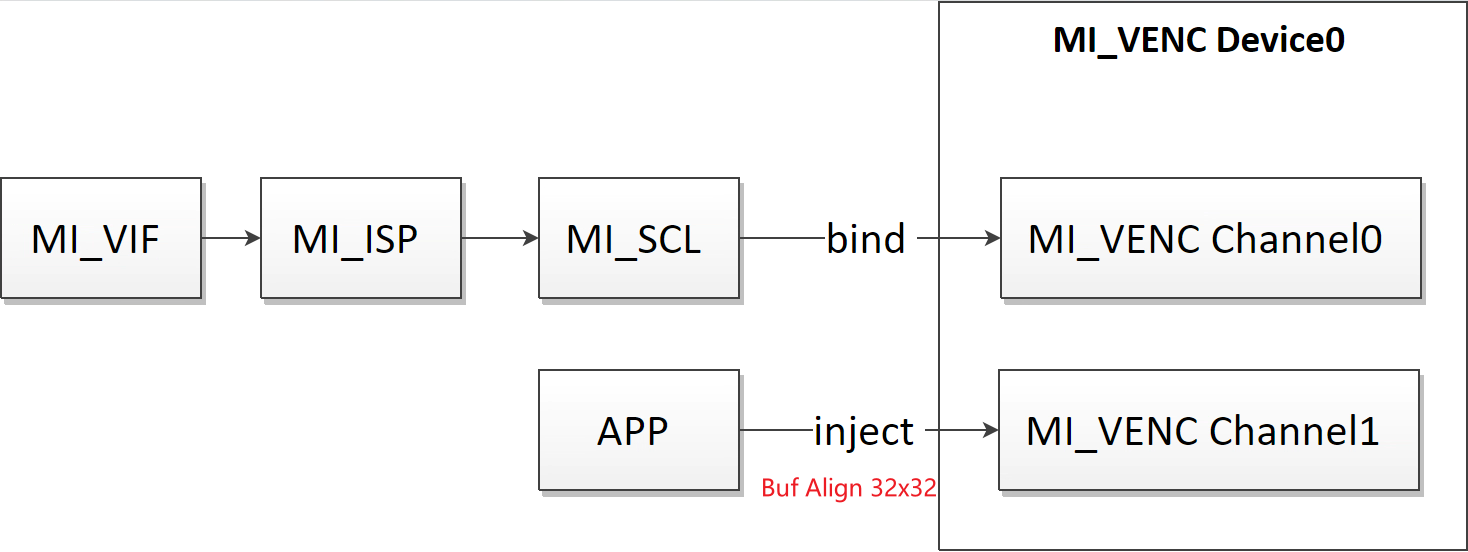
Note: When putting YUV buffer to VENC, the alignment of input buffer should be 32x32.
1.2.1. Tiramisu Encoding Process


The device id used to encode H.264/H.265 is MI_VENC_DEV_ID_H264_H265_0.
The device id used to encode JPEG is MI_VENC_DEV_ID_JPEG_0.
1.2.2. Muffin Encoding Process


The device id used to encode H.264/H.265 is MI_VENC_DEV_ID_H264_H265_0 or MI_VENC_DEV_ID_H264_H265_1;
The device id used to encode JPEG is MI_VENC_DEV_ID_JPEG_0 or MI_VENC_DEV_ID_JPEG_1.
1.2.3. Mochi Encoding Process
The device id used to encode H.264/H.265 is MI_VENC_DEV_ID_H264_H265_0;
The device id used to encode JPEG is MI_VENC_DEV_ID_JPEG_0 or MI_VENC_DEV_ID_JPEG_1.
1.2.4. Maruko Encoding Process
The device id used to encode H.264/H.265 is MI_VENC_DEV_ID_H264_H265_0;
The device id used to encode JPEG is MI_VENC_DEV_ID_JPEG_0.
1.3. Encoding Channel
As a basic control unit, coding channels are completely independent of each other. Encoder (HW) completes the function of converting the original image into a code stream, which is completed by the control of Rate Controller and the Encoder (SW) in cooperation. The Rate Controller and Encoder (SW) of each channel stores all the resources set and managed by all users of the current encoding channel, such as rate control, buffer demand and allocation, etc. The rate control ensures the balance between the output rate and the image quality, while the encoder focuses on the realization of the syntax elements of each codec. Software and hardware control, at the same time, a codec hardware time-sharing multiplexing. Taking two coding channels for example, the basic block diagram of coding channel is as follows:

1.4. Keyword Description
1.4.1. QP
Quantization Parameter. QP value corresponds to the sequence number of quantization step. The smaller the value is, the smaller the quantization step is, and the higher the accuracy of quantization, the better the image quality and the larger the encoded size are.
1.4.2. GOP
Group Of Pictures. The interval between two I frames. The video image sequence consists of one or more GOPs which are independent.
1.4.3. MB
Coding macroblock. Basic unit of H.264 encoding.
1.4.4. CU
Coding Unit. Basic unit of H.265 encoding.
1.4.5. SPS
Sequence Parameter Set. It contains the public information of all images in a GOP.
1.4.6. PPS
Picture Parameter Set. It contains the parameters used to encode an image.
1.4.7. SEI
Supplemental Enhancement information.
1.4.8. ECS
Entropy-coded segment. Compressed image strip after entropy encoding of JPEG.
1.4.9. MCU
Minimum code unit. The basic unit of JPEG encoding
1.4.10. Rate control
From the perspective of Informatics, the image compression ratio is inversely proportional to the quality: the higher the compression ratio, the lower the quality; the lower the compression ratio, the higher the quality.
Taking H.264 as an example, the lower the general image QP, the higher the image quality and the higher the bit rate; the higher the image QP, the lower the image quality and the lower the bit rate. The rate control algorithms supported by different coding protocols are as follows:
Chip |
Rate Control Algorithm |
|||
|---|---|---|---|---|
FIXQP |
CBR |
VBR |
AVBR |
|
| Pretzel | H.264/H.265/JPEG | H.264/H.265/JPEG | H.264/H.265 | NONE |
| Macaron | H.264/H.265/JPEG | H.264/H.265/JPEG | H.264/H.265 | NONE |
| Pudding | H.264/H.265/JPEG | H.264/H.265/JPEG | H.264/H.265 | H.264/H.265 |
| Ispahan | H.264/H.265/JPEG | H.264/H.265/JPEG | H.264/H.265 | H.264/H.265 |
| Tiramisu | H.264/H.265/JPEG | H.264/H.265/JPEG | H.264/H.265 | H.264/H.265 |
| Ikayaki | JPEG | JPEG | None | None |
| Muffin | H.264/H.265/JPEG | H.264/H.265/JPEG | H.264/H.265 | H.264/H.265 |
| Mochi | H.264/H.265/JPEG | H.264/H.265/JPEG | H.264/H.265 | H.264/H.265 |
| Maruko | H.264/H.265/JPEG | H.264/H.265/JPEG | H.264/H.265 | H.264/H.265 |
-
FIXQP
Fixed Quantization Parameter. At any time point, Qp of all MB/CU of the encoded image can directly be set by the user, and the Qp of I frame and P frame can be set respectively in H.264/H.265. However, some chips cannot set P frame Qp. The behavior of different chips is shown in the following table:
Chip
H.264/H.265
Can set I Qp?
Can set P Qp?
Pretzel Y Y Macaron Y Y Pudding Y N Ispahan Y N Tiramisu Y Y Muffin Y Y Mochi Y Y Maruko Y Y The control flow chart of H.264 and H.265 is as follows:

The control flow chart of JPEG is as follows:

It adopts the Qp table recommended by ITU-t81 K.1. The Qfactor set by the user is converted into a proportional factor according to a certain formula, and the multiplication of the two is the final Qp.
-
CBR
Constant Bit Rate. It can guarantee the stability of coding rate during code rate statistics. Because of different prediction methods, the size of I frame and P frame will be significantly different after coding. The bottom statistical time is based on Gop, and the bit accumulation and compensation will be realized between GOPs.
The main steps are as follows:
-
Convert Fps/Gop/bitrate set by user to bits of each GOP.
-
I/P take different process, and BPP(bitperpixel) is calculated according to GOP bits and resolution.
-
Map BPP to frame QP by rate control model.
-
HW further adjusts MB/Cu QP based on frame QP by image texture complexity and other information.
-
After coding, the rate control model is updated to achieve the continuous stability of the whole sequence, and the bit error is accumulated for the fine-tuning of bit allocation of subsequent frames.
-
The bit error of the whole GOP is accumulated after the completion of the whole GOP, which is used for fine tuning of the next GOP bit allocation.
The control flow chart is as follows:

-
-
VBR
Variable Bit Rate. It allows the code rate to fluctuate within the code rate statistics time, so as to ensure the stable quality of the coding image. Take H.264 for example, users can set MaxQp, MinQp, MaxBitRate and ChangePos, details of which can be found in MI_VENC_ParamH264Vbr_t. MaxQp and MinQp are used to control the quality range of images. MaxBitRate is used for limiting maximum code rate within the statistics time. ChangePos is a percentage of the maximum bit rate, which is used to control the code rate reference line of starting to adjust QP, that is when the code rate is greater than MaxBitRate*ChangePos, the image QP will gradually adjust to MaxQp, if the image QP has reached MaxQp, the image QP will be clamped to the maximum value, the clamping effect of MaxBitRate will be lost, and the code rate may exceed MaxBitRate; if the code rate is less than MaxBitRate*ChangePos, the image QP will gradually adjust to MinQp. If the image QP has reached MinQp, the code rate has reached the maximum value and the image quality is best.
The specific process is as follows:
-
Convert the Fps/Gop/MaxBitRate/ChangePos and resolution set by user into the initial quality benchmark in order to set starting QP of the sequence.
-
HW further adjusts MB/CU QP based on frame QP by image texture complexity and other information.
-
Update rate control model after coding
-
Update the quality of the overall sequence
-
Calculate the deviation coefficient according to the difference between the current expected bit and the actual encoded bit, and decide whether the quality can be improved or reduced
-
Calculate the target quality of the current frame by the deviation coefficient and two quality coefficients
-
Map the target quality to frame QP, looping from 2.
The control flow chart is as follows:

-
-
AVBR
Adaptive Variable Bit Rate. It allows the code rate to fluctuate within the code rate statistics time, so as to ensure the stable quality of the coding image. The rate control will detect the static state of the current scene, adopt higher rate coding when moving, and actively reduce the rate when still. Take H.264 for example, users can set MaxBitRate, ChangePos and MinStillPercent, details of which can be found in MI_VENC_ParamH264Avbr_t. MaxBitRate represents the maximum code rate in the motion scene, Minstitlpercent is the percentage of the minimum bit rate relative to the adjusted threshold bit rate in the static scene, MaxBitRate * ChangePos * MinStillPercent represents the minimum code rate in the static scene, and the target code rate will be adjusted between the minimum code rate and the maximum code rate according to the different degree of motion. MaxQp and MinQp are used to control the quality range of the image. The highest priority of the rate control is QP clamp. The rate control beyond MinQp and MaxQp will fail.
-
Note
SAD functions are integrated into VENC AVBR mode starting from platform Muffin, that is, the encoder integrates the SAD calculation function inside, and the SED module is no longer needed to help calculate the SAD.
-
-
UBR
Unspecified Bit Rate, allows users to set the encoding parameters of the next frame according to the parameters output by the callback function.
-
Usage Note
Set when users want to use their own encoding control algorithm.
-
Process introduction
-
API implementation
Implement 4 functions in APP, rc_init(), rc_deinit(), rc_attr_change(), rc_calc(), which four functions are called internally by VENC;
-
Create venc channel, to set UBR mode
It is similar to CBR and VBR in usage;
Selete E_MI_VENC_RC_MODE_H264UBR or E_MI_VENC_RC_MODE_H265UBR mode, refer to MI_VENC_RcMode_e;
-
Start channel
Each time VENC receives an encoded frame, it performs rc_calc and then encodes it according to the calculated Qp value, ensuring real-time performance;
rc_calc interface spending time may affect encode performance;
-
The implementation flow chart is as follows:
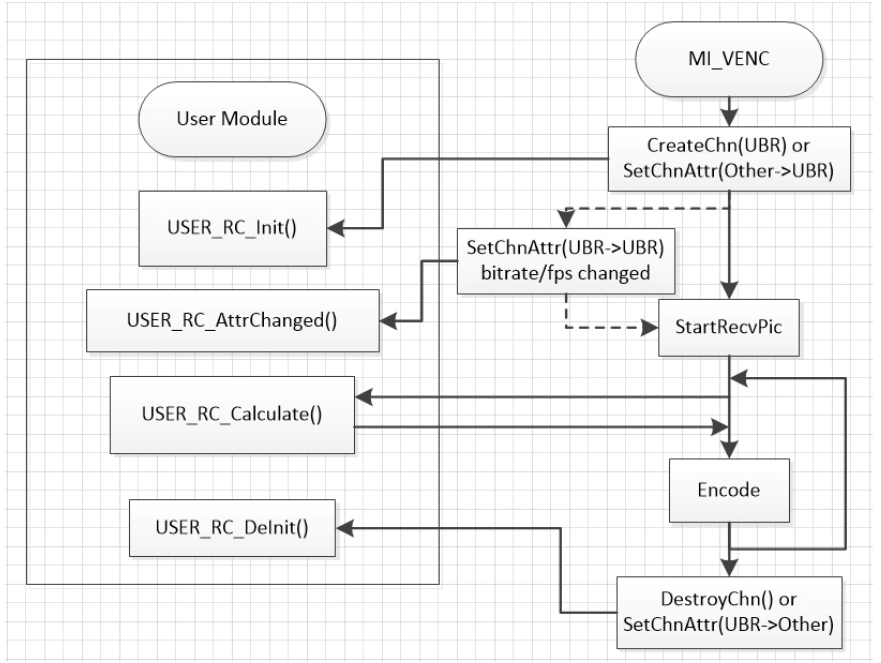
-
-
API instructions
Implement 4 functions in APP, rc_init(), rc_deinit(), rc_attr_change(), rc_calc(). For details, refer to the following interfaces:
-
1.4.11. QPMAP
In qpmap mode, users are allowed to decide the rate control strategy freely, and absolute qpmap and relative qpmap are supported. Please refer to MI_VENC_AllocCustomMap.
1.4.12. Reference frame structure
H. 264/H.265 only supports one reference frame in a single frame, but the whole stream supports multiple reference frame buffers. For example: in LTR/TSVC3 mode, each P can only refer to one, but at most two reference frames will be saved for different P frames.
The reference frame supports 5 modes: NormalP, LTR (VI Ref IDR), LTR (VI Ref VI), TSVC-2 and TSVC-3. All reference frame structures are controlled by three parameters: u32Base, u32Enhance and bEnablePred. Please refer to MI_VENC_ParamRef_t for specific meanings. When u32Enhance is set to 0, it will be converted to NormalP reference frame structure. For other structures, please refer to the corresponding structure chart. The default structure is NormalP reference frame structure. The following details each reference diagram and parameter setting.
-
NormalP
NormalP is the most basic and common reference relationship. P frame directly refers to the previous one, and its structure diagram is shown in the following figure:

-
LTR mode
LTR (Long Term Reference) uses long-term reference frame and short-term reference frame to realize the same frame can be referred to multiple frames. This mode defines one special P as virtual I frame (VI). Compared with all IDR, using VI can reduce the code rate while maintaining a certain error recovery power. At present, LTR supports two modes: all VI refers to the latest IDR and VI refers to the previous VI or IDR (in the case of the first VI). The structures of the two reference modes are as follows:


Note: an extra buffer is required to enable LTR mode.
-
TSVC-2
TSVC-2 provides two-layers coding, and the frame rate can vary between ½ and full. The structure diagram is as follows:

-
TSVC-3
TSVC-3 provides three-layer coding, and the frame rate can vary between ¼, ½, ¾ and full. The structure diagram is as follows:

Note: an extra buffer is required to enable TSVC-3 mode.
1.4.13. Crop
Crop, that is, cutting out a part of the image for encoding. User can set the starting point of clipping left/top, width and height, please refer to relevant API: MI_VENC_SetCrop. The schematic diagram is as follows:

1.4.14. ROI
Region of interest coding, users can configure ROI region to limit the image QP of this region, so as to realize the difference between the QP of this region and other image regions. The system supports H264 and H265 codes to set ROIs. Depending on the platform, a maximum of 8 or 16 ROI areas can be provided for users.
If the platform supports a maximum of 16 ROI regions, the 16 ROI regions can be superimposed on each other, and the priority of the superimposed regions is increased in turn according to the index from 0 to 15, that is, the final Qp determination of the superimposed regions is only processed by the region with the highest priority.The ROI area can be configured with absolute QP and relative QP:
Absolute QP: QP in ROI area is the QP value set by the user
Relative QP: the QP in ROI area is the sum of the QP generated by rate control and the QP offset value set by the user.
In the following example, the encoded image adopts the fixqp mode, setting the image QP to 30, that is, the QP value of all macroblocks of the image is 30. ROI region 0 is set to absolute QP mode, QP value is 20, index is 0; ROI region 1 is set to relative QP mode, QP is -15, index is 1. Because the index of ROI region 0 is smaller than the index of ROI region 1, the QP of ROI region 1 with high priority is set in the overlapped image region. The QP value of region 1 is 30-15 = 15, and the QP value of region 0 except the overlapped image region is 20.

1.4.15. Low frame rate encode in non ROI area
Low frame rate encode in non ROI area, that is to say, the ROI area is normally encoded after the ROI is turned on, while the non ROI area can reduce the frame rate by setting the proportional relationship between the source and the target. According to the scale relationship, the non ROI area of some frames in a GOP will directly use the data of the corresponding area of the previous frame. The user can set the relative frame rate of non ROI area according to the actual situation, and only when the ROI is turned on can it take effect. Please refer to MI_VENC_SetRoiBgFrameRate, s32srcFrmRate and s32dstFrmRate only represent a proportional relationship, independent of the actual frame rate.
1.4.16. Bind Type
Generally speaking, the bind type between front level and VENC is E_MI_SYS_BIND_TYPE_FRAME_BASE, that is, the front level completes a frame buffer completely, and then outputs it to the Venc. In this mode, at least three frame buffers need to be allocated. If the front level is SCL, there are two bind types which can save memory: E_MI_SYS_BIND_TYPE_HW_RING and E_MI_SYS_BIND_TYPE_REALTIME.
E_MI_SYS_BIND_TYPE_HW_RING means that SCL and VENC can read and write on the same one frame buffer in same time. In addition, Ispahan also supports reading and writing on half frame buffer; please refer to MI_VENC_SetInputSourceConfig for details.
E_MI_SYS_BIND_TYPE_REALTIME has two modes, one is IMI mode and the other is EMI mode.If IMI mode is used, no additional Dram buffer is allocated between SCL and VENC. SCL and VENC read and write on the internal Sram buffer.If EMI mode is used, a Dram buffer is allocated between SCL and VENC, and SCL and VENC read and write on this Dram buffer.IMI mode is used by default and cannot be modified.
Different chip and encode protocols support different bind type as follows:
Chip |
Codec |
Bind Type |
||
|---|---|---|---|---|
| FRAME_BASE | HW_RING | REALTIME | ||
| Pretzel | H.264/H.265 | Y | N | N |
| JPEG | Y | N | N | |
| Macaron | H.264/H.265 | Y | Y | N |
| JPEG | Y | N | Y | |
| Pudding | H.264/H.265 | Y | N | N |
| JPEG | Y | Y | Y | |
| Ispahan | H.264/H.265 | Y | Y | N |
| JPEG | Y | N | Y | |
| Tiramisu | H.264/H.265 | Y | Y | N |
| JPEG | Y | N | Y | |
| Ikayaki | JPEG | Y | Y | Y |
| Muffin | H.264/H.265 | Y | Y | N |
| JPEG | Y | N | Y | |
| Mochi | H.264/H.265 | Y | Y | N |
| JPEG | Y | N | Y | |
| Maruko | H.264/H.265 | Y | Y | N |
| JPEG | Y | N | Y | |
When bind type is E_MI_SYS_BIND_TYPE_REALTIME and buffer type is IMI, the maximum width supported by different chip and input image YUV format is as follows:
Chip |
Input Yuv Format |
|
|---|---|---|
| NV12 | YUYV422 | |
| Macaron | 1792 | 2688 |
| Pudding | 1920 | 3840 |
| Ispahan | 1792 | 2688 |
| Tiramisu | 2624 | 4096 |
| Ikayaki | 848 | 1280 |
| Muffin | 4680 | 8192 |
| Mochi | Not Support | 4096 |
| Maruko | Not Support | 3840 |
Note:
- In order to further save memory, Maruko platform can configure E_MI_SYS_BIND_TYPE_HW_RING binding type between SCL and VENC when encoding H264 or h265, and set buffer mode to E_MI_VENC_INPUT_MODE_RING_UNIFIED_DMA with MI_VENC_SetInputSourceConfig. When SCL enables IFC function, the minimum frame buffer shared by SCL and VENC can be set to one quarter. If the IFC function is not turned on, the minimum frame buffer can be set to half sheet. We need to call MI_SYS_ConfigPrivateMMAPool to configure the frame buffer when initializing SCL, please refer to SYS API introduction for specific usage methods. If the YUV output from two SCL channels is inconsistent, the frame buffer should be allocated according to the largest output size. At this case, the subsequent of the VENC main channel bound to SCL can cascade VENC sub channels. At present, it supports up to 2-level sub streams. The bind type between VENC channels need to set E_MI_SYS_BIND_TYPE_HW_RING, and there is no need to call MI_VENC_SetInputSourceConfig for additional settings. Each sub channel of VENC shares a frame buffer for YUV data stream transmission, which only supports the reading and writing of the whole sheet. Since the VENC cascade only supports reduction, and the output size of the subsequent channel must be less than or equal to the output of the previous channel, the frame buffer can be configured once by calling the MI_SYS_ConfigPrivateMMAPool interface by VENC main channel and according to the maximum output size in the subchannel. The working model is as follows:
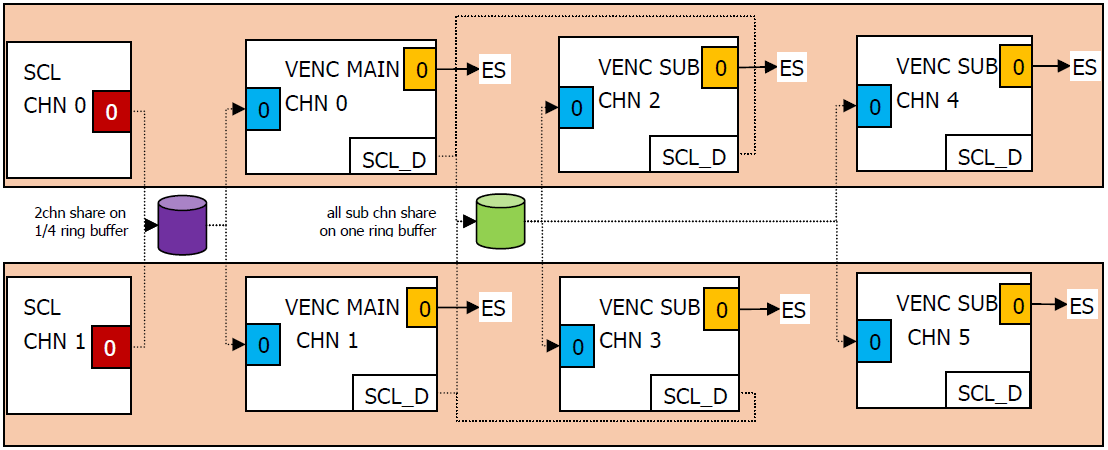
The above scenarios only support the H264 and H265 encoding protocol. In addition, the Maruko platform is limited by hardware, and the largest scenario that can work stably is: one main channel of the venc is cascaded with two sub channels of the venc. The following lists several common resolution scenarios of main channel and the maximum specifications supported by sub channel.
| MainWidth | MainHeight | FPS | n | CR | SubMaxResolution |
|---|---|---|---|---|---|
| 3840 | 2160 | 25 | 4 | 0.8 | 1920x1565 |
| 2880 | 1620 | 30 | 4 | 0.8 | 1920x1230 |
| 2688 | 1520 | 30 | 4 | 0.8 | 1920x1214 |
| 1920 | 1080 | 30 | 4 | 0.8 | 1920x1114 |
| 3840 | 2160 | 25 | 2 | 0.8 | 1920x3342 |
| 2880 | 1620 | 30 | 2 | 0.8 | 1920x2690 |
| 2688 | 1520 | 30 | 2 | 0.8 | 1920x2675 |
| 1920 | 1080 | 30 | 2 | 0.8 | 1920x2575 |
Where the MainWidth/MainHeight represents the width and height of the main channel resolution. The FPS indicates the actual input frame rate of sensor. The n represents the ratio of the required whole buffer size between SCL and VENC to the actually set buffer size. If a quarter of the buffers are set, n=4; If half of the buffers are set, then n=2. The CR indicates the IFC compression ratio (The smaller the CR, the higher the compression ratio). If IFC is not enabled, CR=1. When the resolution of the main channel remains unchanged, the lower the frame rate, or the smaller the n, or the smaller the CR, the total maximum resolution of all the supported sub channel in theory is greater. The above table is based on the relatively ideal environment and can only be used for reference. Because there are many unstable factors in the actual scene, such as images has many noisy, input data frames has garbage and so on, which lead to longer encoding time, so the actual situation still needs specific analysis.
- For the E_MI_SYS_BIND_TYPE_REALTIME binding, Mochi and Maruko do not support NV12 image format, but only YUYV422 image format.
1.4.17. Output buffer configuration of coded bitstream
Different chips support different configurations due to different SW architectures. The default configurations are as follows:
| Chip | H.264 | H.265 | JPEG |
|---|---|---|---|
| Pretzel | WidthxHeight/2 | WidthxHeight/2 | WidthxHeight |
| Macaron | Ring pool:WidthxHeight/2 | Ring pool:WidthxHeight/2 | Ring pool:WidthxHeight/2 |
| Pudding | Ring pool:WidthxHeight/2 | Ring pool:WidthxHeight/2 | Ring pool:WidthxHeight/2 |
| Ispahan | Ring pool:WidthxHeight/2 | Ring pool:WidthxHeight/2 | Ring pool:WidthxHeight/2 |
| Tiramisu | Ring pool:WidthxHeight/2 | Ring pool:WidthxHeight/2 | Ring pool:WidthxHeight/2 |
| Ikayaki | Ring pool:WidthxHeight/2 | Ring pool:WidthxHeight/2 | Ring pool:WidthxHeight/2 |
| Muffin | Ring pool:WidthxHeight/2 | Ring pool:WidthxHeight/2 | Ring pool:WidthxHeight/2 |
| Mochi | Ring pool:WidthxHeight/2 | Ring pool:WidthxHeight/2 | Ring pool:WidthxHeight/2 |
| Maruko | Ring pool:WidthxHeight/2 | Ring pool:WidthxHeight/2 | Ring pool:WidthxHeight/2 |
The above is the default output buffer configuration of each chip. User can specify the output buffer configuration by MI_VENC_CreateChn. Take H.264 as an example, user can specify the output buffer configuration by setting stVeAttr.stAttrH264e.u32BufSize,if the value is 0, the default configuration is used. In Pretzel, frame mode was used, that is to say, for each stream of coding, a specific size buffer will be allocated, generally the size used in the actual encoding will be smaller than the allocated size, which will cause memory fragmentation; while in the ring pool mode, each channel will separately allocate an output ring pool, and each coding will obtain the maximum free buffer from the pool, and then record the size of the actual coding used, and recycle output ring pool, which effectively improves the utilization of the buffer and reduces memory fragmentation.
Note: Under Pudding/Tiramisu/Ikayaki/Muffin/Maruko Chip, there will be two output pools inside jpe to support realtime mode full frame output, otherwise it may be only half of the front-end mi scl output frame rate. If jpe only has frame mode or the frame rate is not high in the realtime mode, you can modify max_jpe_task=1 to force an output pool to save memory.
For example, you can add the following fields to modify max_jpe_task when insmod ko:
insmod mi_venc.ko max_jpe_task=1
1.4.18. Description of scenarios supported by multiple processes
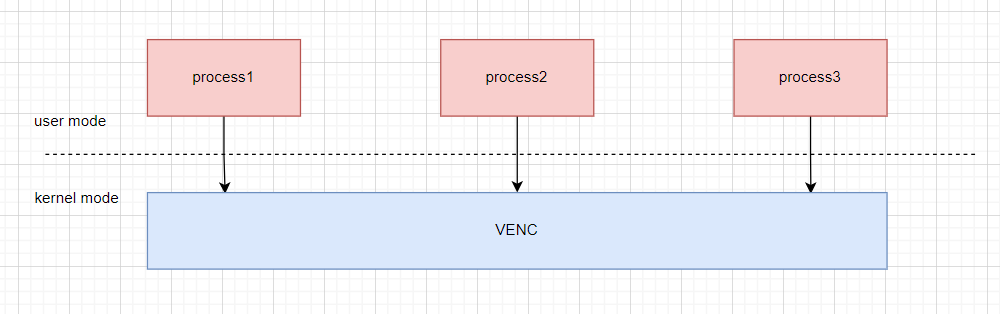
Currently only Mochi's platform supports multi-process coding.
Supporting scenarios:
-
Support the same device, different channel multi-process coding.
For example:
Process1 creates the Device0, channel0 encoding. Process2 creates the Device0, channel1 encoding. Process3 creates device0, channel2 encoding.
-
Support multi-process coding for different devices.
For example:
Process1 creates device0, channel0 encoding. Process2 creates the Device8, channel0 encoding. Process3 created the Device9, channel0 encoding.
-
Support to obtain and set parameters in process 2 other than process 1.
For example:
Process1 creates the Device0, channel0 encoding and device1, channel0 encoding. Process2 creates the Device0, channel1 encoding and device1, channel1 encoding. You can get and set parameters of device0's channel0 and channel1 code channels and Device1's channel0 and channel1 code channels in process3. For example process3 calls the MI_VENC_SetChnAttr function to set the encoding channel properties of Device0, channel0.
Note: Resources created in process1, such as Device0 and channel0, need to be destroyed in process1.
Unsupported scenarios:
-
Streaming and fetching of coded channels created by process 1 in process 2 is not supported.
For example:
Process1 creates Device0, channel0, but does not stream. Process2 sends and receives streams from Device0 and channel0.
-
The front-level module channels created by process 1 do not support binding to the VENC channels created by process 2. Streams need to ensure that the front-level and front-level channels are created in the same process.
For example:
Process1 creates the Device1, channel0 channel of SCL. Process2 created the Device0, channel0 channel for VENC. Binding Device1, channel0, port0 of SCL to Device0, channel0, port0 of VENC in Process1 or Process2 is not supported. If you want to stream, you need to ensure that both the front and back level channels of the binding are created in the same process.
1.4.19. Frame Rate Control
When the venc module is bound with the previous module(See section 1.4.16 for BindType), and the subsequent of the venc main channel is not connected to a venc sub stream , the user can control the output frame rate of a venc channel by calling MI_SYS_BindChnPort2 to set the input frame rate parameter(u32SrcFrmrate) of the previous module(scl) and the output frame rate parameter(u32DstFrmrate) of the subsequent module. In this case, the output frame rate can only be less than or equal to the input frame rate. If the output frame rate of the venc channel is changed halfway, user needs to call MI_SYS_UnBindChnPort interface to unbind modules and call MI_SYS_BindChnPort2 interface to reset the frame rate parameter.
When the venc module is bound with the previous module in HW_RING mode, and the venc main channel is connected to a sub stream , the way that the user controls the output frame rate of a venc channel will change. MI_SYS_BindChnPort2 interface is called to set the input frame rate parameter(u32SrcFrmrate) of the previous module(scl or venc) to be equal to the output frame rate parameter(u32DstFrmrate) of the subsequent module, and MI_VENC_CreateChn is called to set the output frame rate parameter of the current channel. The final actual output frame rate is controlled by the frame rate parameter which is set in MI_VENC_CreateChn. Take H264 encoding FixQp as an example:
MI_VENC_ChnAttr_t stChnAttr;
stChnAttr.stRcAttr.stAttrH264FixQp.u32SrcFrmRateNum = 30;
stChnAttr.stRcAttr.stAttrH264FixQp.u32SrcFrmRateDen = 1;
MI_VENC_CreateChn(VeDev, VeChn, &stChnAttr);
In this way, the output frame rate of the subsequent channel can be greater than the output frame rate of the previous channel. However, if the input frame rate of the main channel(from scl module) is less than the output frame rate, the frame rate control will not be performed, and output frame rate is equal to the input frame rate of the main channel, as shown in the figure below:

If the output frame rate of the venc channel needs to be changed halfway, the user needs to call the MI_VENC_SetChnAttr interface to reset the output frame rate parameter. Take H264 encoding FixQp as an example:
MI_VENC_ChnAttr_t stChnAttr;
MI_VENC_GetChnAttr(VeDev, VeChn, &stChnAttr);
stChnAttr.stRcAttr.stAttrH264FixQp.u32SrcFrmRateNum = 15;
stChnAttr.stRcAttr.stAttrH264FixQp.u32SrcFrmRateDen = 1;
MI_VENC_SetChnAttr(VeDev, VeChn, &stChnAttr);
2. API REFERENCE
| API name | Features |
|---|---|
| MI_VENC_CreateDev | Create venc device |
| MI_VENC_DestroyDev | Destroy venc device |
| MI_VENC_CreateChn | Create a code channel |
| MI_VENC_DestroyChn | Destroy code channel |
| MI_VENC_ResetChn | Reset code channel |
| MI_VENC_StartRecvPic | Turn on the encoding channel to receive the input image |
| MI_VENC_StartRecvPicEx | Turn on the encoding channel to receive the input image, and automatically stop receiving images after the specified number of frames is exceeded. |
| MI_VENC_StopRecvPic | Stop encoding channel to receive input image |
| MI_VENC_Query | Query code channel status |
| MI_VENC_SetChnAttr | Set the encoding properties of the encoding channel |
| MI_VENC_GetChnAttr | Get the encoding attribute of the encoding channel |
| MI_VENC_GetStream | Get the encoded code stream. |
| MI_VENC_ReleaseStream | Release stream buffer |
| MI_VENC_InsertUserData | Insert user data |
| MI_VENC_SetMaxStreamCnt | Set the maximum stream cache frame number |
| MI_VENC_GetMaxStreamCnt | Get the maximum number of stream cache frames |
| MI_VENC_RequestIdr | Request IDR frame |
| MI_VENC_EnableIdr | Enable IDR frame |
| MI_VENC_SetH264IdrPicId | Set the idr_pic_id of the IDR frame |
| MI_VENC_GetH264IdrPicId | Get the idr_pic_id of the IDR frame |
| MI_VENC_GetFd | Obtain the device file handle corresponding to the encoding channel |
| MI_VENC_CloseFd | Close the device file handle corresponding to the encoding channel |
| MI_VENC_SetRoiCfg | Set the region of interest encoding configuration for the encoding channel |
| MI_VENC_GetRoiCfg | Get the region of interest encoding configuration for the encoding channel |
| MI_VENC_SetRoiBgFrameRate | Set the frame rate configuration of the non-interest area of the encoding channel |
| MI_VENC_GetRoiBgFrameRate | Get the frame rate configuration of the non-interest area of the encoding channel |
| MI_VENC_SetH264SliceSplit | Set the slice split configuration of H.264 encoding |
| MI_VENC_GetH264SliceSplit | Get the slice split configuration of H.264 encoding |
| MI_VENC_SetH264InterPred | Set the interframe prediction configuration of H.264 encoding |
| MI_VENC_GetH264InterPred | Get the interframe prediction configuration of H.264 encoding |
| MI_VENC_SetH264IntraPred | Set the intra prediction configuration of H.264 encoding |
| MI_VENC_GetH264IntraPred | Get the intra prediction configuration of H.264 encoding |
| MI_VENC_SetH264Trans | Set the transform and quantization configuration of H.264 encoding |
| MI_VENC_GetH264Trans | Get the transform and quantization configuration of H.264 encoding |
| MI_VENC_SetH264Entropy | Set the entropy encoding configuration of H.264 encoding |
| MI_VENC_GetH264Entropy | Get the entropy encoding configuration of H.264 encoding |
| MI_VENC_SetH265InterPred | Set the interframe prediction configuration of H.265 encoding |
| MI_VENC_GetH265InterPred | Get the interframe prediction configuration of H.265 encoding |
| MI_VENC_SetH265IntraPred | Set H.265 encoded intra prediction configuration |
| MI_VENC_GetH265IntraPred | Get H.265 encoded intra prediction configuration |
| MI_VENC_SetH265Trans | Set H.265 coded transform, quantization configuration |
| MI_VENC_GetH265Trans | Get H.265 encoded transform, quantization configuration |
| MI_VENC_SetH264Dblk | Set the deblocking configuration of H.264 encoding |
| MI_VENC_GetH264Dblk | Get the deblocking configuration of H.264 encoding |
| MI_VENC_SetH265Dblk | Set the deblocking configuration of H.265 encoding |
| MI_VENC_GetH265Dblk | Get the deblocking configuration of H.265 encoding |
| MI_VENC_SetH264Vui | Set H.264 encoded VUI configuration |
| MI_VENC_GetH264Vui | Get H.264 encoded VUI configuration |
| MI_VENC_SetH265Vui | Set the H.265 encoded VUI configuration |
| MI_VENC_GetH265Vui | Get H.265 encoded VUI configuration |
| MI_VENC_SetH265SliceSplit | Set the slice split configuration of H.265 encoding |
| MI_VENC_GetH265SliceSplit | Get the slice split configuration of H.265 encoding |
| MI_VENC_SetJpegParam | Set the JPEG encoded parameter set |
| MI_VENC_GetJpegParam | Get the JPEG encoded parameter set |
| MI_VENC_SetRcParam | Set channel rate control advanced parameters |
| MI_VENC_GetRcParam | Get channel rate control advanced parameters |
| MI_VENC_SetRefParam | Set H.264/H.265 encoding channel advanced frame skipping reference parameters |
| MI_VENC_GetRefParam | Get advanced frame skipping reference parameters for H.264/H.265 encoding channel |
| MI_VENC_SetCrop | Set the cropping properties of VENC |
| MI_VENC_GetCrop | Get the cropping properties of VENC |
| MI_VENC_SetFrameLostStrategy | Set the configuration of the drop frame policy when the instantaneous bit rate exceeds the threshold. |
| MI_VENC_GetFrameLostStrategy | Obtain the configuration of the frame loss policy when the instantaneous bit rate exceeds the threshold. |
| MI_VENC_SetSuperFrameCfg | Set oversized frame processing configuration |
| MI_VENC_GetSuperFrameCfg | Get large frame processing configuration |
| MI_VENC_SetRcPriority | Set the priority type of rate control |
| MI_VENC_GetRcPriority | Get the priority type of rate control |
| MI_VENC_AllocCustomMap | Allocate the memory for Custom Map used by smart encoding |
| MI_VENC_ApplyCustomMap | Apply the configured Custom Map |
| MI_VENC_GetLastHistoStaticInfo | Get the output information when the latest frame is encoded |
| MI_VENC_ReleaseHistoStaticInfo | Release the memory used for the output information when the latest frame is encoded |
| MI_VENC_ SetAdvCustRcAttr | Set the customer defined advanced RC configuration parameters |
| MI_VENC_SetInputSourceConfig | Set H.264/H.265 input source info |
| MI_VENC_SetSmartDetInfo | Set smart detector information |
| MI_VNEC_SetIntraRefresh | Set H.264/H.265 P-frame brush Islice |
| MI_VNEC_GetIntraRefresh | Get H.264/H.265 P-frame brush Islice |
| MI_VENC_DupChn | Synchronize status of venc channel |
| rc_init | H264/H265 UBR RC initialization |
| rc_deinit | H264/H265 UBR RC deinitialization |
| rc_attr_change | Set H264/H265 UBR RC channel attribute |
| rc_calc | H264/H265 UBR RC parameter setting after calculation |
2.1. MI_VENC_CreateDev
-
Description
Create VENC device.
-
Syntax
MI_S32 MI_VENC_CreateDev(MI_VENC_DEV VeDev, MI_VENC_InitParam_t *pstInitParam);
-
Parameters
Parameter Description Input/Output VeDev Encode device number Input pstInitParam Initialization parameter poniter. Input -
Return Value
-
MI_SUCCESS: Successful
-
Not MI_SUCCESS: Failed, see error code for details.
-
-
Dependency
-
Header file: mi_venc.h, mi_venc_datatype.h
-
Library file: libmi_venc.a / libmi_venc.so
-
-
Note
-
This function is recommended to be called and set the initialization parameters according to the actual coding maximum resolution. If it is not called before MI_VENC_CreateChn, then a valid device id needs to be specified in MI_VENC_CreateChn. The corresponding device will be created internally using the maximum resolution supported by default, and the memory used will increase.
-
This interface should be used in pair with MI_VENC_DestroyDev; otherwise a failed message will be returned.
-
2.2. MI_VENC_DestroyDev
-
Description
Destroy venc device.
-
Syntax
MI_S32 MI_VENC_DestroyDev(MI_VENC_DEV VeDev);
-
Parameters
Parameter Description Input/Output VeDev Encode device number Input -
Return Value
-
MI_SUCCESS: Successful
-
Not MI_SUCCESS: Failed, see error code for details.
-
-
Dependency
-
Header file: mi_venc.h, mi_venc_datatype.h
-
Library file: libmi_venc.a / libmi_venc.so
-
-
Note
-
This interface should be called after device has been initialized; otherwise a failed message will be returned.
-
If this interface has not been called after the app exited, venc device will be auto de-initialized.
-
This interface should be used in pair with MI_VENC_CreateDev; otherwise a failed message will be returned.
-
This interface parameter setting only takes effect on Pudding, Ispahan and Tiramisu.
-
2.3. MI_VENC_CreateChn
-
Features
Create a code channel.
-
Syntax
MI_S32 MI_VENC_CreateChn(MI_VENC_DEV VeDev, MI_VENC_CHN VeChn,
MI_VENC_ChnAttr_t *pstAttr);
-
Parameter
Parameter name Description Input/Output VeDev Encode device number. Input VeChn Encode channel number. Value range: [0, VENC_MAX_CHN_NUM). Input pstAttr Coding channel attribution pointer. Input -
Return Value
-
MI_SUCCESS: Successful
-
Not MI_SUCCESS: Failed, see error code for details.
-
-
Requirement
-
Header files: mi_venc.h, mi_venc_datatype.h
-
Library file: libmi_venc.a / libmi_venc.so
-
-
Chip Difference
The supported coding specifications of different chip are shown in the following table:
Chip
H.264
H.265
JPEG
Baseline Profile Main Profile High Profile Main Profile Baseline Profile Pretzel Y Y N Y Y Macaron Y Y N Y Y Pudding Y Y Y Y Y Ispahan Y Y Y Y Y Tiramisu Y Y Y Y Y Ikayaki N N N N N Muffin Y Y Y Y Y Mochi Y Y Y Y Y Maruko Y Y Y Y Y The width and height of coding channels supported by different chips are shown in the table below:
Chip Resolution Spec H.264 H.265 JPEG Pretzel MIN_WIDTHxMIN_HEIGHT 192x128 192x128 16x16 MAX_WIDTHxMAX_HEIGHT 3840x2176 3840x2176 3840x2176 MIN_ALIGN 8x2 8x2 8x2 Macaron MIN_WIDTHxMIN_HEIGHT 192x128 192x128 16x16 MAX_WIDTHxMAX_HEIGHT 2688x1920 2688x1920 2688x2688 MIN_ALIGN 8x2 8x2 8x2 Pudding MIN_WIDTHxMIN_HEIGHT 256x128 256x128 16x16 MAX_WIDTHxMAX_HEIGHT 3840x2176 3840x2176 3840x2176 MIN_ALIGN 8x2 8x2 8x2 Ispahan MIN_WIDTHxMIN_HEIGHT 256x128 256x128 16x16 MAX_WIDTHxMAX_HEIGHT 2592x1952 2592x1952 2688x2688 MIN_ALIGN 8x2 8x2 8x2 Tiramisu MIN_WIDTHxMIN_HEIGHT 256x128 256x128 16x16 MAX_WIDTHxMAX_HEIGHT 4096x2176 4096x2176 8192x8192 MIN_ALIGN 8x2 8x2 8x2 Ikayaki MIN_WIDTHxMIN_HEIGHT None None 16x16 MAX_WIDTHxMAX_HEIGHT None None 1920x1088 MIN_ALIGN None None 8x2 Muffin MIN_WIDTHxMIN_HEIGHT 256x128 256x128 16x16 MAX_WIDTHxMAX_HEIGHT 8192x4096 8192x4096 8192x8192 MIN_ALIGN 8x2 8x2 8x2 Mochi MIN_WIDTHxMIN_HEIGHT 256x128 256x128 16x16 MAX_WIDTHxMAX_HEIGHT 8192x4096 8192x4096 8192x8192 MIN_ALIGN 8x2 8x2 8x2 Maruko MIN_WIDTHxMIN_HEIGHT 256x128 256x128 16x16 MAX_WIDTHxMAX_HEIGHT 4096x2176 4096x2176 8192x6480 MIN_ALIGN 8x2 8x2 8x2 The following table describes the alignment parameters of input YUV buffer required by HW:
Coding protocol Binding mode Input YUV format Width alignment (byte) Height alignment (byte) H264/H265 Frame mode sp420 32 32 Ring mode 32 2 JPE Frame mode sp420 16 16 yuyv422 16 8 Ring mode sp420 16 16 yuyv422 16 8 Realtime mode sp420 16 16 yuyv422 16 8 The maximum VENC_MAX_CHN_NUM specifications supported by different chips are shown in the table below:
Chip Max Macaron 16 Pudding 16 Ispahan 16 Ikayaki 16 Tiramisu 33 Ikayaki 16 Muffin 33 Mochi 33 Maruko 64 -
Note
-
MI_VENC_CreateDev is not called before calling this API, but a valid device id is passed in, the corresponding device will be created internally.
-
The encoding channel attribute consists of two parts, the encoder attribute and the rate controller attribute.
-
The encoder attribute first needs to select the encoding protocol, and then assign values to the attributes corresponding to the various protocols.
-
The maximum width and height of the encoder attributes must be as follows:
MaxPicWidth∈[MIN_WIDTH,MAX_WIDTH]
MaxPicHeight∈[MIN_HEIGHT,MAX_HEIGHT]
PicWidth∈[MIN_WIDTH,MaxPicwidth]
PicHeight∈[MIN_HEIGHT,MaxPicHeight]
-
The maximum width and height, the channel width must be an integer multiple of MIN_ALIGN.
-
Where MIN_WIDTH, MAX_WIDTH, MIN_HEIGHT, MAX_HEIGHT, MIN_ALIGN represent the minimum width, maximum width, minimum height, maximum height, and minimum alignment unit (pixels) supported by the encoding channel, respectively.
-
The encoding channel can be encoded when the input image size is not greater than the maximum width and height of the channel encoded image.
-
The recommended code widths are: 3840x2160 ( 4k*2k ), 1920x1080(1080P)、1280x720 ( 720P ), 960x540, 640x360, 704x576, 704x480, 352x288, 352x240.
-
In addition to the channel width and height and profile, the encoder attribute is a static attribute. Once the code channel is created successfully, the static attribute does not support modification unless the channel is destroyed and recreated. Please refer to the MI_VENC_SetChnAttr interface Description for the matters needing attention during setup.
-
The rate controller attribute first needs to configure the RC mode. The JPEG capture channel does not need to configure the rate controller attribute. Other protocol type channels (H.264/H.265) must be configured. The rate controller attribute RC mode must match the encoder attribute protocol type.
-
u32SrcFrmRateNum is the numerator of the frame rate of the encoding module, and u32SrcFrmRateDen is the denominator. u32SrcFrmRateNum/u32SrcFrmRateDen should be set to the actual input frame rate, and RC needs to count the actual frame rate and perform bit rate control based on it. If the actual input frame rate of the encoded image is 30, set u32SrcFrmRateNum to 30 and u32SrcFrmRateDen to 1.
-
In addition to the above attributes, CBR also needs to set the target bit rate. The unit of the target bit rate is bps. The setting of the target bit rate is related to the encoding channel width and the image frame rate. The typical target bit rate settings are shown as follow. Note that the setting of the target bit rate in the table below is the setting when the channel encoding frame rate is the full frame rate (30 fps). When the user sets the code output frame rate not to the full frame rate, the ratio of the user-set frame rate to the full frame rate (30 fps) can be converted to the bit rate in the table below.
Image size
Bitrate levelD1 (720x576) 720p (1280x720) 1080p (1920x1080) Low bit rate < 400 Kbps < 800 Kbps < 2000 Kbps Medium code rate 400 ~ 1000Kbps 800 ~ 4000Kpbs 2000~8000Kbps High code rate > 1000Kbps > 4000Kbps > 8000Kbps -
The fluctuation level setting is divided into 5 levels. The larger the fluctuation level, the larger the fluctuation range of the system allowed code rate. If the fluctuation level is set high, the image quality may be smoother for some scenes with complex images and dramatic changes. It is suitable for scenes with rich network bandwidth. If the fluctuation level is set low, the code rate of the code will be relatively stable. For some images, In scenes with dramatic changes, the image quality may not be as high as the volatility level. It is suitable for scenes with less bandwidth, reserved, and temporarily unused.
-
In addition to the above attributes, VBR needs to set MaxBitRate, MaxQp, MinQp.
1) MaxBitRate: The maximum code rate allowed for the encoding channel during the rate statistics period.
2) MaxQp: The maximum QP allowed for the image.
3) MinQp: The minimum QP allowed for the image.
-
FIXQP addition to the above properties, also need to set IQp, PQp.
1) IQp: QP value used for fixed images in I frames.
2) PQp: The QP value used for fixed images in P frames.
When the I frame QP and the P frame QP are set, the I frame QP and the P frame QP can be adjusted upward or downward simultaneously according to the current bandwidth limitation. In order to reduce the breathing effect, it is recommended that the I frame QP is always 2 to 3 smaller than the QP of the P frame.
-
Maruko supports users to modify max_chn_num to save memory (about 20KB can be saved at most). The max_chn_num is 6 by default, for example, if you want to change it to 16, you can add the following fields to modify max_chn_num when insmod ko:
insmod mi_venc.ko max_chn_num=16
-
-
Example
MI_S32 StartVenc()
{
    MI_S32 s32Ret;

    MI_VENC_DEV VeDev = MI_VENC_DEV_ID_H264_H265_0;

    MI_VENC_CHN VeChn = 0;

    MI_VENC_ChnAttr_t stAttr;

    /*set h264 channel video encode attribute*/

    stAttr.stVeAttr.eType = E_MI_VENC_MODTYPE_H264E;

    stAttr.stVeAttr.stAttrH264e.u32PicWidth = u32PicWidth;

    stAttr.stVeAttr.stAttrH264e.u32PicHeight = u32PicHeight;

    stAttr.stVeAttr.stAttrH264e.u32MaxPicWidth = u32MaxPicWidth;

    stAttr.stVeAttr.stAttrH264e.u32MaxPicHeight = u32MaxPicHeight;

    stAttr.stVeAttr.stAttrH264e.u32Profile = 2;

    /*set h264 channel rate control attribute*/

    stAttr.stRcAttr.enRcMode = E_MI_VENC_RC_MODE_H264CBR;

    stAttr.stRcAttr.stAttrH264Cbr.u32BitRate = 10*1024*1024;

    stAttr.stRcAttr.stAttrH264Cbr.u32SrcFrmRateNum = 30;

    stAttr.stRcAttr.stAttrH264Cbr.u32SrcFrmRateDen  = 1;

    stAttr.stRcAttr.stAttrH264Cbr.u32Gop = 30;

    stAttr.stRcAttr.stAttrH264Cbr.u32FluctuateLevel = 1;

    stAttr.stRcAttr.stAttrH264Cbr.u32StatTime = 1;

    s32Ret = MI_VENC_CreateChn(VeDev, VeChn, &stAttr);

    if (MI_SUCCESS != s32Ret)
    {
        printf("MI_VENC_CreateChn err0x%x\n", s32Ret);
        return E_MI_ERR_FAILED;
    }

    s32Ret = MI_VENC_StartRecvPic(VeDev, VeChn);

    if (s32Ret != MI_SUCCESS)
    {
        printf("MI_VENC_StartRecvPic err0x%x\n",s32Ret);
        return E_MI_ERR_FAILED;
    }

    return MI_SUCCESS;
}
2.4. MI_VENC_DestroyChn
-
Features
Destroy the encoding channel.
-
Syntax
MI_S32 MI_VENC_DestroyChn(MI_VENC_DEV VeDev, MI_VENC_CHN VeChn);
-
Parameter
Parameter name Description Input/Output VeDev Encode device number Input VeChn Encode channel number. Value range: [0, VENC_MAX_CHN_NUM). Input -
Return Value
-
MI_SUCCESS: Successful
-
Not MI_SUCCESS: Failed, see error code for details.
-
-
Requirement
-
Header files: mi_venc.h, mi_venc_datatype.h
-
Library file: libmi_venc.a / libmi_venc.so
-
-
Note
- Destroy a channel that does not exist and return failure.
-
Example
MI_S32 StopVenc()
{
    MI_S32 s32Ret;
    MI_VENC_DEV VeDev = MI_VENC_DEV_ID_H264_H265_0;
    MI_VENC_CHN VeChn = 0;

    s32Ret = MI_VENC_StopRecvPic(VeDev, VeChn);
    if (s32Ret != MI_SUCCESS)
    {
        printf("MI_VENC_StopRecvPic err0x%x\n", s32Ret);
        return E_MI_ERR_FAILED;
    }
    s32Ret = MI_VENC_DestroyChn(VeDev, VeChn);

    if (s32Ret != MI_SUCCESS)
    {
        printf("MI_VENC_DestroyChn err0x%x\n", s32Ret);
        return E_MI_ERR_FAILED;
    }

    return MI_SUCCESS;
}
2.5. MI_VENC_ResetChn
-
Features
Reset the channel. It will clear the cached image and bitstream before calling the interface.
-
Syntax
MI_S32 MI_VENC_ResetChn(MI_VENC_DEV VeDev, MI_VENC_CHN VeChn);
-
Parameter
Parameter name Description Input/Output VeDev Encode device number Input VeChn Channel number. Value range: [0, VENC_MAX_CHN_NUM). Input -
Return Value
-
MI_SUCCESS: Successful
-
Not MI_SUCCESS: Failed, see error code for details.
-
-
Requirement
-
Header files: mi_venc.h, mi_venc_datatype.h
-
Library file: libmi_venc.a / libmi_venc.so
-
-
Note
-
Reset does not exist in the channel, returning failure MI_ERR_VENC_UNEXIST.
-
If a channel does not stop receiving images and resets the channel, it returns a failure.
-
-
Example
Please refer to Example in MI_VENC_StartRecvPicEx.
2.6. MI_VENC_StartRecvPic
-
Features
Turn on the encoding channel to receive the input image.
-
Syntax
MI_S32 MI_VENC_StartRecvPic(MI_VENC_DEV VeDev, MI_VENC_CHN VeChn);
-
Parameter
Parameter name Description Input/Output VeDev Encode device number Input VeChn Encode channel number. Value range: [0, VENC_MAX_CHN_NUM). Input -
Return Value
-
MI_SUCCESS: Successful
-
Not MI_SUCCESS: Failed, see error code for details.
-
-
Requirement
-
Header files: mi_venc.h, mi_venc_datatype.h
-
Library file: libmi_venc.a / libmi_venc.so
-
-
Note
-
If the channel is not created, the failure MI_ERR_VENC_UNEXIST is returned.
-
This interface does not determine whether the reception is currently enabled, that is, allows repeated activation without returning an error.
-
The encoder starts receiving image coding only after calling this interface.
-
-
Example
Please refer to MI_VENC_CreateChn Example.
2.7. MI_VENC_StartRecvPicEx
-
Features
Turn on the encoding channel to receive the input image, and automatically stop receiving images after the specified number of frames.
-
Syntax
MI_S32 MI_VENC_StartRecvPicEx(MI_VENC_DEV VeDev, MI_VENC_CHN VeChn, MI_VENC_RecvPicParam_t *pstRecvParam);
-
Parameter
Parameter name Description Input/Output VeDev Encode device number Input VeChn Encode channel number. Value range: [0, VENC_MAX_CHN_NUM). Input pstRecvParam Receives an image parameter structure pointer that specifies the number of image frames that need to be received. Input -
Return Value
-
MI_SUCCESS: Successful
-
Not MI_SUCCESS: Failed, see error code for details.
-
-
Requirement
-
Header files: mi_venc.h, mi_venc_datatype.h
-
Library file: libmi_venc.a / libmi_venc.so
-
-
Chip Difference
The following table shows whether different chips support the function of receiving the specified number of image frames:
Chip Whether to support Pretzel N Macaron N Pudding N Ispahan N Tiramisu N Ikayaki N Muffin Y Mochi Y Maruko Y -
Note
-
This interface is equivalent to MI_VENC_StartRecvPic interface only for chips after Muffin that support the function of receiving specified image frames.
-
If the channel is not created, the failure MI_ERR_VENC_UNEXIST is returned.
-
If the channel has already called MI_VENC_StartRecvPic to start receiving images without stopping receiving images, or has not received enough images since the last call to MI_VENC_StartRecvPicEx, calling this interface again will return MI_SUCCESS and take no effect.
-
This interface is used to continuously receive N frames and encode scenes. When N=0, the interface is equivalent to MI_VENC_StartRecvPic.
-
If the channel has already called MI_VENC_StartRecvPic to start receiving images, stop receiving images, and call MI_VENC_StartRecvPicEx to start encoding again, it is recommended that the user call MI_VENC_ResetChn to clear the image and code stream buffered by the encoding module before calling the interface.
-
If you create a jpeg channel capture, it is recommended that you call MI_VENC_StartRecvPicEx because you need to receive an integer image and stop receiving it automatically.
-
-
Example
MI_S32 JpegSnapProcess()
{
    MI_S32 s32Ret;
    MI_VENC_DEV VeDev = MI_VENC_DEV_ID_JPEG_0;
    MI_VENC_CHN VeChn=0;
    MI_VENC_ChnAttr_t stAttr;
    MI_VENC_RecvPicParam_t stRecvParam;

    /*set jpeg channel video encode attribute*/
    stAttr.stVeAttr.eType = E_MI_VENC_MODTYPE_JPEGE;
    stAttr.stVeAttr.stAttrJpeg.u32PicWidth = u32PicWidth;
    stAttr.stVeAttr.stAttrJpeg.u32PicHeight = u32PicHeight;
    stAttr.stVeAttr.stAttrJpeg.u32MaxPicWidth = u32MaxPicWidth;
    stAttr.stVeAttr.stAttrJpeg.u32MaxPicHeight = u32MaxPicHeight;

    //…omit other video encode assignments here.

    //create jpeg channel
    s32Ret = MI_VENC_CreateChn(VeDev, VeChn, &stAttr);
    if (MI_SUCCESS != s32Ret)
    {
        printf("MI_VENC_CreateChn err0x%x\n", s32Ret);
        return E_MI_ERR_FAILED;
    }
    //start snapping
    stRecvParam.s32RecvPicNum = 2;
    s32Ret = MI_VENC_StartRecvPicEx(VeDev, VeChn, &stRecvParam);
    if (s32Ret != MI_SUCCESS)
    {
        printf("MI_VENC_StartRecvPicEx err0x%x\n", s32Ret);
        return E_MI_ERR_FAILED;
    }

    //…wait until all pictures have been encoded.

    s32Ret = MI_VENC_StopRecvPic(VeDev, VeChn);
    if (s32Ret != MI_SUCCESS)
    {
        printf("MI_VENC_StopRecvPic err0x%x\n", s32Ret);
        return E_MI_ERR_FAILED;
    }

    s32Ret = MI_VENC_ResetChn(VeDev, VeChn);
    if (s32Ret != MI_SUCCESS)
    {
        printf("MI_VENC_ResetChn err0x%x\n", s32Ret);
        return E_MI_ERR_FAILED;
    }
    //destroy jpeg channel
    s32Ret = MI_VENC_DestroyChn(VeDev, VeChn);
    if (s32Ret != MI_SUCCESS)
    {
        printf("MI_VENC_DestroyChn err0x%x\n", s32Ret);
        return E_MI_ERR_FAILED;
    }

    return MI_SUCCESS;
}
2.8. MI_VENC_StopRecvPic
-
Features
Stop the encoding channel to receive the input image.
-
Syntax
MI_S32 MI_VENC_StopRecvPic(MI_VENC_DEV VeDev, MI_VENC_CHN VeChn);
-
Parameter
Parameter name Description Input/Output VeDev Encode device number Input VeChn Encode channel number. Value range: [0, VENC_MAX_CHN_NUM). Input -
Return Value
-
MI_SUCCESS: Successful
-
Not MI_SUCCESS: Failed, see error code for details.
-
-
Requirement
-
Header files: mi_venc.h, mi_venc_datatype.h
-
Library file: libmi_venc.a / libmi_venc.so
-
-
Note
-
If the channel is not created, it returns a failure.
-
This interface does not determine whether to stop receiving currently, that is, to allow repeated stop reception without returning an error.
-
This interface is used to encode the channel to stop receiving images for encoding, and must stop receiving images before the encoding channel is destroyed or reset.
-
Calling this interface only stops receiving the original data encoding, and the stream buffer is not cleared.
-
Call the MI_VENC_StartRecvPic and MI_VENC_StartRecvPicEx interfaces to start receiving images, you can call this interface to stop receiving.
-
-
Example
Please refer to MI_VENC_DestroyChn Example.
2.9. MI_VENC_Query
-
Features
Query the status of the encoded channel.
-
Syntax
MI_S32 MI_VENC_Query(MI_VENC_DEV VeDev, MI_VENC_CHN VeChn,
MI_VENC_ChnStat_t *pstStat);
-
Parameter
Parameter name Description Input/Output VeDev Encode device number Input VeChn Encode channel number. Value range: [0, VENC_MAX_CHN_NUM). Input pstStat The status pointer of the encoding channel. Input/Output -
Return Value
-
MI_SUCCESS: Successful
-
Not MI_SUCCESS: Failed, see error code for details.
-
-
Requirement
-
Header files: mi_venc.h, mi_venc_datatype.h
-
Library file: libmi_venc.a / libmi_venc.so
-
-
Note
-
If the channel is not created, it returns a failure.
This interface is used to query the encoder state at the time of this function call. pstStat contains four main pieces of information:
1) u32LeftPics represents the number of frames to be encoded. Before resetting the channel, you can determine the reset timing by querying whether there are still images to be encoded, and prevent the frames that may need to be cleaned out during reset.
2) u32LeftStreamBytes represents the number of bytes remaining in the code stream buffer. Before resetting the channel, you can determine the reset timing by querying whether the code stream is still not processed, and prevent the code stream that may be needed from being cleared when resetting.
3) u32LeftStreamFrames represents the number of frames remaining in the code stream buffer. Before resetting the channel, you can determine the reset timing by querying whether the code stream of the image is not taken, and prevent the code stream that may be needed from being cleared when resetting.
4) u32CurPacks represents the number of code stream packets of the current frame. Make sure u32CurPacks is greater than 0 before calling MI_VENC_GetStream; otherwise, it will return an error that no buffer is available.
-
The current frame may not be a complete frame (taken a part) when acquired by packet, and the number of packets representing the current complete frame when acquired by frame (or 0 if there is no frame data ). When the user needs to obtain the code stream by frame, the number of packets of a complete frame needs to be queried. In this case, the query operation can usually be performed after the select succeeds. At this time, u32CurPacks is the number of packets in the current complete frame.
-
In the code channel state structure, u32LeftRecvPics indicates the number of frames remaining waiting to be received after calling the MI_VENC_StartRecvPicEx interface.
-
If MI_VENC_StartRecvPicEx is not called, the number of u32LeftRecvPics and u32LeftEncPics is always 0.
-
-
Example
Please refer to MI_VENC_GetStream Example.
2.10. MI_VENC_SetChnAttr
-
Features
Set the encoding channel dynamic properties, including coded width and height, profile, and rate control parameters.
-
Syntax
MI_S32 MI_VENC_SetChnAttr(MI_VENC_DEV VeDev, MI_VENC_CHN VeChn,
MI_VENC_ChnAttr_t *pstAttr);
-
Parameter
Parameter name Description Input/Output VeDev Encode device number Input VeChn Encode channel number. Value range: [0, VENC_MAX_CHN_NUM). Input pstAttr Coding channel attribution pointer. Input -
Return Value
-
MI_SUCCESS: Successful
-
Not MI_SUCCESS: Failed, see error code for details.
-
-
Requirement
-
Header files: mi_venc.h, mi_venc_datatype.h
-
Library file: libmi_venc.a / libmi_venc.so
-
-
Note
-
The maximum width and maximum height of the encoding channel cannot be dynamically set.
-
The encoding channel attribute includes two parts: the encoder attribute and the rate controller attribute.
-
Sets the properties of an uncreated channel and returns a failure.
-
If pstAttr is empty, it returns a failure.
-
As the channel limitations and restrictions created when the coded picture size setting
-
The coding channel attributes are divided into dynamic attributes and static attributes. The attribute value of the dynamic attribute is configured when the channel is created, and can be modified before the channel is destroyed. The attribute value of the static attribute is configured when the channel is created, and cannot be modified after the channel is created.
-
This interface can only set dynamic properties in the encoding channel properties, or return failure if the static properties are set. The encoding protocol of the encoding channel, the way of acquiring the code stream (acquiring the code stream by frame or by packet), and the maximum width and height of the encoded image attribute are static attributes. In addition, the static attributes of each encoding protocol are specified by each protocol module. For details, see MI_VENC_ChnAttr_t.
-
Set the code rate controller attribute in the code channel attribute. The rate control mode is VBR. When the rate control advanced parameter is u32MinIQp is less than u32MinQp, where u32MinQp is the rate controller attribute, this interface changes the value of u32MinIQp to u32MinQp.
-
When setting the channel width and height attributes in the encoder properties, the priority of the channel will not be restored to the default. All other parameters of the encoding channel are restored to the default values, the OSD is closed, and the stream buffer and cached image queue are cleared.
-
2.11. MI_VENC_GetChnAttr
-
Features
Get the encoding channel properties.
-
Syntax
MI_S32 MI_VENC_GetChnAttr(MI_VENC_DEV VeDev, MI_VENC_CHN VeChn,
MI_VENC_ChnAttr_t *pstAttr);
-
Parameter
Parameter name Description Input/Output VeDev Encode device number Input VeChn Encode channel number. Value range: [0, VENC_MAX_CHN_NUM). Input pstAttr Coding channel attribution pointer. Output -
Return Value
-
MI_SUCCESS: Successful
-
Not MI_SUCCESS: Failed, see error code for details.
-
-
Requirement
-
Header files: mi_venc.h, mi_venc_datatype.h
-
Library file: libmi_venc.a / libmi_venc.so
-
-
Note
-
Get the properties of the channel that was not created, returning the failure MI_ERR_VENC_UNEXIST.
-
If pstAttr is empty, it returns a failure.
-
2.12. MI_VENC_GetStream
-
Features
Get the encoded code stream.
-
Syntax
MI_S32 MI_VENC_GetStream(MI_VENC_DEV VeDev, MI_VENC_CHN VeChn,
MI_VENC_Stream_t *pstStream,MI_S32 s32MilliSec);
-
Parameter
Parameter name Description Input/Output VeDev Encode device number Input VeChn Encode channel number. Value range: [0, VENC_MAX_CHN_NUM). Input pstStream Encode stream structure pointer. The upper layer needs to point the pointer to an allocated block of memory, and also needs to allocate the memory of PackCount*sizeof(MI_VENC_Pack_t) for the Member MI_VENC_Pack_t *pstPack. Input/Output s32MilliSec The waiting time to call the API until the code stream is obtained. Value range: greater than or equal to 1. -1: Blocked. 0: Non-blocking. Greater than 0: Timeout, which is relative time, in ms. Input -
Return Value
-
MI_SUCCESS: Successful
-
Not MI_SUCCESS: Failed, see error code for details.
-
-
Requirement
-
Header files: mi_venc.h, mi_venc_datatype.h
-
Library file: libmi_venc.a / libmi_venc.so
-
-
Note
-
If the channel is not created, the return fails.
-
Returns MI_ERR_VENC_NULL_PTR if pstStream is empty.
-
If s32MilliSec is less than -1, return MI_ERR_VENC_ILLEGAL_PARAM.
-
Support timeout mode acquisition. Support for select/poll system calls.
-
When s32MilliSec=0, it is non-blocking acquisition, that is, if there is no data in the buffer, it returns the failure MI_ERR_VENC_BUF_EMPTY. When s32MilliSec=-1, it is blocked, that is, if there is no data in the buffer, it will return to the success if it waits for data. When s32MilliSec>0, it is timeout, that is, if there is no data in the buffer, it will wait for the timeout time set by the user. If there is data within the set time, the return is successful, otherwise the return timeout fails.
-
The code stream structure MI_VENC_Stream_t contains four parts:
1) the code stream packet information pointer pstPack points to a memory space of a group of MI_VENC_Pack_t, which space is allocated by the caller. The size is u32PackCount x sizeof(MI_VENC_Pack_t), which can be obtained by calling MI_VENC_Query after selection.
2) U32PackCount specifies the number of MI_VENC_Pack_t in the pstPack, which is the number of code streams in a complete frame.
3) U32Seq represents the sequence of a frame.
4) The stH264Info/stJpegInfo/stMpeg4Info/stH265Info combinations are the stream feature, which contains the characteristic information of code stream corresponding to different coding protocols. The output of the characteristic information of code stream is used to support the upper application of users.
-
This interface should be paired with MI_Venc_ReleaseStream for use. The system will not actively release the bitstream cache after the user obtains the bitstream. The user needs to release the acquired bitstream cache in time; otherwise, it may cause the bitstream buffer to be full, thereby affecting the encoder coding.
-
It is recommended that the user use the select method to obtain the code stream, and follow the following process:
1) call the MI_VENC_Query function to query the encoding channel state.
2) ensure that u32CurPacks and u32LeftStreamFrames are greater than 0 at the same time.
3) call malloc to allocate u32CurPacks packet information structures.
4) call MI_VENC_GetStream to obtain the encoded code stream.
5) Call MI_VENC_ReleaseStream to release the code stream buffer.
-
Taking H.264 as an example to introduce the code stream structure stored in pstPack[0], the corresponding information of pstPack[0] is as follows:
pstPack[0].u32DataNum=3,
pstPack[0].stPackInfo[0].u32PackType.enH264EType=E_MI_VENC_H264E_NALU_SPS,
pstPack[0].stPackInfo[1].u32PackType.enH264EType=E_MI_VENC_H264E_NALU_PPS,
pstPack[0].stPackInfo[2].u32PackType.enH264EType=E_MI_VENC_H264E_NALU_SEI ;
The pstPack[0] contains three NALU packages, including SPS/PPS/SEI, as shown in the figure below:

-
Tiramisu platform supports decoding, so it can encoding and decoding in a same case, in that case, the packet obtained from MI_VENC_GetStream needs to be ensured if it is a complete frame. If the answer is yes, send the packet to the decoder directly. If not, combine multiple packets into a complete frame and send it to vdec for decoding. Judging whether the packet is a complete frame through the bFrameEnd flag of MI_VENC_Pack_t. If it is 1, it means yes, if it is 0, it is divided into multiple packets.
-
-
Example
MI_S32 VencGetH264Stream()
{
    MI_S32 i;
    MI_S32 s32Ret;
    MI_S32 s32VencFd;
    MI_U32 u32FrameIdx = 0;
    MI_VENC_DEV VeDev = MI_VENC_DEV_ID_H264_H265_0;
    MI_VENC_CHN VeChn = 0;
    MI_VENC_ChnStat_t stStat;
    MI_VENC_Stream_t stStream;
    fd_set read_fds;
    FILE* pFile=NULL;

    pFile = fopen("stream.h264","wb");
    if (pFile == NULL)
    {
        return E_MI_ERR_FAILED;
    }
    s32VencFd = MI_VENC_GetFd(VeDev, VeChn);
    do{
        FD_ZERO(&read_fds);
        FD_SET(s32VencFd, &read_fds);
        s32Ret = select(s32VencFd+1, &read_fds, NULL, NULL, NULL);
        if (s32Ret < 0)
        {
            printf("select err\n");
            return E_MI_ERR_FAILED;
        }
        else if (0 == s32Ret)
        {
            printf("timeout\n");
            return E_MI_ERR_FAILED;
        }
        else
        {
            if (FD_ISSET(s32VencFd, &read_fds))
            {
                s32Ret = MI_VENC_Query(VeDev, VeChn, &stStat);
                if (s32Ret != MI_SUCCESS)
                {
                    return E_MI_ERR_FAILED;
                }
    /*******************************************************
    suggest to check both u32CurPacks and u32LeftStreamFrames at
    the same time,for example:
                if (0 == stStat.u32CurPacks || 0 == stStat.u32LeftStreamFrames)
                {
                    continue;
                }
    *******************************************************/
                if (0 == stStat.u32CurPacks)
                {
                    continue;
                }
                stStream.pstPack = (MI_VENC_Pack_t*)malloc(sizeof(MI_VENC_Pack_t)*stStat.u32CurPacks);
                if (NULL == stStream.pstPack)
                {
                    return E_MI_ERR_FAILED;
                }
                stStream.u32PackCount = stStat.u32CurPacks;
                s32Ret = MI_VENC_GetStream(VeDev, VeChn, &stStream, -1);
                if (MI_SUCCESS != s32Ret)
                {
                    free(stStream.pstPack);
                    stStream.pstPack = NULL;
                    return E_MI_ERR_FAILED;
                }
                for (i=0; i<stStream.u32PackCount; i++)
                {
                    fwrite(stStream.pstPack[i].pu8Addr+stStream.pstPack[i].u32Offset, 1,
                        stStream.pstPack[i].u32Len-stStream.pstPack[i].u32Offset, pFile);
                }
                s32Ret = MI_VENC_ReleaseStream(VeDev, VeChn, &stStream);
                if (MI_SUCCESS != s32Ret)
                {
                    free(stStream.pstPack);
                    stStream.pstPack=NULL;
                    return E_MI_ERR_FAILED;
                }
                free(stStream.pstPack);
                stStream.pstPack = NULL;
            }
        }
        u32FrameIdx++;
    }while(u32FrameIdx<0xff);
    fclose(pFile);

    return s32Ret;
}
2.13. MI_VENC_ReleaseStream
-
Features
Release stream buffer.
-
Syntax
MI_S32 MI_VENC_ReleaseStream(MI_VENC_DEV VeDev, MI_VENC_CHN VeChn,
MI_VENC_Stream_t *pstStream);
-
Parameter
Parameter name Description Input/Output VeDev Encode device number Input VeChn Encode channel number. Value range: [0, VENC_MAX_CHN_NUM). Input pstStream Encode stream structure pointer. Input -
Return Value
-
MI_SUCCESS: Successful
-
Not MI_SUCCESS: Failed, see error code for details.
-
-
Requirement
-
Header files: mi_venc.h, mi_venc_datatype.h
-
Library file: libmi_venc.a / libmi_venc.so
-
-
Note
-
If the channel is not created, an error code is returned MI_ERR_VENC_UNEXIST.
-
in case pstStream Empty, return error code MI_ERR_VENC_NULL_PTR.
-
This interface should be MI_VENC_GetStream Paired and used, the user must release the acquired code stream cache in time after obtaining the code stream, otherwise the code stream may be caused. Buffer Full, affecting the encoder encoding, and the user must release the already acquired stream buffer in the order in which they were first released first.
-
After the code channel is reset, all unreleased stream packets are invalid and cannot be used or released.
-
Releasing an invalid stream will return a failure MI_ERR_VENC_ILLEGAL_PARAM.
-
-
Example
Please refer to MI_VENC_GetStream Example.
2.14. MI_VENC_InsertUserData
-
Features
Insert user data. The user applies for a space, fills in the custom information, and passes in the corresponding pointer and data length. The NAL of the next SEI (before the latest code stream packet) will have the corresponding information.
-
Syntax
MI_S32 MI_VENC_InsertUserData(MI_VENC_DEV VeDev, MI_VENC_CHN VeChn,
MI_U8 *pu8Data,MI_U32 u32Len);
-
Parameter
Parameter name Description Input/Output VeDev Encode device number Input VeChn Encode channel number. Value range: [0, VENC_MAX_CHN_NUM). Input pu8Data User data pointer. Input u32Len User data length. Value range: (0,1024), in bytes. Input -
Return Value
-
MI_SUCCESS: Successful
-
Not MI_SUCCESS: Failed, see error code for details.
-
-
Requirement
-
Header files: mi_venc.h, mi_venc_datatype.h
-
Library file: libmi_venc.a / libmi_venc.so
-
-
Chip Difference
The maximum number of memory space blocks that can be allocated to cache user data at the same time supported by different Chips is shown in the following table:
Chip Max Pretzel 4 Macaron 4 Pudding 1 Ispahan 1 Tiramisu 1 Muffin 1 Mochi 1 Maruko 1 -
Note
-
If the channel is not created, it returns a failure.
-
In case of pu8Data, if it is empty, it will return failure.
-
Insertion of user data only supports H.264/H.265.
-
H.264/H.265 protocol channel supports the maximum number of memory space blocks allocated at the same time for buffering user data as shown in the above table, and the size of each segment of user data does not exceed 1kbyte. If the user inserts more data than the maximum number of blocks, or the inserted segment of user data is greater than 1kbyte, this interface will return an error. Each piece of user data is inserted as an SEI package before the latest code stream package. After a certain segment of user data packet is encoded and sent, the memory space for buffering this segment of user data in the H.264/H.265 channel is cleared to store new user data.
-
-
Example
MI_S32 VencInsertUserData()
{
    MI_S32 s32Ret;
    MI_VENC_DEV VeDev = MI_VENC_DEV_ID_H264_H265_0;
    MI_VENC_CHN VeChn = 0;
    MI_U8 au8UserData[]="sigmastar2020";
    s32Ret = MI_VENC_InsertUserData(VeDev, VeChn, au8UserData, sizeof(au8UserData));
    if (MI_SUCCESS != s32Ret)
    {
        printf("MI_VENC_InsertUserData err0x%x\n", s32Ret);
        return E_MI_ERR_FAILED;
    }

    return s32Ret;
}
2.15. MI_VENC_SetMaxStreamCnt
-
Features
Set the maximum number of cache frames for the stream.
-
Syntax
MI_S32 MI_VENC_SetMaxStreamCnt(MI_VENC_DEV VeDev, MI_VENC_CHN VeChn,
MI_U32 u32MaxStrmCnt);
-
Parameter
Parameter name Description Input/Output VeDev Encode device number Input VeChn Encode channel number. Value range: [0, VENC_MAX_CHN_NUM). Input u32MaxStrmCnt Maximum number of stream buffer frames. Input -
Return Value
-
MI_SUCCESS: Successful
-
Not MI_SUCCESS: Failed, see error code for details.
-
-
Requirement
-
Header files: mi_venc.h, mi_venc_datatype.h
-
Library file: libmi_venc.a / libmi_venc.so
-
-
Note
-
This interface is used to set the code stream of the encoding channel. Buffer The maximum number of streams that can be cached.
-
If the number of cached stream frames has reached the maximum number of stream frames, the current image to be encoded is due to the code stream. Buffer Full without being encoded.
-
The maximum number of streams is specified by the system when the channel is created. The default value is 3.
-
This interface can be called after the channel is created and before the code channel is destroyed. Take effect before the next frame starts encoding. This interface allows multiple calls. It is recommended to set the encoding before starting the encoding. It is not recommended to dynamically adjust during the encoding process.
-
2.16. MI_VENC_GetMaxStreamCnt
-
Features
Get the maximum number of cache frames in the stream.
-
Syntax
MI_S32 MI_VENC_GetMaxStreamCnt(MI_VENC_DEV VeDev, MI_VENC_CHN VeChn,
MI_U32 *pu32MaxStrmCnt);
-
Parameter
Parameter name Description Input/Output VeDev Encode device number Input VeChn Encode channel number. Value range: [0, VENC_MAX_CHN_NUM). Input pu32MaxStrmCnt A pointer to the maximum number of stream buffer frames. Output -
Return Value
-
MI_SUCCESS: Successful
-
Not MI_SUCCESS: Failed, see error code for details.
-
-
Requirement
-
Header files: mi_venc.h, mi_venc_datatype.h
-
Library file: libmi_venc.a / libmi_venc.so
-
2.17. MI_VENC_RequestIdr
-
Features
Request an IDR frame.
-
Syntax
MI_S32 MI_VENC_RequestIdr(MI_VENC_DEV VeDev, MI_VENC_CHN VeChn, MI_BOOL bInstant);
-
Parameter
Parameter name Description Input/Output VeDev Encode device number Input VeChn Encode channel number. Value range: [0, VENC_MAX_CHN_NUM). Input bInstant Whether to enable encoding of IDR frames immediately. 0: IDR frames are coded in the shortest possible time. 1: The next frame is an IDR frame. Input -
Return Value
-
MI_SUCCESS: Successful
-
Not MI_SUCCESS: Failed, see error code for details.
-
-
Requirement
-
Header files: mi_venc.h, mi_venc_datatype.h
-
Library file: libmi_venc.a / libmi_venc.so
-
-
Note
-
If the channel is not created, it returns a failure.
-
I Frame request, only support H.264/H.265Coding protocol.
-
Since this interface is not affected by frame rate control, an IDR will be encoded when call this interface. Frequent calls will affect the stability of frame rate and code rate.
-
-
Example
MI_S32 VencRequestIdr()
{
    MI_S32 s32Ret;
    MI_VENC_DEV VeDev = MI_VENC_DEV_ID_H264_H265_0;
    MI_VENC_CHN VeChn = 0;
    MI_BOOL bInstant;

    bInstant = TRUE;
    s32Ret = MI_VENC_RequestIdr(VeDev, VeChn, bInstant);
    if (MI_SUCCESS != s32Ret)
    {
        printf("MI_VENC_RequestIDR err0x%x\n", s32Ret);
        return E_MI_ERR_FAILED;
    }

    return s32Ret;
}
2.18. MI_VENC_EnableIdr
-
Features
Whether to enable IDR frames.
-
Syntax
MI_S32 MI_VENC_EnableIdr(MI_VENC_DEV VeDev, MI_VENC_CHN VeChn, MI_BOOL bEnableIdr);
-
Parameter
Parameter name Description Input/Output VeDev Encode device number Input VeChn Encode channel number. Value range: [0, VENC_MAX_CHN_NUM). Input bEnableIDR Whether the flag is enabled. Input -
Return Value
-
MI_SUCCESS: Successful
-
Not MI_SUCCESS: Failed, see error code for details.
-
-
Requirement
-
Header files: mi_venc.h, mi_venc_datatype.h
-
Library file: libmi_venc.a / libmi_venc.so
-
-
Note
-
This interface is not supported currently.
-
If the channel is not created, it returns a failure.
-
If not enabled IDR Frame, it will not be edited after the next frame IDR Frame or I Frame until it is enabled again.
-
This interface only supports H.264/H.265 Coding protocol.
-
-
Example
MI_S32 VencEnableIdr()
{
    MI_S32 s32Ret;
    MI_VENC_DEV VeDev = MI_VENC_DEV_ID_H264_H265_0;
    MI_VENC_CHN VeChn = 0;
    MI_BOOL bEnableIdr = TRUE;
    s32Ret = MI_VENC_EnableIdr(VeDev, VeChn, bEnableIdr);
    if (MI_SUCCESS != s32Ret)
    {
        printf("MI_VENC_EnableIdr err0x%x\n",s32Ret);
        return E_MI_ERR_FAILED;
    }

    return s32Ret;
}
2.19. MI_VENC_SetH264IdrPicId
-
Features
Set the idr_pic_id attribute of the IDR frame.
-
Syntax
MI_S32 MI_VENC_SetH264IdrPicId(MI_VENC_DEV VeDev, MI_VENC_CHN VeChn, MI_VENC_H264IdrPicIdCfg_t*pstH264eIdrPicIdCfg);
-
Parameter
Parameter name Description Input/Output VeDev Encode device number Input VeChn Encode channel number. Value range: [0, VENC_MAX_CHN_NUM). Input pstH264IdrPicIdCfg The parameter pointer to idr_pic_id. Input -
Return Value
-
MI_SUCCESS: Successful
-
Not MI_SUCCESS: Failed, see error code for details.
-
-
Requirement
-
Header files: mi_venc.h, mi_venc_datatype.h
-
Library file: libmi_venc.a / libmi_venc.so
-
-
Note
-
This interface is not supported currently.
-
If the channel is not created, it returns a failure.
-
Idr_pic_id The parameters are mainly determined by two parameters:
1) enH264eIdrPicIdMode: Settings IDR frame Idr_pic_id Mode, enH264eIdrPicIdMode = E_MI_VENC_H264E_IDR_PIC_ID_MODE_AUTO Representation generated automatically by the internal process of the code Idr_pic_id, enH264eIdrPicIdMode=E_MI_VENC_H264E_IDR_PIC_ID_MODE_USR Indicates that the user is set Idr_pic_id Value.
2) u32H264eIdrPicId: Settings IDR frame Idr_pic_id value. This value is valid only when enH264eIdrPicIdMode = E_MI_VENC_H264E_IDR_PIC_ID_MODE_USR.
-
Setting IDR Framed Idr_pic_id, only supported H.264 Coding protocol.
-
This interface can be called after the channel is created and before the code channel is destroyed. Take effect before the next frame starts encoding. This interface allows multiple calls. It is recommended to set the encoding before starting the encoding. It is not recommended to dynamically adjust during the encoding process.
-
2.20. MI_VENC_GetH264IdrPicId
-
Features
Get the configuration attribute of the idr_pic_id of the IDR frame.
-
Syntax
MI_S32 MI_VENC_GetH264IdrPicId(MI_VENC_DEV VeDev, MI_VENC_CHN VeChn, MI_VENC_H264IdrPicIdCfg_t *pstH264eIdrPicIdCfg);
-
Parameter
Parameter name Description Input/Output VeDev Encode device number Input VeChn Encode channel number. Value range: [0, VENC_MAX_CHN_NUM). Input pstH264eIdrPicIdCfg The parameter pointer to idr_pic_id. Output -
Return Value
-
MI_SUCCESS: Successful
-
Not MI_SUCCESS: Failed, see error code for details.
-
-
Requirement
-
Header files: mi_venc.h, mi_venc_datatype.h
-
Library file: libmi_venc.a / libmi_venc.so
-
-
Note
-
This interface is not supported currently.
-
If the channel is not created, it returns a failure.
-
This interface can be called after the channel is created and before the code channel is destroyed.
-
2.21. MI_VENC_GetFd
-
Features
Get the device file handle corresponding to the encoding channel. It will be called before calling select/poll to listen for encoded data, thereby reducing CPU usage compared to polling.
-
Syntax
MI_S32 MI_VENC_GetFd(MI_VENC_DEV VeDev, MI_VENC_CHN VeChn);
-
Parameter
Parameter name Description Input/Output VeDev Encode device number Input VeChn Encode channel number. Value range: [0, VENC_MAX_CHN_NUM). Input -
Return Value
-
Device file handle: Successful
-
Others: Failed, see error code for details.
-
-
Requirement
-
Header files: mi_venc.h, mi_venc_datatype.h
-
Library file: libmi_venc.a / libmi_venc.so
-
-
Example
See the example in MI_VENC_GetStream.
2.22. MI_VENC_CloseFd
-
Features
Close the device file handle corresponding to the encoding channel.
-
Syntax
MI_S32 MI_VENC_CloseFd(MI_VENC_DEV VeDev, MI_VENC_CHN VeChn);
-
Parameter
Parameter name Description Input/Output VeDev Encode device number Input VeChn Video encoding channel number. Value range: [0, VENC_MAX_CHN_NUM). Input -
Return Value
-
MI_SUCCESS: Successful
-
Not MI_SUCCESS: Failed, see error code for details.
-
-
Requirement
-
Header files: mi_venc.h, mi_venc_datatype.h
-
Library file: libmi_venc.a / libmi_venc.so
-
2.23. MI_VENC_SetRoiCfg
-
Features
Set the ROI attribute of the H.264/H.265 channel.
-
Syntax
MI_S32 MI_VENC_SetRoiCfg(MI_VENC_DEV VeDev, MI_VENC_CHN VeChn,
MI_VENC_RoiCfg_t *pstVencRoiCfg);
-
Parameter
Parameter name Description Input/Output VeDev Encode device number Input VeChn Encode channel number. Value range: [0, VENC_MAX_CHN_NUM). Input pstVencRoiCfg ROI area parameter pointer. Input -
Return Value
-
MI_SUCCESS: Successful
-
Not MI_SUCCESS: Failed, see error code for details.
-
-
Requirement
-
Header files: mi_venc.h, mi_venc_datatype.h
-
Library file: libmi_venc.a / libmi_venc.so
-
-
Chip Difference
Different chip and coding protocols have different restrictions on ROI parameters, as shown in the following table:
Chip
Codec
Alignment
bAbsQp
u32Left u32Top u32Width u32Height AbsQp RelQP Pretzel H.264 16 16 16 16 [12,48] [-7,7] H.265 32 32 32 32 [12,48] [-7,7] Macaron H.264 16 16 16 16 [12,48] [-7,7] H.265 32 32 32 32 [12,48] [-7,7] Pudding H.264 16 16 16 16 Not support [-32,31] H.265 32 32 32 32 Not support [-32,31] Ispahan H.264 16 16 16 16 Not support [-32,31] H.265 32 32 32 32 Not support [-32,31] Tiramisu H.264 16 16 16 16 Not support [-32,31] H.265 32 32 32 32 Not support [-32,31] Muffin H.264 16 16 16 16 Not support [-32,31] H.265 32 32 32 32 Not support [-32,31] Mochi H.264 16 16 16 16 Not support [-32,31] H.265 32 32 32 32 Not support [-32,31] Maruko H.264 16 16 16 16 Not support [-32,31] H.265 32 32 32 32 Not support [-32,31] Pretzel and Macaron platforms support a maximum of 8 ROI regions per channel, while Pudding and post-pudding platforms, such as Ispahan, Tiramisu, Muffin, Mochi and Maruko platforms support a maximum of 16 ROI regions per channel.
-
Note
-
This interface is used to set H.264/H.265 Protocol coding channel ROI Regional parameters, ROI Mainly by parameters 5 Parameter decision.
-
u32Index: Assume that the system supports a maximum of 16 ROI areas for each channel. The system manages ROI areas based on the index number from 0 to 15. u32Index indicates the index number of the ROI set by users. ROI Areas can be superimposed on each other, and when overlays occur, ROI Priority between regions increase according to index number 0 ~ 15 in turns.
-
bEnable: specify the current ROI Whether the area is enabled.
-
bAbsQp: specify the current ROI absolute use of the area QP Way or relative QP.
-
s32Qp: when bAbsQp for True Time, s32Qp Express ROI All macroblocks within the region are used QP Value, when bAbsQp for False Time, s32Qp Express ROI Relative to all macroblocks within the region QP value.
-
tRect: specify the current ROI The position coordinates of the area and size of the area. ROI starting point coordinates of the area must be within the image range.
-
-
This interface belongs to the advanced interface. The system does not have a default. ROI The zone is enabled and the user must call this interface to start ROI.
-
This interface can be set before the code channel is destroyed after the code channel is created. This interface takes effect when the next frame is called when it is called during encoding.
-
It is recommended that the user call this interface before starting the encoding after creating the channel, reducing the number of calls during the encoding process.
-
Before calling this interface, it is recommended that call MI_VENC_GetRoiCfg first to get the ROI config of current channel.
-
Note the alignment of parameters when setting the frame rate in the non-ROI region in H.265 encoding mode. For details, see MI_VENC_RoiCfg_t.
-
-
Example
MI_S32 VencSetRoi()
{
    MI_S32 s32Ret;
    MI_VENC_RoiCfg_t stRoiCfg;
    MI_S32 index=0;
    MI_VENC_DEV VeDev = MI_VENC_DEV_ID_H264_H265_0;
    MI_VENC_CHN VeChnId=0;
    //...omit other thing
    s32Ret = MI_VENC_GetRoiCfg(VeDev, VeChnId, index, &stRoiCfg);
    if (MI_SUCCESS != s32Ret)
    {
        printf("MI_VENC_GetRoiCfg err0x%x\n", s32Ret);
        return E_MI_ERR_FAILED;
    }
    stRoiCfg.bEnable = TRUE;
    stRoiCfg.bAbsQp = FALSE;
    stRoiCfg.s32Qp = 10;
    stRoiCfg.stRect.u32Left = 16;
    stRoiCfg.stRect.u32Top = 16;
    stRoiCfg.stRect.u32Width = 16;
    stRoiCfg.stRect.u32Height = 16;
    stRoiCfg.u32Index = 0;
    s32Ret = MI_VENC_SetRoiCfg(VeDev, VeChnId, &stRoiCfg);
    if (MI_SUCCESS != s32Ret)
    {
        printf("MI_VENC_SetRoiCfg err0x%x\n", s32Ret);
        return E_MI_ERR_FAILED;
}

    return s32Ret;
}
2.24. MI_VENC_GetRoiCfg
-
Features
Get the ROI configuration properties of the H.264/H.265 channel.
-
Syntax
MI_S32 MI_VENC_GetRoiCfg(MI_VENC_DEV VeDev, MI_VENC_CHN VeChn,
MI_U32 u32Index,MI_VENC_RoiCfg_t *pstVencRoiCfg);
-
Parameter
Parameter name Description Input/Output VeDev Encode device number Input VeChn Encode channel number. Value range: [0, VENC_MAX_CHN_NUM). Input u32Index H.264 protocol encoding channel ROI region index. Input pstVencRoiCfg Corresponds to the configuration pointer of the ROI area. Output -
Return Value
-
MI_SUCCESS: Successful
-
Not MI_SUCCESS: Failed, see error code for details.
-
-
Requirement
-
Header files: mi_venc.h, mi_venc_datatype.h
-
Library file: libmi_venc.a / libmi_venc.so
-
-
Note
-
This interface is used to obtain H.264/H.265 Protocol coding channel Index of ROI configuration.
-
This interface can be called after the encoding channel is destroyed after the encoding channel is created.
-
It is recommended that the user call this interface before starting the encoding after creating the channel, reducing the number of calls during the encoding process.
-
-
Example
Please refer to MI_VENC_SetRoiCfg Example.
2.25. MI_VENC_SetRoiBgFrameRate
-
Features
Set the non-ROI area frame rate attribute of the H.264/H.265 channel.
-
Syntax
MI_S32 MI_VENC_SetRoiBgFrameRate(MI_VENC_DEV VeDev, MI_VENC_CHN VeChn, MI_VENC_RoiBgFrameRate_t *pstRoiBgFrmRate);
-
Parameter
Parameter name Description Input/Output VeDev Encode device number Input VeChn Encode channel number. Value range: [0, VENC_MAX_CHN_NUM). Input pstRoiBgFrmRate Non-ROI area frame rate control parameter pointer. Input -
Return Value
-
MI_SUCCESS: Successful
-
Not MI_SUCCESS: Failed, see error code for details.
-
-
Requirement
-
Header files: mi_venc.h, mi_venc_datatype.h
-
Library file: libmi_venc.a / libmi_venc.so
-
-
Note
-
This interface is used to set the frame rate control parameters of the non-ROI area of the H.264/H.265 protocol encoding channel.
-
The ROI area must be enabled before calling this interface.
-
This interface belongs to the advanced interface. The system is not enabled by default. ROI The area frame rate attribute, the user must call this interface to enable.
-
This interface can be set before the code channel is destroyed after the code channel is created. This interface takes effect when the next frame is called when it is called during encoding.
-
Input frame rate when setting channel frame rate control attribute SrcFrmRate Greater than the output frame rate DstFrmRate And DstFrmRate greater or equal to 0 Or at the same time -1.
-
It is recommended that the user call this interface before starting the encoding after creating the channel, reducing the number of calls during the encoding process.
-
It is recommended that the user call MI_VENC_GetRoiBgFrameRate interface to get the non ROI Regional frame rate configuration of current channel before calling this interface.
-
When setting the frame rate of the non-ROI area to be lower than the ROI area, it is not recommended to use frame skip reference or svc-t encoding. In the frame skipping reference or svc-t coding scenario, if the frame rate of the non-ROI area is set to be lower than the ROI area, the target frame rate of the actual encoded non-ROI area may be greater than the target frame rate configured by the user, because the base layer is non-ROI Regions cannot be encoded as pskip blocks. For example, before calling this interface to set the frame rate ratio of non ROI area to 2:1, MI_VENC_SetRefParam is also called to set the long reference frame, which will result in the actual frame rate ratio of non ROI area being less than 2:1.
-
Note the alignment of parameters when setting the frame rate in the non-ROI region in H.265 encoding mode. For details, see MI_VENC_RoiCfg_t.
-
-
Example
MI_S32 VencSetRoiFrameRate()
{
    MI_S32 s32Ret;
    MI_VENC_RoiBgFrameRate_t stRoiBgFrameRate;
    MI_S32 index = 0;
    MI_VENC_DEV VeDev = MI_VENC_DEV_ID_H264_H265_0;
    MI_VENC_CHN VeChnId=0;

    //...omit other thing
    s32Ret = MI_VENC_GetRoiBgFrameRate (VeDev, VeChnId, &stRoiBgFrameRate);
    if (MI_SUCCESS != s32Ret)
    {
        printf("MI_VENC_GetRoiBgFrameRate err0x%x\n", s32Ret);
        return E_MI_ERR_FAILED;
    }

    //...omit other thing
    stRoiBgFrameRate.s32SrcFrmRate=30;
    stRoiBgFrameRate.s32DstFrmRate=15;
    s32Ret = MI_VENC_SetRoiBgFrameRate(VeDev, VeChnId, &stRoiBgFrameRate);
    if (MI_SUCCESS != s32Ret)
    {
        printf("MI_VENC_SetRoiBgFrameRate err0x%x\n", s32Ret);
        return E_MI_ERR_FAILED;
    }

    return s32Ret;
}
2.26. MI_VENC_GetRoiBgFrameRate
-
Features
Get the non-ROI area frame rate configuration attribute of the H.264/H.265 channel.
-
Syntax
MI_S32 MI_VENC_GetRoiBgFrameRate(MI_VENC_DEV VeDev, MI_VENC_CHN VeChn, MI_VENC_RoiBgFrameRate_t *pstRoiBgFrmRate);
-
Parameter
Parameter name Description Input/Output VeDev Encode device number Input VeChn Encode channel number. Value range: [0, VENC_MAX_CHN_NUM). Input pstRoiBgFrmRate Configuration pointer of non-ROI area frame rate. Output -
Return Value
-
MI_SUCCESS: Successful
-
Not MI_SUCCESS: Failed, see error code for details.
-
-
Requirement
-
Header files: mi_venc.h, mi_venc_datatype.h
-
Library file: libmi_venc.a / libmi_venc.so
-
-
Note
-
This interface can be called after the encoding channel is destroyed after the encoding channel is created.
-
It is recommended that the user call this interface before starting the encoding after creating the channel, reducing the number of calls during the encoding process.
-
-
Example
Please refer to MI_VENC_SetRoiBgFrameRate Example.
2.27. MI_VENC_SetH264SliceSplit
-
Features
Set the slice split attribute of the H.264 channel.
-
Syntax
MI_S32 MI_VENC_SetH264SliceSplit(MI_VENC_DEV VeDev, MI_VENC_CHN VeChn, MI_VENC_ParamH264SliceSplit_t *pstSliceSplit);
-
Parameter
Parameter name Description Input/Output VeDev Encode device number Input VeChn Encode channel number. Value range: [0, VENC_MAX_CHN_NUM). Input pstSliceSplit H.264 code stream slice segmentation parameter pointer. Input -
Return Value
-
MI_SUCCESS: Successful
-
Not MI_SUCCESS: Failed, see error code for details.
-
-
Requirement
-
Header files: mi_venc.h, mi_venc_datatype.h
-
Library file: libmi_venc.a / libmi_venc.so
-
-
Note
-
This interface is used to set H.264 Protocol encoding channel code stream segmentation.
-
Slice Split attribute is mainly Two Parameter decision:
1) bSplitEnable: Whether the current frame is in progress Slice segmentation.
2) u32SliceRowCount: Slice Split according to the macro block line. u32SliceRowCount represents the number of lines of each splice in the image macro block. And when encoding to the last few lines of the image, insufficient u32SliceRowCount will occur when the remaining macroblock lines are divided into one Slice.
-
The default value of bSplitEnable is false. When bSplitEnable is set to true, the u32SliceRowCount macroblock row is used as a slice to encode separately. After each slice is encoded, the user can get the stream data of the slice. It is better not to set u32SliceRowCount too small. The smaller the u32SliceRowCount is, the more frequent the user receives the notification, resulting in greater system overhead.
-
It is recommended to call this interface after creating the channel and before starting the channel, to reduce the number of calls during the encoding process. It takes effect at the next frame.
-
Before calling this interface, it is recommended that call MI_VENC_GetH264SliceSplit first to get slicesplit config of current channel.
-
-
Example
MI_S32 VencSetSliceSplit()
{
    MI_S32 s32Ret;
    MI_VENC_ParamH264SliceSplit_t stSlice;
    MI_VENC_DEV VeDev = MI_VENC_DEV_ID_H264_H265_0;
    MI_VENC_CHN VeChnId = 0;

    //...omit other thing
    s32Ret = MI_VENC_GetH264SliceSplit(VeDev, VeChnId, &stSlice);
    if (MI_SUCCESS != s32Ret)
    {
        printf("MI_VENC_GetH264SliceSplit err0x%x\n", s32Ret);
        return E_MI_ERR_FAILED;
    }
    stSlice.bSplitEnable = TRUE;
    stSlice.u32SliceRowCount = 8;
    s32Ret = MI_VENC_SetH264SliceSplit(VeDev, VeChnId, &stSlice);

    if(MI_SUCCESS != s32Ret)
    {
        printf("MI_VENC_SetH264SliceSplit err0x%x\n", s32Ret);
        return E_MI_ERR_FAILED;
    }

    return s32Ret;
}
2.28. MI_VENC_GetH264SliceSplit
-
Description
Get the slice split attribute of the H.264 channel
-
Syntax
MI_S32 MI_VENC_GetH264SliceSplit(MI_VENC_DEV VeDev, MI_VENC_CHN VeChn, MI_VENC_ParamH264SliceSplit_t *pstSliceSplit);
-
Parameters
parameter name Description Input/Output VeDev Encode device number Input VeChn EnoEncode channel number. Value range: [0, VENC_MAX_CHN_NUM). Input pstSliceSplit H.264 stream slice splite parameter pointer. Output -
Return value
-
MI_SUCCESS: Successful
-
Not MI_SUCCESS: Failed, see error code for details.
-
-
Dependence
-
Header files: mi_venc.h, mi_venc_datatype.h
-
Library file: libmi_venc.a / libmi_venc.so
-
-
Note
-
This interface is used to obtain the slice segmentation attribute of the H.264 protocol encoding channel.
-
This interface can be called before the encoding channel is destroyed and after the encoding channel is created.
-
It is recommended that the user call this interface before starting the encoding and after creating the channel, reducing the number of calls during the encoding process
-
-
Example
See the example of MI_VENC_SetH264SliceSplit
2.29. MI_VENC_SetH264InterPred
-
Description
Set the inter prediction property of the H.264 protocol encoding channel.
-
Syntax
MI_S32 MI_VENC_SetH264InterPred(MI_VENC_DEV VeDev, MI_VENC_CHN VeChn, MI_VENC_ParamH264InterPred_t *pstH264InterPred);
-
Parameters
Parameter Name Description Input/Output VeDev Encode device number Input VeChn Encode channel number. Value range: [0, VENC_MAX_CHN_NUM). Input pstH264InterPred Inter-prediction configuration pointer of the H.264 protocol encoding channel. Input -
Return value
-
MI_SUCCESS: Successful
-
Not MI_SUCCESS: Failed, see error code for details.
-
-
Dependence
-
Header files: mi_venc.h, mi_venc_datatype.h
-
Library file: libmi_venc.a / libmi_venc.so
-
-
Note
-
This interface is not supported currently.
-
This interface is used to set the interframe prediction configuration of the H.264 protocol encoding channel.
-
The properties of inter prediction are mainly determined by seven parameters:
1) u32HWSize: the size of the horizontal search window when inter prediction.
2) u32VWSize: The size of the vertical search window for inter prediction.
3) bInter16x16PredEn: 16x16 block inter prediction enable flag.
4) bInter16x8PredEn: 16x8 block inter prediction enable flag.
5) bInter8x16PredEn: 8x16 block inter prediction enable flag.
6) bInter8x8PredEn: 8x8 block inter prediction enable flag.
7) bExtedgeEn: Interframe prediction expansion search enable. When inter-prediction is performed on a macroblock on an image boundary, the range of the search window may exceed the boundary of the image. At this time, the expansion search enables the image to be expanded and inter-frame predicted. If the extended search enable is turned off, no prediction will be made for search windows that are outside the range of the image.
-
This interface belongs to the advanced interface, which can be called by the user. It is recommended not to call, and the system will have default values. The default search window size will vary depending on the resolution of the image, and the other five predictive enable switches are all enabled by default.
-
The predictive switch of bInter16x16PredEn can only be turned on.
-
This interface can be set before the code channel is destroyed after the code channel is created. When this interface is called during the encoding process, it takes effect until the next frame.
-
It is recommended that the user call this interface before starting the encoding after creating the channel, reducing the number of calls during the encoding process
-
Users are advised before calling this interface, first call MI_VENC_GetH264InterPred interface configured to obtain InterPred current channel coding, and then set it.
-
-
Example
MI_S32 VencSetInterPred()
{
    MI_S32 s32Ret;
    MI_VENC_ParamH264InterPred_t stInterPred;
    MI_VENC_DEV VeDev = MI_VENC_DEV_ID_H264_H265_0;
    MI_VENC_CHN VeChnId = 0;

    //...omit other thing
    s32Ret = MI_VENC_GetH264InterPred(VeDev,VeChnId, &stInterPred);
    if (MI_SUCCESS != s32Ret)
    {
        printf("MI_VENC_GetH264InterPred err0x%x\n", s32Ret);
        return E_MI_ERR_FAILED;
    }
    stInterPred.bExtedgeEn = TRUE;
    stInterPred.bInter16x16PredEn = TRUE;
    stInterPred.bInter16x8PredEn = FALSE;
    stInterPred.bInter8x16PredEn = FALSE;
    stInterPred.bInter8x8PredEn = FALSE;
    stInterPred.u32HWSize = 4;
    stInterPred.u32VWSize = 2;
    s32Ret = MI_VENC_SetH264InterPred(VeDev,VeChnId, &stInterPred);
    if (MI_SUCCESS != s32Ret)
    {
        printf("MI_VENC_SetH264InterPred err0x%x\n", s32Ret);
        return E_MI_ERR_FAILED;
    }

    return s32Ret;
}
2.30. MI_VENC_GetH264InterPred
-
Description
Obtain the interframe prediction property of the H.264 protocol coding channel.
-
Syntax
MI_S32 MI_VENC_GetH264InterPred(MI_VENC_DEV VeDev, MI_VENC_CHN VeChn, MI_VENC_ParamH264InterPred_t *pstH264InterPred);
-
Parameters
parameter name Description Input/Output VeDev Encode device number Input VeChn Encode channel number. Value range: [0, VENC_MAX_CHN_NUM). Input pstH264InterPred Interframe prediction parameter pointer of the H.264 protocol coding channel. Output -
Return value
-
MI_SUCCESS: Successful
-
Not MI_SUCCESS: Failed, see error code for details.
-
-
Dependence
-
Header files: mi_venc.h, mi_venc_datatype.h
-
Library file: libmi_venc.a / libmi_venc.so
-
-
Note
-
This interface is not supported currently.
-
This interface is used to obtain the interframe prediction property of the H.264 protocol coding channel.
-
This interface can be called after the encoding channel is destroyed after the encoding channel is created.
-
It is recommended that the user call this interface before starting the encoding after creating the channel, reducing the number of calls during the encoding process.
-
-
Example
See the example of MI_VENC_SetH264InterPred.
2.31. MI_VENC_SetH264IntraPred
-
Description
Set the intraframe prediction property of the H.264 protocol encoding channel.
-
Syntax
MI_S32 MI_VENC_SetH264IntraPred(MI_VENC_DEV VeDev, MI_VENC_CHN VeChn, MI_VENC_ParamH264IntraPred_t *pstH264IntraPred);
-
Parameters
parameter name Description Input/Output VeDev Encode device number Input VeChn Encode channel number. Value range: [0, VENC_MAX_CHN_NUM). Input pstH264IntraPred Intraframe prediction configuration pointer of the H.264 protocol coding channel. Input -
Return value
-
MI_SUCCESS: Successful
-
Not MI_SUCCESS: Failed, see error code for details.
-
-
Dependence
-
Header files: mi_venc.h, mi_venc_datatype.h
-
Library file: libmi_venc.a / libmi_venc.so
-
-
Note
-
This interface is not supported currently.
-
This interface is used to set the intraframe prediction configuration of the H.264 protocol encoding channel.
-
The intraframe prediction property is mainly determined by four parameters:
1) bIntra16x16PredEn: 16x16 block intra prediction enable flag.
2) bIntraNxNPredEn: NxN block intra prediction enable flag. Among them, NxN means 4x4 and 8x8.
3) bIpcmEn: IPCM block intra prediction enable flag.
4) bConstrainedIntraPredFlag: For the specific meaning, please refer to the H.264 protocol.
-
This interface is a high-level interface that can be called by the user. It is not recommended to call. The system has default values. bIntra16x16PredEn and bIntraNxNPredEn are enabled by default. bIpcmEn has different default values for different chips. bConstrainedIntraPredFlag is 0 by default.
-
There must be one of the two intraframe prediction enable switches, bIntra16x16PredEn and bIntraNxNPredEn, and the system does not support that all two switches are turned off.
-
This interface can be set before the code channel is destroyed after the code channel is created. When this interface is called during the encoding process, it takes effect until the next I frame.
-
It is recommended that the user call this interface before starting the encoding after creating the channel, reducing the number of calls during the encoding process.
-
It is recommended that the user call the MI_VENC_GetH264IntraPred interface to obtain the IntraPred configuration of the current encoding channel before calling this interface, and then set it.
-
-
Example
MI_S32 VencSetIntraPred()
{
    MI_S32 s32Ret;
    MI_VENC_ParamH264IntraPred_t stIntraPred;
    MI_VENC_DEV VeDev = MI_VENC_DEV_ID_H264_H265_0;
    MI_VENC_CHN VeChnId = 0;

    //...omit other thing
    s32Ret = MI_VENC_GetH264IntraPred(VeDev, VeChnId, &stIntraPred);
    if (MI_SUCCESS != s32Ret)
    {
        printf("MI_VENC_GetH264IntraPred err0x%x\n", s32Ret);
        return E_MI_ERR_FAILED;
    }
    stIntraPred.bIntra16x16PredEn = TRUE;
    stIntraPred.bIntraNxN   PredEn  = FALSE;
    stIntraPred.bIpcmEn = FALSE;
    stIntraPred.bConstrainedIntraPredFlag = 0;
    s32Ret = MI_VENC_SetH264IntraPred(VeDev, VeChnId, &stIntraPred);
    if (MI_SUCCESS != s32Ret)
    {
        printf("MI_VENC_SetH264IntraPred err0x%x\n", s32Ret);
        return E_MI_ERR_FAILED;
    }

    return s32Ret;
}
2.32. MI_VENC_GetH264IntraPred
-
Description
Get the intraframe prediction attribute of the H.264 protocol encoding channel.
-
Syntax
MI_S32 MI_VENC_GetH264IntraPred(MI_VENC_DEV VeDev, MI_VENC_CHN VeChn, MI_VENC_ParamH264IntraPred_t *pstH264IntraPred);
-
Parameters
parameter name Description Input/Output VeDev Encode device number Input VeChn Encode channel number. Value range: [0, VENC_MAX_CHN_NUM). Input pstH264IntraPred Intraframe prediction parameter pointer of the H.264 protocol coding channel. Output -
Return value
-
MI_SUCCESS: Successful
-
Not MI_SUCCESS: Failed, see error code for details.
-
-
Dependence
-
Header files: mi_venc.h, mi_venc_datatype.h
-
Library file: libmi_venc.a / libmi_venc.so
-
-
Note
-
This interface is not supported currently.
-
This interface is used to obtain the intraframe prediction mode of the H.264 protocol coding channel.
-
This interface can be called after the encoding channel is destroyed after the encoding channel is created.
-
It is recommended that the user call this interface before starting the encoding after creating the channel, reducing the number of calls during the encoding process.
-
-
Example
See the example of MI_VENC_SetH264IntraPred.
2.33. MI_VENC_SetH264Trans
-
Description
Set the transform and quantized attributes of the H.264 protocol encoding channel.
-
Syntax
MI_S32 MI_VENC_SetH264Trans(MI_VENC_DEV VeDev, MI_VENC_CHN VeChn, MI_VENC_ParamH264Trans_t *pstH264Trans);
-
Parameters
parameter name Description Input/Output VeDev Encode device number Input VeChn Encode channel number. Value range: [0, VENC_MAX_CHN_NUM). Input pstH264Trans The transform and quantization attribute pointer of the H.264 protocol coding channel. Input -
Return value
-
MI_SUCCESS: Successful
-
Not MI_SUCCESS: Failed, see error code for details.
-
-
Dependence
-
Header files: mi_venc.h, mi_venc_datatype.h
-
Library file: libmi_venc.a / libmi_venc.so
-
-
Note
-
This interface is used to set the transformation and quantization configuration of the H.264 protocol encoding channel.
-
Transform, quantization property mainly by three parameters.
1) u32IntraTransMode: The transform attribute of the intra prediction macroblock. This is a reserved interface that is currently not supported.
2) u32InterTransMode: The transform attribute of the inter prediction macroblock. This is a reserved interface that is currently not supported.
3) s32ChromaQpIndexOffset: For details, see the chroma_qp_index_offset of H.264 protocol.
-
This interface is a high-level interface that can be called by the user. It is not recommended to call this interface. The system has default values.
-
This interface can be set before the code channel is destroyed after the code channel is created. When this interface is called during the encoding process, it takes effect until the next I frame.
-
It is recommended that the user call this interface before starting the encoding after creating the channel, reducing the number of calls during the encoding process.
-
Users are advised before calling this interface, first call MI_VENC_GetH264Trans interfaces, access to pre-coded channel when the trans configuration, and then set it.
-
-
Example
MI_S32 VencSetTrans()
{
    MI_S32 s32Ret;
    MI_VENC_ParamH264Trans_t stTrans;
    MI_VENC_DEV VeDev = MI_VENC_DEV_ID_H264_H265_0;
    MI_VENC_CHN VeChnId = 0;

    //...omit other thing
    s32Ret = MI_VENC_GetH264Trans(VeDev, VeChnId, &stTrans);
    if (MI_SUCCESS != s32Ret)
    {
        printf("MI_VENC_GetH264Trans err0x%x\n", s32Ret);
        return E_MI_ERR_FAILED;
    }
    stTrans.u32IntraTransMode = 2;
    stTrans.u32InterTransMode = 2;
    stTrans.s32ChromaQpIndexOffset = 2;
    s32Ret = MI_VENC_SetH264Trans(VeDev, VeChnId, &stTrans);
    if (MI_SUCCESS != s32Ret)
    {
        printf("MI_VENC_SetH264Trans err0x%x\n", s32Ret);
        return E_MI_ERR_FAILED;
    }

    return s32Ret;
}
2.34. MI_VENC_GetH264Trans
-
Description
Obtain the transform and quantization attributes of the H.264 protocol coding channel.
-
Syntax
MI_S32 MI_VENC_GetH264Trans(MI_VENC_DEV VeDev, MI_VENC_CHN VeChn, MI_VENC_ParamH264Trans_t *pstH264Trans);
-
Parameters
parameter name Description Input/Output VeDev Encode device number Input VeChn Encode channel number. Value range: [0, VENC_MAX_CHN_NUM). Input pstH264Trans The transform and quantization parameter pointer of the H.264 protocol coding channel. Output -
Return value
-
MI_SUCCESS: Successful
-
Not MI_SUCCESS: Failed, see error code for details.
-
-
Dependence
-
Header files: mi_venc.h, mi_venc_datatype.h
-
Library file: libmi_venc.a / libmi_venc.so
-
-
Note
-
This interface is used to obtain the transform and quantization configuration of the H.264 protocol coding channel.
-
This interface can be called after the encoding channel is destroyed after the encoding channel is created.
-
It is recommended that the user call this interface before starting the encoding after creating the channel, reducing the number of calls during the encoding process.
-
-
Example
See the example of MI_VENC_SetH264Trans.
2.35. MI_VENC_SetH264Entropy
-
Description
Set the entropy coding mode of the H.264 protocol coding channel.
-
Syntax
MI_S32 MI_VENC_SetH264Entropy(MI_VENC_DEV VeDev, MI_VENC_CHN VeChn, MI_VENC_ParamH264Entropy_t *pstH264EntropyEnc);
-
Parameters
parameter name Description Input/Output VeChn Encode channel number. Value range: [0, VENC_MAX_CHN_NUM). Input pstH264EntropyEnc Entropy coding mode pointer of the H.264 protocol coding channel. Input -
Return value
-
MI_SUCCESS: Successful
-
Not MI_SUCCESS: Failed, see error code for details.
-
-
Dependence
-
Header files: mi_venc.h, mi_venc_datatype.h
-
Library file: libmi_venc.a / libmi_venc.so
-
-
Note
-
This interface is used to set the entropy coding configuration of the H.264 protocol coding channel.
-
Transform quantization property mainly by two parameters:
1) u32EntropyEncModeI: entropy coding mode I frame, u32EntropyEncModeI = 0 indicates that the I-frame coding using cavlc, u32EntropyEncModeI = 1 indicates an I frame encoding cabac used.
2) u32EntropyEncModeP: entropy encoding of P frames, u32EntropyEncModeP = 0 indicates coding P frames use cavlc, u32EntropyEncModeP = 1 indicates P-frame coding using cabac.
-
The entropy coding mode of the I frame and the entropy coding mode of the P frame can be set separately.
-
Baselineprofile does not support cabac encoding, supports cavlc encoding, main profile and high profile support cabac encoding and cavlc encoding.
-
The Cabac encoding method requires a larger amount of computation than the cavlc encoding method, but generates less code streams. If the system performance is not rich enough, it is recommended that users can take I frame cavlcencoding, P frame cabac encoding.
-
This interface is a high-level interface that can be called by the user. It is not recommended to call. The system has default values. The default parameters are set according to different profiles. The default entropy encoding parameters of the system under different profiles are shown in the table below.
Profile u32EntropyEncModeI u32EntropyEncModeP Baseline 0 0 Mainprofile/Highprofile 1 1 -
This interface can be set before the code channel is destroyed after the code channel is created. When this interface is called during the encoding process, it takes effect until the next I frame.
-
It is recommended that the user call this interface before starting the encoding after creating the channel, reducing the number of calls during the encoding process.
-
It is recommended that the user call the MI_VENC_GetH264Entropy interface to obtain the Entropy configuration of the current encoding channel before calling this interface, and then set it.
-
-
Example
MI_S32 VencSetEntropy()
{
    MI_S32 s32Ret;
    MI_VENC_ParamH264Entropy_t stEntropy;
    MI_VENC_DEV VeDev = MI_VENC_DEV_ID_H264_H265_0;
    MI_VENC_CHN VeChnId = 0;

    //...omit other thing
    s32Ret = MI_VENC_GetH264Entropy(VeDev, VeChnId, &stEntropy);
    if (MI_SUCCESS != s32Ret)
    {
        printf("MI_VENC_GetH264Entropy err0x%x\n", s32Ret);
        return E_MI_ERR_FAILED;
    }
    stEntropy.u32EntropyEncModeI = 0;
    stEntropy.u32EntropyEncModeP = 0;
    s32Ret = MI_VENC_SetH264Entropy(VeDev, VeChnId, &stEntropy);
    if (MI_SUCCESS != s32Ret)
    {
        printf("MI_VENC_SetH264Entropy err0x%x\n", s32Ret);
        return E_MI_ERR_FAILED;
    }

    return s32Ret;
}
2.36. MI_VENC_GetH264Entropy
-
Description
Obtain the entropy encoding attribute of the H.264 protocol encoding channel.
-
Syntax
MI_S32 MI_VENC_GetH264Entropy(MI_VENC_DEV VeDev, MI_VENC_CHN VeChn, MI_VENC_ParamH264Entropy_t *pstH264EntropyEnc);
-
Parameters
parameter name Description Input/Output VeDev Encode device number Input VeChn Encode channel number. Value range: [0, VENC_MAX_CHN_NUM). Input pstH264EntropyEnc The entropy coding attribute pointer of the H.264 protocol coding channel. Output -
Return value
-
MI_SUCCESS: Successful
-
Not MI_SUCCESS: Failed, see error code for details.
-
-
Dependence
-
Header files: mi_venc.h, mi_venc_datatype.h
-
Library file: libmi_venc.a / libmi_venc.so
-
-
Note
-
This interface is used to obtain the entropy coding configuration of the H.264 protocol coding channel.
-
This interface can be called after the encoding channel is destroyed after the encoding channel is created.
-
It is recommended that the user call this interface before starting the encoding after creating the channel, reducing the number of calls during the encoding process.
-
-
Example
See the example of MI_VENC_SetH264Entropy.
2.37. MI_VENC_SetH265InterPred
-
Description
Set the inter prediction property of the H.265 protocol encoding channel.
-
Syntax
MI_S32 MI_VENC_SetH265InterPred(MI_VENC_DEV VeDev, MI_VENC_CHN VeChn, MI_VENC_ParamH265InterPred_t *pstH265InterPred);
-
Parameters
parameter name Description Input/Output VeDev Encode device number Input VeChn Encode channel number. Value range: [0, VENC_MAX_CHN_NUM). Input pstH265InterPred Inter-prediction configuration pointer of the H.265 protocol coding channel Input -
Return Value
-
MI_SUCCESS: Successful
-
Not MI_SUCCESS: Failed, see error code for details.
-
-
Dependence
-
Header files: mi_venc.h, mi_venc_datatype.h
-
Library file: libmi_venc.a / libmi_venc.so
-
-
Note
-
This interface is not supported currently.
-
This interface is used to set the interframe prediction configuration of the H.265 protocol encoding channel.
-
The properties of inter prediction are mainly determined by seven parameters:
1) u32HWSize: the size of the horizontal search window when inter prediction.
2) u32VWSize: The size of the vertical search window for inter prediction.
3) bInter16x16PredEn: 16x16 block inter prediction enable flag.
4) bInter16x8PredEn: 16x8 block inter prediction enable flag.
5) bInter8x16PredEn: 8x16 block inter prediction enable flag.
6) bInter8x8PredEn: 8x8 block inter prediction enable flag.
7) bExtedgeEn: Interframe prediction expansion search enable. When inter-prediction is performed on a macroblock on an image boundary, the range of the search window may exceed the boundary of the image. At this time, the expansion search enables the image to be expanded and inter-frame predicted. If the extended search enable is turned off, no prediction will be made for search windows that are outside the range of the image.
-
This interface belongs to the advanced interface, which can be called by the user. It is recommended not to call, and the system will have default values. The default search window size will vary depending on the resolution of the image, and the other five predictive enable switches are all enabled by default.
-
The predictive switch of bInter16x16PredEn can only be turned on.
-
This interface can be set before the code channel is destroyed after the code channel is created. When this interface is called during the encoding process, it takes effect until the next frame.
-
It is recommended that the user call this interface before starting the encoding after creating the channel, reducing the number of calls during the encoding process.
-
Before calling this interface, users are advised to call MI_VENC_GetH265InterPred interface first to obtain InterPred current channel coding.
-
-
Example
Please refer to the example of MI_VENC_SetH264InterPred
2.38. MI_VENC_GetH265InterPred
-
Description
Obtain the inter prediction property of the H.265 protocol coding channel.
-
Syntax
MI_S32 MI_VENC_GetH265InterPred(MI_VENC_DEV VeDev, MI_VENC_CHN VeChn, MI_VENC_ParamH265InterPred_t *pstH265InterPred);
-
Parameters
parameter name Description Input/Output VeDev Encode device number Input VeChn Encode channel number. Value range: [0, VENC_MAX_CHN_NUM). Input pstH265InterPred Inter-prediction parameter pointer of the H.265 protocol coding channel. Output -
Return Value
-
MI_SUCCESS: Successful
-
Not MI_SUCCESS: Failed, see error code for details.
-
-
Dependence
-
Header files: mi_venc.h, mi_venc_datatype.h
-
Library file: libmi_venc.a / libmi_venc.so
-
-
Note
-
This interface is not supported currently.
-
This interface is used to obtain the inter-frame prediction property of the H.265 protocol coding channel.
-
This interface can be called after the encoding channel is destroyed after the encoding channel is created.
-
It is recommended that the user call this interface before starting the encoding after creating the channel, reducing the number of calls during the encoding process.
-
-
Example
See the example of MI_VENC_SetH265InterPred
2.39. MI_VENC_SetH265IntraPred
-
Description
Set the intra prediction property of the H.265 protocol encoding channel.
-
Syntax
MI_S32 MI_VENC_SetH265IntraPred(MI_VENC_DEV VeDev, MI_VENC_CHN VeChn, MI_VENC_ParamH265IntraPred_t *pstH265IntraPred);
-
Parameters
parameter name Description Input/Output VeDev Encode device number Input VeChn Encode channel number. Value range: [0, VENC_MAX_CHN_NUM). Input pstH265IntraPred Intra prediction configuration pointer of the H.265 protocol coding channel. Input -
Return Value
-
MI_SUCCESS: Successful
-
Not MI_SUCCESS: Failed, see error code for details.
-
-
Dependence
-
Header files: mi_venc.h, mi_venc_datatype.h
-
Library file: libmi_venc.a / libmi_venc.so
-
-
Note
-
This interface is not supported currently.
-
This interface is used to set the intra prediction configuration of the H.265 protocol encoding channel.
-
The intra-frame prediction is mainly determined by the properties of three parameters.
1) u32Intra32x32Penalty: The probability that 32 x 32 block intra prediction is selected. The larger the value, the lower the probability.
2) u32Intra16x16Penalty: The probability that 16 x 16 block intra prediction is selected. The larger the value, the lower the probability.
3) u32Intra8x8Penalty: 8 x 8 block intra prediction is selected probability, the larger the value, the lower the probability.
-
This interface is a high-level interface that can be called by the user. It is not recommended to call. The system has default values.
-
This interface can be set before the code channel is destroyed after the code channel is created. When this interface is called during the encoding process, it takes effect until the next I frame.
-
It is recommended that the user call this interface before starting the encoding after creating the channel, reducing the number of calls during the encoding process.
-
It is recommended that the user call the MI_VENC_GetH265IntraPred interface to obtain the IntraPred configuration of the current encoding channel before calling this interface, and then set it.
-
-
Example
MI_S32 H265SetIntraPred()
{
    MI_S32 s32Ret;
    MI_VENC_ParamH265IntraPred_t stIntraPred;
    MI_VENC_DEV VeDev = MI_VENC_DEV_ID_H264_H265_0;
    MI_VENC_CHN VeChnId = 0;

    //...omit other thing
    s32Ret = MI_VENC_GetH265IntraPred(VeDev, VeChnId, &stIntraPred);
    if (MI_SUCCESS != s32Ret)
    {
        printf("MI_VENC_GetH265IntraPred err0x%x\n", s32Ret);
        return E_MI_ERR_FAILED;
    }
    stIntraPred.u32Intra32x32Penalty = 0;
    stIntraPred.u32Intra16x16Penalty = 0;
    stIntraPred.u32Intra8x8Penalty = 10;
    s32Ret = MI_VENC_SetH265IntraPred(VeDev, VeChnId, &stIntraPred);
    if (MI_SUCCESS != s32Ret)
    {
        printf("MI_VENC_SetH265IntraPred err0x%x\n", s32Ret);
        return E_MI_ERR_FAILED;
    }

    return s32Ret;
}
2.40. MI_VENC_GetH265IntraPred
-
Description
Obtain the intra prediction attribute of the H.265 protocol coding channel.
-
Syntax
MI_S32 MI_VENC_GetH265IntraPred(MI_VENC_DEV VeDev, MI_VENC_CHN VeChn, MI_VENC_ParamH265IntraPred_t *pstH265IntraPred);
-
Parameters
parameter name Description Input/Output VeDev Encode device number Input VeChn Encode channel number. Value range: [0, VENC_MAX_CHN_NUM). Input pstH265IntraPred The intra prediction parameter pointer of the H.265 protocol coding channel. Output -
Return Value
-
MI_SUCCESS: Successful
-
Not MI_SUCCESS: Failed, see error code for details.
-
-
Dependence
-
Header files: mi_venc.h, mi_venc_datatype.h
-
Library file: libmi_venc.a / libmi_venc.so
-
-
Note
-
This interface is not supported currently.
-
This interface is used to obtain the intra prediction property of the H.265 protocol coding channel.
-
This interface can be called after the encoding channel is destroyed after the encoding channel is created.
-
It is recommended that the user call this interface before starting the encoding after creating the channel, reducing the number of calls during the encoding process.
-
-
Example
See the example of MI_VENC_SetH265IntraPred
2.41. MI_VENC_SetH265Trans
-
Description
Set the transform and quantized attributes of the H.265 protocol encoding channel.
-
Syntax
MI_S32 MI_VENC_SetH265Trans(MI_VENC_DEV VeDev, MI_VENC_CHN VeChn, MI_VENC_ParamH265Trans_t *pstH265Trans);
-
Parameters
parameter name Description Input/Output VeDev Encode device number Input VeChn Encode channel number. Value range: [0, VENC_MAX_CHN_NUM). Input pstH265Trans Transform and quantization attribute pointer of the H.265 protocol coding channel. Input -
Return Value
-
MI_SUCCESS: Successful
-
Not MI_SUCCESS: Failed, see error code for details.
-
-
Dependence
-
Header files: mi_venc.h, mi_venc_datatype.h
-
Library file: libmi_venc.a / libmi_venc.so
-
-
Note
-
This interface is used to set the conversion and quantization configuration of the H.265 protocol encoding channel.
-
Transform, quantization property mainly by three parameters.
1) u32IntraTransMode: The transform attribute of the intra prediction macroblock. This is a reserved interface that is currently not supported.
2) u32InterTransMode: The transform attribute of the inter prediction macroblock. This is a reserved interface that is currently not supported.
3) s32ChromaQpIndexOffset: For details, see the slice_cb_qp_offset and slice_cr_qp_offset of H.265 protocol.
-
This interface is a high-level interface that can be called by the user. It is not recommended to call this interface. The system has default values.
-
This interface can be set before the code channel is destroyed after the code channel is created. When this interface is called during the encoding process, it takes effect until the next I frame.
-
It is recommended that the user call this interface before starting the encoding after creating the channel, reducing the number of calls during the encoding process.
-
It is recommended that the user call the MI_VENC_GetH265Trans interface before calling this interface.
-
-
Example
MI_S32 H265SetTrans()
{
    MI_S32 s32Ret;
    MI_VENC_ParamH265Trans_t stTrans;
    MI_VENC_DEV VeDev = MI_VENC_DEV_ID_H264_H265_0;
    MI_VENC_CHN VeChnId = 0;

    //...omit other thing
    s32Ret = MI_VENC_GetH265Trans(VeDev, VeChnId, &stTrans);
    if (MI_SUCCESS != s32Ret)
    {
        printf("MI_VENC_GetH265Trans err0x%x\n", s32Ret);
        return E_MI_ERR_FAILED;
    }
    stTrans.u32IntraTransMode = 2;
    stTrans.u32InterTransMode = 2;
    stTrans.s32ChromaQpIndexOffset = 2;
    s32Ret = MI_VENC_SetH265Trans(VeDev, VeChnId, &stTrans);
    if (MI_SUCCESS != s32Ret)
    {
        printf("MI_VENC_SetH265Trans err0x%x\n", s32Ret);
        return E_MI_ERR_FAILED;
    }

    return s32Ret;
}
2.42. MI_VENC_GetH265Trans
-
Description
Obtain the transform and quantization attributes of the H.265 protocol coding channel.
-
Syntax
MI_S32 MI_VENC_GetH265Trans(MI_VENC_DEV VeDev, MI_VENC_CHN VeChn, MI_VENC_ParamH265Trans_t *pstH265Trans);
-
Parameters
parameter name Description Input/Output VeDev Encode device number Input VeChn Encode channel number. Value range: [0, VENC_MAX_CHN_NUM). Input pstH265Trans The transform and quantization parameter pointer of the H.265 protocol coding channel. Output -
Return Value
-
MI_SUCCESS: Successful
-
Not MI_SUCCESS: Failed, see error code for details.
-
-
Dependence
-
Header files: mi_venc.h, mi_venc_datatype.h
-
Library file: libmi_venc.a / libmi_venc.so
-
-
Note
-
This interface is used to obtain the transform and quantization configuration of the H.265 protocol coding channel.
-
This interface can be called after the encoding channel is destroyed after the encoding channel is created.
-
It is recommended that the user call this interface before starting the encoding after creating the channel, reducing the number of calls during the encoding process.
-
-
Example
See the example of MI_VENC_SetH265Trans
2.43. MI_VENC_SetH264Dblk
-
Description
Set the deblocking type of the H.264 protocol encoding channel.
-
Syntax
MI_S32 MI_VENC_SetH264Dblk(MI_VENC_DEV VeDev, MI_VENC_CHN VeChn, MI_VENC_ParamH264Dblk_t *pstH264Dblk);
-
Parameters
parameter name Description Input/Output VeDev Encode device number Input VeChn Encode channel number. Value range: [0, VENC_MAX_CHN_NUM). Input pstH264Dblk Deblocking parameter pointer of the H.264 protocol encoding channel. Input -
Return Value
-
MI_SUCCESS: Successful
-
Not MI_SUCCESS: Failed, see error code for details.
-
-
Dependence
-
Header files: mi_venc.h, mi_venc_datatype.h
-
Library file: libmi_venc.a / libmi_venc.so
-
-
Note
-
This interface is used to set the Deblocking configuration of the H.264 protocol encoding channel.
-
The Deblocking attributes are mainly composed of three parameters:
1) disable_deblocking_filter_idc: For details, see the H.264 protocol.
2) Slice_alpha_c0_offset_div2: For details, see the H.264 protocol.
3) Slice_beta_offset_div2: See the H.264 protocol for the specific meaning.
-
The system disables the deblocking function by default. The default disable_deblocking_filter_idc=0, slice_alpha_c0_offset_div2=0, slice_beta_offset_div2=0.
-
If the user wants to turn off the deblocking function, set disable_deblocking_filter_idc to 1.
-
This interface can be set before the code channel is destroyed after the code channel is created. When this interface is called during the encoding process, it takes effect until the next frame.
-
It is recommended that the user call this interface before starting the encoding after creating the channel, reducing the number of calls during the encoding process.
-
It is recommended that the user call the MI_VENC_GetH264Dblk interface before calling this interface to get the Dblk configuration and then set.
-
-
Example
MI_S32 VencSetDblk()
{
    MI_S32 s32Ret;
    MI_VENC_ParamH264Dblk_t stDblk;
    MI_VENC_DEV VeDev = MI_VENC_DEV_ID_H264_H265_0;
    MI_VENC_CHN VeChnId = 0;

    //...omit other thing
    s32Ret = MI_VENC_GetH264Dblk(VeDev, VeChnId, &stDblk);
    if (MI_SUCCESS != s32Ret)
    {
        printf("MI_VENC_GetH264Dblk err0x%x\n", s32Ret);
        return E_MI_ERR_FAILED;
    }
    stDblk.disable_deblocking_filter_idc = 0;
    stDblk.slice_alpha_c0_offset_div2 = 6;
    stDblk.slice_beta_offset_div2 = 5;
    s32Ret = MI_VENC_SetH264Dblk(VeDev, VeChnId, &stDblk);
    if (MI_SUCCESS != s32Ret)
    {
        printf("MI_VENC_SetH264Dblk err0x%x\n", s32Ret);
        return E_MI_ERR_FAILED;
    }

    return s32Ret;
}
2.44. MI_VENC_GetH264Dblk
-
Description
Get the deblocking type of the H.264 protocol encoding channel.
-
Syntax
MI_S32 MI_VENC_GetH264Dblk(MI_VENC_DEV VeDev, MI_VENC_CHN VeChn, MI_VENC_ParamH264Dblk_t *pstH264Dblk);
-
Parameters
parameter name Description Input/Output VeDev Encode device number Input VeChn Encode channel number. Value range: [0, VENC_MAX_CHN_NUM). Input pstH264Dblk The dblk attribute pointer of the H.264 protocol encoding channel. Output -
Return Value
-
MI_SUCCESS: Successful
-
Not MI_SUCCESS: Failed, see error code for details.
-
-
Dependence
-
Header files: mi_venc.h, mi_venc_datatype.h
-
Library file: libmi_venc.a / libmi_venc.so
-
-
Note
-
This interface is used to obtain the Deblocking configuration of the H.264 protocol encoding channel.
-
This interface can be called after the encoding channel is destroyed after the encoding channel is created.
-
It is recommended that the user call this interface before starting the encoding after creating the channel, reducing the number of calls during the encoding process.
-
-
Example
See the example of MI_VENC_SetH264Dblk
2.45. MI_VENC_SetH265Dblk
-
Description
Set the Deblocking type of the H.265 protocol encoding channel.
-
Syntax
MI_S32 MI_VENC_SetH265Dblk(MI_VENC_DEV VeDev, MI_VENC_CHN VeChn, MI_VENC_ParamH265Dblk_t *pstH265Dblk);
-
Parameters
parameter name Description Input/Output VeDev Encode device number Input VeChn Encode channel number. Value range: [0, VENC_MAX_CHN_NUM). Input pstH265Dblk H.265 Deblocking parameter pointer of the protocol coding channel. Input -
Return Value
-
MI_SUCCESS: Successful
-
Not MI_SUCCESS: Failed, see error code for details.
-
-
Dependence
-
Header files: mi_venc.h, mi_venc_datatype.h
-
Library file: libmi_venc.a / libmi_venc.so
-
-
Note
-
This interface is used to set the channel coding H.265 protocol configuration Deblocking
-
The Deblocking attributes are mainly composed of three parameters:
1) disable_deblocking_filter_idc: For details, see the slice_deblocking_filter_disabled_flag of H.265 Protocol.
2) slice_tc_offset_div2: For details, see H.265 Protocol.
3) slice_beta_offset_div2: For details, see H.265 protocol.
-
The system disables the deblocking function by default. The default disable_deblocking_filter_idc=0, slice_tc_offset_div2=0, slice_beta_offset_div2=0.
-
If the user wants to turn off the deblocking function, set disable_deblocking_filter_idc to 1.
-
This interface can be set before the code channel is destroyed after the code channel is created. When this interface is called during the encoding process, it takes effect until the next frame.
-
It is recommended that the user call this interface before starting the encoding after creating the channel, reducing the number of calls during the encoding process.
-
It is recommended that the user call the MI_VENC_GetH265Dblk interface to get the Deblocking configuration before calling this interface.
-
-
Example
See MI_VENC_SetH264Dblk Example.
2.46. MI_VENC_GetH265Dblk
-
Description
Get the Deblocking type of the H.265 protocol encoding channel.
-
Syntax
MI_S32 MI_VENC_GetH265Dblk(MI_VENC_DEV VeDev, MI_VENC_CHN VeChn, MI_VENC_ParamH265Dblk_t *pstH265Dblk);
-
Parameters
parameter name Description Input/Output VeDev Encode device number Input VeChn Encode channel number. Value range: [0, VENC_MAX_CHN_NUM). Input pstH265Dblk H.265 Deblocking channel coding protocol attribute pointer. Output -
Return Value
-
MI_SUCCESS: Successful
-
Not MI_SUCCESS: Failed, see error code for details.
-
-
Dependence
-
Header files: mi_venc.h, mi_venc_datatype.h
-
Library file: libmi.a
-
-
Note
-
This interface is used to obtain the Deblocking configuration of the H.265 protocol encoding channel.
-
This interface can be called after the encoding channel is destroyed after the encoding channel is created.
-
It is recommended that the user call this interface before starting the encoding after creating the channel, reducing the number of calls during the encoding process.
-
-
Example
See the example of MI_VENC_SetH264Dblk
2.47. MI_VENC_SetH264Vui
-
Description
Set the VUI parameter of the H.264 protocol encoding channel.
-
Syntax
MI_S32 MI_VENC_SetH264Vui(MI_VENC_DEV VeDev, MI_VENC_CHN VeChn, MI_VENC_ParamH264Vui_t *pstH264Vui);
-
Parameters
parameter name Description Input/Output VeDev Encode device number Input VeChn Encode channel number. Value range: [0, VENC_MAX_CHN_NUM). Input pstH264Vui The VUI parameter pointer of the H.264 protocol encoding channel. Input -
Return Value
-
MI_SUCCESS: Successful
-
Not MI_SUCCESS: Failed, see error code for details.
-
-
Dependence
-
Header files: mi_common.h, mi_venc.h
-
Library file: libmi_venc.a / libmi_venc.so
-
-
Note
-
This interface is used to set the VUI configuration of the H.264 protocol encoding channel.
-
This interface can be set before the code channel is destroyed after the code channel is created. When this interface is called during the encoding process, it takes effect until the next I frame.
-
It is recommended that the user call this interface before starting the encoding after creating the channel, reducing the number of calls during the encoding process.
-
Users are advised before calling this interface, first call MI_VENC_GetH264Vui interface to get the current channel coding VUI configuration, and then set it.
-
-
Example
MI_S32 SetVui()
{
    MI_S32 s32Ret;
    MI_VENC_ParamH264Vui_t stVui;
    MI_VENC_DEV VeDev = MI_VENC_DEV_ID_H264_H265_0;
    MI_VENC_CHN VeChnId = 0;

    //...omit other thing
    s32Ret = MI_VENC_GetH264Vui(VeDev, VeChnId, &stVui);
    if (MI_SUCCESS != s32Ret)
    {
        printf("MI_VENC_GetH264Vui err0x%x\n", s32Ret);
        return E_MI_ERR_FAILED;
    }
    stVui.stVuiTimeInfo.u8TimingInfoPresentFlag = 1;
    s32Ret = MI_VENC_SetH264Vui(VeDev, VeChnId,&stVui);
    if (MI_SUCCESS != s32Ret)
    {
        printf("MI_VENC_SetH264Vui err0x%x\n", s32Ret);
        return E_MI_ERR_FAILED;
    }

    return s32Ret;
2.48. MI_VENC_GetH264Vui
-
Description
Obtain the VUI configuration of the H.264 protocol encoding channel.
-
Syntax
MI_S32 MI_VENC_GetH264Vui(MI_VENC_DEV VeDev, MI_VENC_CHN VeChn, MI_VENC_ParamH264Vui_t *pstH264Vui);
-
Parameters
parameter name Description Input/Output VeDev Encode device number Input VeChn Encode channel number. Value range: [0, VENC_MAX_CHN_NUM). Input pstH264Vui The VUI attribute pointer of the H.264 protocol encoding channel. Output -
Return Value
-
MI_SUCCESS: Successful
-
Not MI_SUCCESS: Failed, see error code for details.
-
-
Dependence
-
Header files: mi_venc.h, mi_venc_datatype.h
-
Library file: libmi_venc.a / libmi_venc.so
-
-
Note
-
This interface is used to obtain the VUI configuration of the H.264 protocol encoding channel.
-
This interface can be called after the encoding channel is destroyed after the encoding channel is created.
-
It is recommended that the user call this interface before starting the encoding after creating the channel, reducing the number of calls during the encoding process.
-
-
Example
See the example of MI_VENC_SetH264Vui
2.49. MI_VENC_SetH265Vui
-
Description
Set the VUI parameter of the H.265 protocol encoding channel.
-
Syntax
MI_S32 MI_VENC_SetH265Vui(MI_VENC_DEV VeDev, MI_VENC_CHN VeChn, MI_VENC_ParamH265Vui_t *pstH265Vui);
-
Parameters
parameter name Description Input/Output VeDev Encode device number Input VeChn Encode channel number. Value range: [0, VENC_MAX_CHN_NUM). Input pstH265Vui H.265 VUI parameter pointer of the protocol coding channel. Input -
Return Value
-
MI_SUCCESS: Successful
-
Not MI_SUCCESS: Failed, see error code for details.
-
-
Dependence
-
Header files: mi_venc.h, mi_venc_datatype.h
-
Library file: libmi_venc.a / libmi_venc.so
-
-
Note
-
This interface is used to set the VUI configuration of the H.265 protocol encoding channel.
-
This interface can be set before the code channel is destroyed after the code channel is created. When this interface is called during the encoding process, it takes effect until the next I frame.
-
It is recommended that the user call this interface before starting the encoding after creating the channel, reducing the number of calls during the encoding process.
-
It is recommended that the user call the MI_VENC_GetH265Vui interface before calling this interface to obtain the VUI configuration of the current encoding channel, and then set it.
-
-
Example
See the example of MI_VENC_SetH264Vui Example
2.50. MI_VENC_GetH265Vui
-
Description
Obtain the VUI configuration of the H.265 protocol encoding channel.
-
Syntax
MI_S32 MI_VENC_GetH265Vui(MI_VENC_DEV VeDev, MI_VENC_CHN VeChn, MI_VENC_ParamH265Vui_t *pstH265Vui);
-
Parameters
parameter name Description Input/Output VeDev Encode device number Input VeChn Encode channel number. Value range: [0, VENC_MAX_CHN_NUM). Input pstH265Vui H.265 VUI attribute pointer of the protocol encoding channel. Output -
Return Value
-
MI_SUCCESS: Successful
-
Not MI_SUCCESS: Failed, see error code for details.
-
-
Dependence
-
Header files: mi_venc.h, mi_venc_datatype.h
-
Library file: libmi_venc.a / libmi_venc.so
-
-
Note
-
This interface is used to obtain the VUI configuration of the H.265 protocol encoding channel.
-
This interface can be called after the encoding channel is destroyed after the encoding channel is created.
-
It is recommended that the user call this interface before starting the encoding after creating the channel, reducing the number of calls during the encoding process.
-
-
Example
See the example of MI_VENC_SetH264Vui
2.51. MI_VENC_SetH265SliceSplit
-
Description
Set the slice split attribute of H.265 channels.
-
Syntax
MI_S32 MI_VENC_SetH265SliceSplit(MI_VENC_DEV VeDev, MI_VENC_CHN VeChn, MI_VENC_ParamH265SliceSplit_t *pstSliceSplit);
-
Parameters
parameter name Description Input/Output VeDev Encode device number Input VeChn Encode channel number. Value range: [0, VENC_MAX_CHN_NUM). Input pstSliceSplit H.265 code stream slice segmentation parameter pointer. Input -
Return Value
-
MI_SUCCESS: Successful
-
Not MI_SUCCESS: Failed, see error code for details.
-
-
Dependence
-
Header files: mi_venc.h, mi_venc_datatype.h
-
Library file: libmi_venc.a / libmi_venc.so
-
-
Note
-
This interface is used to set the split mode of the H.265 protocol coded channel code stream.
-
Slice dividing property consists of two decision parameters.
1) bSplitEnable: whether the current frame slice division.
2) u32SliceRowCount: The slice is split according to the macro block line. u32SliceRowCount indicates that each slice occupies the number of image macroblock lines. And when encoding to the last few lines of the image, less than u32SliceRowCount, the remaining macroblock lines are divided into a slice.
-
This interface belongs to the advanced interface. The user can call it selectively. It is recommended not to call. The default bSplitEnable is false. This interface can be set before the code channel is destroyed after the code channel is created. This interface takes effect when the next frame is called when it is called during encoding.
-
It is recommended that the user call this interface before starting the encoding after creating the channel, reducing the number of calls during the encoding process.
-
It is recommended that the user call the MI_VENC_GetH265SliceSplit interface to obtain the sliceplit configuration of the current channel before calling this interface, and then set it.
-
-
Example
See the example of MI_VENC_SetH264SliceSplit
2.52. MI_VENC_GetH265SliceSplit
-
Description
Get the slice split attribute of H.265 channel.
-
Syntax
MI_S32 MI_VENC_GetH265SliceSplit(MI_VENC_DEV VeDev, MI_VENC_CHN VeChn, MI_VENC_ParamH265SliceSplit_t *pstSliceSplit);
-
Parameters
parameter name Description Input/Output VeDev Encode device number Input VeChn Encode channel number. Value range: [0, VENC_MAX_CHN_NUM). Input pstSliceSplit H.265 code stream slice segmentation parameter pointer. Output -
Return Value
-
MI_SUCCESS: Successful
-
Not MI_SUCCESS: Failed, see error code for details.
-
-
Dependence
-
Header files: mi_venc.h, mi_venc_datatype.h
-
Library file: libmi_venc.a / libmi_venc.so
-
-
Note
-
This interface is used to obtain the slice split attribute of the H.265 protocol code channel.
-
This interface can be called after the encoding channel is destroyed after the encoding channel is created.
-
It is recommended that the user call this interface before starting the encoding after creating the channel, reducing the number of calls during the encoding process.
-
-
Example
See the example of MI_VENC_SetH264SliceSplit
2.53. MI_VENC_SetJpegParam
-
Description
Set advanced parameters for the JPEG protocol encoding channel.
-
Syntax
MI_S32 MI_VENC_SetJpegParam(MI_VENC_DEV VeDev, MI_VENC_CHN VeChn,MI_VENC_ParamJpeg_t *pstJpegParam);
-
Parameters
parameter name Description Input/Output VeDev Encode device number Input VeChn Encode channel number. Value range: [0, VENC_MAX_CHN_NUM). Input pstJpegParam The advanced parameter pointer of JPEG protocol encoding channel. Input -
Return Value
-
MI_SUCCESS: Successful
-
Not MI_SUCCESS: Failed, see error code for details.
-
-
Dependence
-
Header files: mi_venc.h, mi_venc_datatype.h
-
Library file: libmi_venc.a / libmi_venc.so
-
-
Note
-
This interface is used to set advanced parameters of the JPEG protocol encoding channel.
-
The advanced parameters are mainly composed of 4 parameters:
1) u32Qfactor: The quantization table factor range is [1,90]. The larger the u32Qfactor is, the smaller the quantization coefficient in the quantization table is, the better the image quality will be, and the lower the compression ratio. Similarly the smaller the u32Qfactor is, the greater the quantization coefficients in the quantization table, the image quality will be obtained even worse, while a higher code compression rate. See the RFC2435 standard for the relationship between the specific u32Qfactor and the quantization table.
2) au8YQt [64], au8CbCrQt [64]: corresponding to two quantization table space, by which the user can two sets a quantization table of user parameters.
3) u32McuPerEcs: Each Ecs contains much Mcu. The system mode u32MCUPerECS=0 indicates that all MCUs of the current frame are encoded as one ECS. The minimum value of u32MCUPerECS is 0, and the maximum value does not exceed (picwidth+15)>>4x(picheight+15)>>4x2. This parameter is not supported yet.
-
If you want to use your own quantization table, set the Qfactor to 50 while setting the quantization table.
-
This interface can be set before the code channel is destroyed after the code channel is created. When this interface is called during the encoding process, it will take effect when the next frame is encoded.
-
It is recommended that the user call this interface before starting the encoding after creating the channel, reducing the number of calls during the encoding process.
-
Users are advised before calling this interface, first call MI_VENC_GetJpegParam interface to obtain when the front channel coding JpegParam configuration, and then set it.
-
-
Example
MI_S32 SetJpegParam()
{
    MI_S32 s32Ret;
    MI_VENC_ParamJpeg_t stParamJpeg;
    MI_VENC_DEV VeDev = MI_VENC_DEV_ID_JPEG_0;
    MI_VENC_CHN VeChnId = 0;
    int i;

    //...omit other thing
    s32Ret = MI_VENC_GetJpegParam(VeDev, VeChnId, &stParamJpeg);
    if (MI_SUCCESS != s32Ret)
    {
        printf("MI_VENC_GetJpegParam err0x%x\n", s32Ret);
        return E_MI_ERR_FAILED;
    }
    stParamJpeg.u32MCUPerEcs = 100;
    for (i = 0; i < 64; i++)
    {
        stParamJpeg.au8YQt[i] = 16;
        stParamJpeg.au8CbCrQt[i] = 17;
    }
    s32Ret=MI_VENC_SetJpegParam(VeDev, VeChnId, &stParamJpeg);
    if (MI_SUCCESS != s32Ret)
    {
        printf("MI_VENC_SetJpegParam err0x%x\n",s32Ret);
        return E_MI_ERR_FAILED;
    }

    return s32Ret;
}
2.54. MI_VENC_GetJpegParam
-
Description
Get the advanced parameter configuration of the JPEG protocol encoding channel.
-
Syntax
MI_S32 MI_VENC_GetJpegParam(MI_VENC_DEV VeDev, MI_VENC_CHN VeChn, MI_VENC_ParamJpeg_t *pstJpegParam);
-
Parameters
parameter name Description Input/Output VeDev Encode device number Input VeChn Encode channel number. Value range: [0, VENC_MAX_CHN_NUM). Input pstJpegParam Advanced parameter configuration pointer of the Jpeg protocol encoding channel. Output -
Return Value
-
MI_SUCCESS: Successful
-
Not MI_SUCCESS: Failed, see error code for details.
-
-
Dependence
-
Header files: mi_venc.h, mi_venc_datatype.h
-
Library file: libmi_venc.a / libmi_venc.so
-
-
Note
-
This interface is used to obtain the advanced parameter configuration of the JPEG protocol encoding channel.
-
This interface can be called after the encoding channel is destroyed after the encoding channel is created.
-
It is recommended that the user call this interface before starting the encoding after creating the channel, reducing the number of calls during the encoding process.
-
-
Example
See the example of MI_VENC_SetJpegParam
2.55. MI_VENC_SetRcParam
-
Description
Set advanced parameters for the code channel rate controller.
-
Syntax
MI_S32 MI_VENC_SetRcParam(MI_VENC_DEV VeDev, MI_VENC_CHN VeChn,
MI_VENC_RcParam_t  *pstRcParam);
-
Parameters
parameter name Description Input/Output VeDev Encode device number Input VeChn Encode channel number. Value range: [0, VENC_MAX_CHN_NUM). Input pstRcParam Advanced parameter pointer for encoding channel rate controllers. Input -
Return Value
-
MI_SUCCESS: Successful
-
Not MI_SUCCESS: Failed, see error code for details.
-
-
Dependence
-
Header files: mi_venc.h, mi_venc_datatype.h
-
Library file: libmi_venc.a / libmi_venc.so
-
-
Chip Difference
The rate control algorithms supported by different chips and different coding protocols are different, as shown in the following table:
Chip H.264 H.265 JPEG Pretzel FIXQP/CBR/VBR FIXQP/CBR/VBR FIXQP/CBR Macaron FIXQP/CBR/VBR FIXQP/CBR/VBR FIXQP/CBR Pudding FIXQP/CBR/VBR/AVBR FIXQP/CBR/VBR/AVBR FIXQP/CBR Ispahan FIXQP/CBR/VBR/AVBR FIXQP/CBR/VBR/AVBR FIXQP/CBR Tiramisu FIXQP/CBR/VBR/AVBR FIXQP/CBR/VBR/AVBR FIXQP/CBR Ikayaki None None FIXQP/CBR Muffin FIXQP/CBR/VBR/AVBR FIXQP/CBR/VBR/AVBR FIXQP/CBR Mochi FIXQP/CBR/VBR/AVBR FIXQP/CBR/VBR/AVBR FIXQP/CBR Maruko FIXQP/CBR/VBR/AVBR/UBR FIXQP/CBR/VBR/AVBR/UBR FIXQP/CBR -
Note
-
The advanced parameters of the coded channel rate controller have default values, rather than having to call this interface to start the code channel.
-
It is recommended that the user first call the MI_VENC_GetRcParam interface to obtain the RC advanced parameters, then modify the corresponding parameters, and then call this interface to set the advanced parameters.
-
The RC advanced parameters now only support H.264/H.265/Mjpeg rate control modes.
-
The advanced parameters of the rate controller consist of the following parameters (Note: The parameters are not supported yet): u32ThrdI[ RC_TEXTURE_THR_SIZE ], u32ThrdP[ RC_TEXTURE_THR_SIZE ]: A set of thresholds for measuring the macroblock complexity of I frames and P frames, respectively. The thresholds are arranged in order from small to large, and each threshold has a value range of [0, 255]. This set of thresholds is used to appropriately adjust the Qp of each macroblock according to image complexity when performing macroblock level rate control. For H.264, the macroblock level rate control only adds direction (maximum plus 12 ), that is, if the image complexity of the current macroblock is between some two thresholds, the Qp value of the current macroblock starts at the macroblock line. Qp based on adding value X.
The value of X is shown in the following table (C represents image complexity):
C Range x C<=u32Thrd[0] 0 u32Thrd[0]<C<=u32Thrd[1] 1 u32Thrd[1]<C<=u32Thrd[2] 2 u32Thrd[2]<C<=u32Thrd[3] 3 u32Thrd[3]<C<=u32Thrd[4] 4 u32Thrd[4]<C<=u32Thrd[5] 5 u32Thrd[5]<C<=u32Thrd[6] 6 u32Thrd[6]<C<=u32Thrd[7] 7 u32Thrd[7]<C<=u32Thrd[8] 8 u32Thrd[8]<C<=u32Thrd[9] 9 u32Thrd[9]<C<=u32Thrd[10] 10 u32Thrd[10]<C<=u32Thrd[11] 11 u32Thrd[11]<C 12 For H.265, macroblock The code rate control has both the plus direction (maximum plus 8) and the minus direction (maximum minus 4 ), that is, if the image complexity of the current macroblock is less than or equal to the u32Thr[3] threshold, the Qp value of the current macroblock is in the macro. Block rows starting Qp subtracting the value on the basis of X ; If the current macroblock image complexity is greater than u32Thr [3] the threshold value, the current macroblock Qp value is a macroblock row starting Qp based on adding value y. The values of X and Y are shown in the following table (C represents image complexity):
C Range x or y C<u32Thrd[0] x=4 u32Thrd[0]<=C<u32Thrd[1] x=3 u32Thrd[1]<=C<u32Thrd[2] x=2 u32Thrd[2]<=C<u32Thrd[3] x=1 u32Thrd[3]<=C<=u32Thrd[4] x=y=0 u32Thrd[4]<C<=u32Thrd[5] y=1 u32Thrd[5]<C<=u32Thrd[6] y=2 u32Thrd[6]<C<=u32Thrd[7] y=3 u32Thrd[7]<C<=u32Thrd[8] y=4 u32Thrd[8]<C<=u32Thrd[9] y=5 u32Thrd[9]<C<=u32Thrd[10] y=6 u32Thrd[10]<C<=u32Thrd[11] y=7 u32Thrd[11]<C y=8 -
u32RowQpDelta: The amplitude of the fluctuation of the starting QP of each row of macroblocks relative to the starting QP of the frame at the time of macroblock level rate control. For the next rate fluctuations more stringent scenario, this parameter can try to transfer large to achieve a more accurate rate control, but may cause image quality to the interior of the frame images have some difference different. At high bit rates, this value is recommended to be 0; the medium code rate is recommended to be 0 or 1; for low bit rates it is recommended to be 2 to 5. (Note: The parameters are not supported yet.)
-
The CBR parameters are as follows:
1) u32MinIPProp&u32MaxIPProp: CBR advanced parameters, which represent the minimum IP ratio and the maximum IP ratio. The IP ratio represents the ratio of the number of Bits of the I frame and the P frame. These two values are used to clamp the range of IP ratios. When u32MinIPProp is adjusted to be large, the I frame is clear and the P frame is blurred. When u32MaxIPProp is adjusted to be small, the I frame is blurred and the P frame is clear. Under normal circumstances, it is not recommended to constrain the IP size ratio to avoid breathing effects and code rate fluctuations. The default u32MinIPProp is set to 1 and u32MaxIPProp is set to 0 to close the clamping function. In a scenario where the I frame size is constrained, u32MinIPProp and u32MaxIPProp can be set according to the dependence on the I frame size fluctuation. u32MinIPProp is not supported yet.
2) u32MaxQp&u32MinQp&u32MaxStartQp: CBR advanced parameters, u32MaxQp, u32MinQp represent the maximum QP and minimum QP of the current frame. This clamp has the strongest effect, and all other adjustments to the imageQP, such as macroblock rate control, are ultimately constrained to this maximum QP and minimum QP. u32MaxStartQp represents the maximum QP of the frame-level rate control output, which is in the range [u32MinQp, u32MaxQp]. Macroblock level rate control may cause QPs of some macroblocks to be larger or smaller than u32MaxStartQp, but will be clamped to [u32MinQp, u32MaxQp]. The default value u32MinQp is 12, u32MaxQp is 48, andu32MaxStartQp is 48. It is recommended not to change this group of parameters without special requirements for quality. u32MaxStartQp is not supported yet.
3) u32MaxPPDeltaQp&u32MaxIPDeltaQp: The CBR advanced parameter indicates the maximum difference between the maximum difference between the starting Qp of two consecutive P frames and the starting QP of consecutive IP frames. When there is a large motion, scene switching, etc., the guaranteed code rate is stable, which may cause the QP difference between consecutive P frames to be too large, resulting in image mosaic, etc., and the QP changes can be clamped by adjusting these two parameters. Avoid image quality fluctuations. u32MaxPPDeltaQp and u32MaxIPDeltaQp are not supported yet.
4) s32IPQPDelta: CBR advanced parameter, which indicates the difference between the average QP value and the current I frame QP. The CBR advanced parameter represents the difference between the average QP value and the QP of the current I frame. This parameter can be a positive or negative value to adjust the excessive I frame and breathing effect. The default value of the system is 0, increasing it will clear the I frame and reduce the breathing effect.
-
The VBR parameters are as follows:
1) s32IPQPDelta: The VBR advanced parameter indicates the maximum QP change between frames and frames during VBR quality fluctuations. This parameter can be used to prevent mosaics from appearing. The system defaults to 0.
2) s32ChangePos: VBR advanced parameter, which indicates the ratio of the code rate to the maximum code rate when VBR starts to adjust QP. The system defaults to 90. If the content changes drastically and the maximum bit rate is not exceeded, it is recommended to reduce this value and increase s32IPQPDelta, but the code rate is small and the quality deviation is stable when the rate control is stable.
-
The AVBR parameters are as follows.
1) s32ChangePos: AVBR advanced parameter, which indicates the ratio of code rate to maximum code rate when AVBR starts to adjust QP. The default value of the system is 80. If the content changes drastically and the maximum bit rate is not exceeded, it is recommended to reduce this value and increase s32IPQPDelta, but the code rate is small and the quality deviation is stable when the rate control is stable.
2) u32MaxQp&u32MinQp: AVBR advanced parameters, u32MaxQp and u32MinQp represent the maximum and minimum QP of the current frame. The clamping effect is the most powerful, and all other adjustments to image QP such as macroblock level rate control, will eventually be constrained to this maximum and minimum QP. The default value of u32MinQp is 12, and u32MaxQp is 48. If there is no special requirement for quality, it is not recommended to change this group of parameters.
3) u32MaxIQp&u32MinIQp: AVBR advanced parameters, u32MaxIQp and u32MinIQp represent the maximum and minimum QP of IDR frame in the current sequence. The clamping effect is the most powerful, and all other adjustment of image QP such as macroblock level rate control, will eventually be constrained to the maximum and minimum QP. If there is no special requirement for quality, it is not recommended to change this group of parameters.
4) u32MotionSensivity: AVBR advanced parameters for motion sensitivity. If this value is higher, it means the rate control will have faster response for motion info, but then it will be more sensitive to noise.
5) SAD functions are integrated into VENC AVBR mode starting from platform Muffin, that is, the encoder integrates the SAD calculation function inside, and the SED module is no longer needed to help calculate the SAD.
-
pRcParam: RC advanced parameters formulated by the user, reserved, not used at the moment.
-
It is recommended that the user call this interface before starting the encoding after creating the channel, reducing the number of calls during the encoding process.
-
-
Example
MI_S32 VencSetRcParam()
{
    MI_S32 s32Ret;
    MI_VENC_RcParam_t stVencRcPara;
    MI_VENC_DEV VeDev = MI_VENC_DEV_ID_H264_H265_0;
    MI_VENC_CHN VeChnId = 0;

    //...omit other thing
    s32Ret = MI_VENC_GetRcParam(VeDev,VeChnId, &stVencRcPara);
    if (MI_SUCCESS != s32Ret)
    {
        printf("MI_VENC_GetRcParam err0x%x\n", s32Ret);
        return E_MI_ERR_FAILED;
    }

    stVencRcPara.stParamH264Cbr.s32IPQPDelta = 2;
    s32Ret = MI_VENC_SetRcParam(VeDev,VeChnId, &stVencRcPara);
    if (MI_SUCCESS != s32Ret)
    {
        printf("MI_VENC_SetRcParam err0x%x\n", s32Ret);
        return E_MI_ERR_FAILED;
    }
    //...omit other thing

    return s32Ret;
}
2.56. MI_VENC_GetRcParam
-
Description
Get the channel rate control advanced parameters.
-
Syntax
MI_S32 MI_VENC_GetRcParam(MI_VENC_DEV VeDev, MI_VENC_CHN VeChn,
MI_VENC_RcParam_t  *pstRcParam);
-
Parameters
parameter name Description Input/Output VeDev Encode device number Input VeChn Encode channel number. Value range: [0, VENC_MAX_CHN_NUM). Input pstRcParam Channel rate control parameter pointer. Output -
Return Value
-
MI_SUCCESS: Successful
-
Not MI_SUCCESS: Failed, see error code for details.
-
-
Dependence
-
Header files: mi_venc.h, mi_venc_datatype.h
-
Library file: libmi_venc.a / libmi_venc.so
-
-
Note
-
This interface is used to obtain advanced parameters of the H.264 encoding channel rate control. The specific meaning of each parameter, please refer to MI_VENC_RcParam_t.
-
If pstRcParam is empty, it returns a failure.
-
2.57. MI_VENC_SetRefParam
-
Description
Set the H.264/H.265 encoding channel advanced frame skipping reference parameters.
-
Syntax
MI_S32 MI_VENC_SetRefParam(MI_VENC_DEV VeDev, MI_VENC_CHN VeChn,
MI_VENC_ParamRef_t *pstRefParam)
-
Parameters
parameter name Description Input/Output VeDev Encode device number Input VeChn Encode channel number. Value range: [0, VENC_MAX_CHN_NUM). Input pstRefParam H.264/H.265 coding channel advanced frame skipping reference parameter pointer. Input -
Return Value
-
MI_SUCCESS: Successful
-
Not MI_SUCCESS: Failed, see error code for details.
-
-
Dependence
-
Header files: mi_venc.h, mi_venc_datatype.h
-
Library file: libmi_venc.a / libmi_venc.so
-
-
Note
-
If pstRefParam is empty, it returns a failure.
-
Create H.264 / H.265 when channel coding protocol, the default mode is the reference frame skipping 1 times the reference frame skip mode. If the user needs to modify the frame skipping reference of the encoding channel, it is recommended to call this interface before starting the encoding after creating the channel, reducing the number of calls during the encoding process
-
When this interface is called during the encoding process, it takes effect until the next I frame.
-
If the user sets a time reference frame skip mode, the corresponding configuration is: bEnablePred = TRUE, u32Enhance = 0, u32Base = 1;
If set 2 times the reference frame skip mode, the corresponding configuration is:bEnablePred = TRUE, u32Enhance = 1, u32Base = 1;
If set 4 times the reference frame skip mode, the corresponding configuration is: bEnablePred = TRUE, u32Enhance = 3, u32Base = 1.
For other than the above frame skip reference mode, the value of u32Enhance can refer to the following formula: u32Enhance = gop / (number of virtual I frames + 1)-1, u32Base can take any value.
-
-
Example
MI_S32 VencSetRefParam()
{
    MI_S32 s32Ret;
    MI_VENC_ParamRef_t stRefParam;
    MI_VENC_DEV VeDev = MI_VENC_DEV_ID_H264_H265_0;
    MI_VENC_CHN VeChnId = 0;

    //...omit other thing
    s32Ret = MI_VENC_GetRefParam(VeDev, VeChn, &stRefParam);
    if (MI_SUCCESS != s32Ret)
    {
        printf("MI_VENC_GetRefParam err0x%x\n", s32Ret);
        return E_MI_ERR_FAILED;
    }

    //...omit other thing
    stRefParam.u32Base = 1;
    stRefParam.u32Enhance = 3;
    stRefParam.bEnablePred = TRUE;
    s32Ret = MI_VENC_SetRefParam(VeDev, VeChn, &stRefParam);
    if (MI_SUCCESS != s32Ret)
    {
        printf("MI_VENC_SetRefParam err0x%x\n", s32Ret);
        return E_MI_ERR_FAILED;
    }

    return s32Ret;
}
2.58. MI_VENC_GetRefParam
-
Description
Obtain the advanced frame skipping reference parameters of the H.264/H.265 coding channel.
-
Syntax
MI_S32 MI_VENC_GetRefParam(MI_VENC_DEV VeDev, MI_VENC_CHN VeChn,
MI_VENC_ParamRef_t *pstRefParam)
-
Parameters
parameter name Description Input/Output VeDev Encode device number Input VeChn Encode channel number. Value range: [0, VENC_MAX_CHN_NUM). Input pstRefParam H.264/H.265 coding channel advanced frame skipping reference parameter pointer. Output -
Return Value
-
MI_SUCCESS: Successful
-
Not MI_SUCCESS: Failed, see error code for details.
-
-
Dependence
-
Header files: mi_venc.h, mi_venc_datatype.h
-
Library file: libmi_venc.a / libmi_venc.so
-
-
Note
If pstRefParam is empty, it returns a failure.
-
Example
Please refer to the example of MI_VENC_SetRefParam.
2.59. MI_VENC_SetCrop
-
Description
Set the crop properties of the channel.
-
Syntax
MI_S32 MI_VENC_SetCrop (MI_VENC_DEV VeDev, MI_VENC_CHN VeChn,
MI_VENC_CropCfg_t *pstCropCfg)
-
Parameters
parameter name Description Input/Output VeDev Encode device number. Input VeChn Encode channel number. Value range: [0, VENC_MAX_CHN_NUM). Input pstCropCfg Channel cropping property pointer. Input -
Return Value
-
MI_SUCCESS: Successful
-
Not MI_SUCCESS: Failed, see error code for details.
-
-
Dependence
-
Header files: mi_venc.h, mi_venc_datatype.h
-
Library file: libmi_venc.a / libmi_venc.so
-
-
Chip Difference
The crop alignment parameters supported by different Chips are shown in the following table.
Chip
Alignment of (stRect.u32Left, stRect.u32Top, stRect.u32Width, stRect.u32Height)
H.264 H.265 JPEG Pretzel (16,16,8,2) (16,16,8,2) (256,16,8,2) Macaron (16,16,8,2) (16,16,8,2) (256,16,8,2) Pudding (16,16,8,2) (16,16,8,2) (256,16,8,2) Ispahan (16,16,8,2) (16,16,8,2) (256,16,8,2) Tiramisu (16,16,8,2) (16,16,8,2) (256,16,8,2) Ikayaki None None (256,16,8,2) Muffin (16,16,8,2) (16,16,8,2) (16,2,8,2) Mochi (16,16,8,2) (16,16,8,2) (16,2,8,2) Maruko (16,16,8,2) (16,16,8,2) (16,2,8,2) -
Note
-
This interface is used to set the cropping properties of the channel.
-
This interface must be called after the channel is created and before the channel is destroyed.
-
If IFC mode is enabled in SCL, crop is not supported.
-
If VENC is binded to the preceding and posterior levels of VENC or the binding relationship with the preceding and posterior levels is E_MI_SYS_BIND_TYPE_HW_RING, crop is not supported.
-
The crop property consists of two parts:
1) bEnable: Whether the channel cropping function is enabled.
2) stRect: Crop area properties, including the coordinates of the starting point of the crop area, and the size of the crop area.
-
2.60. MI_VENC_GetCrop
-
Description
Get the crop properties of the channel.
-
Syntax
MI_S32 MI_VENC_GetCrop (MI_VENC_DEV VeDev, MI_VENC_CHN VeChn,
MI_VENC_CropCfg_t *pstCropCfg)
-
Parameters
parameter name Description Input/Output VeDev Encode device number Input VeChn Encode channel number. Value range: [0, VENC_MAX_CHN_NUM). Input pstCropCfg Channel cropping property pointer. Output -
Return Value
-
MI_SUCCESS: Successful
-
Not MI_SUCCESS: Failed, see error code for details.
-
-
Dependence
-
Header files: mi_venc.h, mi_venc_datatype.h
-
Library file: libmi_venc.a / libmi_venc.so
-
-
Note
-
This interface is used to obtain the cropping properties of the channel.
-
This interface must be called after the channel is created and before the channel is destroyed.
-
2.61. MI_VENC_SetFrameLostStrategy
-
Description
Set the frame loss policy when the code channel instantaneous code rate exceeds the threshold.
-
Syntax
MI_S32 MI_VENC_SetFrameLostStrategy (MI_VENC_DEV VeDev, MI_VENC_CHN VeChn, MI_VENC_ParamFrameLost_t *pstFrmLostParam)
-
Parameters
parameter name Description Input/Output VeDev Encode device number Input VeChn Encode channel number. Value range: [0, VENC_MAX_CHN_NUM). Input pstFrmLostParam The parameter pointer of the encode channel drop frame strategy. Input -
Return Value
-
MI_SUCCESS: Successful
-
Not MI_SUCCESS: Failed, see error code for details.
-
-
Dependence
-
Header files: mi_venc.h, mi_venc_datatype.h
-
Library file: libmi_venc.a / libmi_venc.so
-
-
Note
-
If pstFrmLostParam is empty, it returns a failure.
-
pstFrmLostParam is mainly determined by four parameters.
1) eFrmLostMode: frame lost strategy mode.
2) u32EncFrmGaps: frame lost interval.
3) bFrmLostOpen: frame lost switch.
4) u32FrmLostBpsThr: frame lost threshold.
-
This interface belongs to the advanced interface. The user can select it selectively. The system has default values. By default, the frame is lost when the instantaneous code rate exceeds the threshold.
-
This interface provides two processing modes when the instantaneous bit rate exceeds the threshold: losing frames and encoding pskip frames. u32EncFrmGaps controls whether to lose frames uniformly or to encode pskip frames uniformly. (Note: It is not supported encoded pskip frames mode yet.) As the figure below:
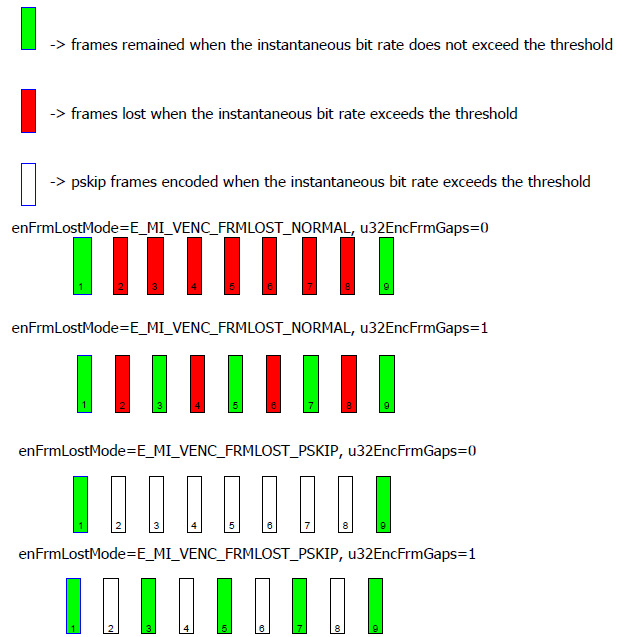
-
This interface can be set before the code channel is destroyed after the code channel is created. This interface takes effect when the next frame is called when it is called during encoding.
-
2.62. MI_VENC_GetFrameLostStrategy
-
Description
Obtain the frame loss policy when the instantaneous code rate of the coding channel exceeds the threshold.
-
Syntax
MI_S32 MI_VENC_GetFrameLostStrategy(MI_VENC_DEV VeDev, MI_VENC_CHN VeChn, MI_VENC_ParamFrameLost_t *pstFrmLostParam);
-
Parameters
parameter name Description Input/Output VeDev Encode device number Input VeChn Encode channel number. Value range: [0, VENC_MAX_CHN_NUM). Input pstFrmLostParam The parameter pointer of frame lost strategy in encode channel Output -
Return Value
-
MI_SUCCESS: Successful
-
Not MI_SUCCESS: Failed, see error code for details.
-
-
Dependence
-
Header files: mi_venc.h, mi_venc_datatype.h
-
Library file: libmi_venc.a / libmi_venc.so
-
-
Note
If pstFrmLostParam is empty, it returns a failure.
2.63. MI_VENC_SetSuperFrameCfg
-
Description
Set the encoding jumbo frame configuration.
-
Syntax
MI_S32 MI_VENC_SetSuperFrameCfg(MI_VENC_DEV VeDev, MI_VENC_CHN VeChn, MI_VENC_SuperFrameCfg_t *pstSuperFrmParam);
-
Parameters
parameter name Description Input/Output VeDev Encode device number Input VeChn Encode channel number. Value range: [0, VENC_MAX_CHN_NUM). input pstSuperFrmParam Encode jumbo frame configuration parameter pointer. input -
Return Value
-
MI_SUCCESS: Successful
-
Not MI_SUCCESS: Failed, see error code for details.
-
-
Dependence
-
Header files: mi_venc.h, mi_venc_datatype.h
-
Library file: libmi_venc.a / libmi_venc.so
-
-
Chip Diffenrence
Whether different chips support re-encoding is as follows:
Chip Whether to support Pretzel Y Macaron Y Pudding Y Ispahan N Tiramisu Y Muffin Y Mochi Y Maruko Y -
Note
-
If the channel is not created, it returns a failure.
-
This interface is a high-level interface that users can optionally call. The system default value is eSuperFrmMode = E_MI_VENC_SUPERFRM_NONE.
-
This interface can be set before the code channel is destroyed after the code channel is created.
-
When super frame mode is E_MI_VENC_SUPERFRM_NONE, MI do nothing.
-
When super frame mode is E_MI_VENC_SUPERFRM_DISCARD, MI will discard the super frame and continue encoding the next frame. If the chip version is after Macaron, MI will force to request I frame after discarding the super frame because of insufficient memory.
-
When super frame mode is E_MI_VENC_SUPERFRM_REENCODE, MI will increase the QP of the frame by 4 and reencode the super frame.If it still exceeds the threshold after repeating up to 4 times, MI will discard the frame.
-
Super frame processing is mainly to prevent the picture from getting stuck due to a certain frame being too large.The unit of threshold is bit.It is recommended to set it according to the actual scene.
-
If the previous binding relationship of VENC is E_MI_SYS_BIND_TYPE_HW_RING, the super frame mode is not supported.
-
In order to save memory, Maruko platform turns off the super frame reencode function by default. If you need to support super frame reencode, you need to add the following fields to modify use_ring_ref when insmod ko. And set the parameter use_ring_ref=0, so that each channel will use more memory about the size of a yuv buffer.
insmod mi_venc.ko use_ring_ref=0
-
2.64. MI_VENC_GetSuperFrameCfg
-
Description
Get the encoded jumbo frame configuration.
-
Syntax
MI_S32 MI_VENC_GetSuperFrameCfg(MI_VENC_DEV VeDev, MI_VENC_CHN VeChn, MI_VENC_SuperFrameCfg_t *pstSuperFrmParam);
-
Parameters
parameter name Description Input/Output VeDev Encode device number Input VeChn Encode channel number. Value range: [0, VENC_MAX_CHN_NUM). Input pstSuperFrmParam Encode jumbo frame configuration parameter pointer. Output -
Return Value
-
MI_SUCCESS: Successful
-
Not MI_SUCCESS: Failed, see error code for details.
-
-
Dependence
-
Header files: mi_venc.h, mi_venc_datatype.h
-
Library file: libmi_venc.a / libmi_venc.so
-
-
Note
If pstSuperFrmParam is empty, it returns a failure.
2.65. MI_VENC_SetRcPriority
-
Description
Set the priority type for rate control.
-
Syntax
MI_S32 MI_VENC_SetRcPriority(MI_VENC_DEV VeDev, MI_VENC_CHN VeChn, MI_VENC_RcPriority_e *peRcPriority);
-
Parameters
Parameter Description Input/Output VeDev Encode device number. Input VeChn Encode channel number. Value range: [0, VENC_MAX_CHN_NUM). Input peRcPriority Pointer to the priority type. Input -
Return Value
-
MI_SUCCESS: Successful
-
Not MI_SUCCESS: Failed, see error code for details.
-
-
Dependency
-
Header file: mi_venc.h, mi_venc_datatype.h
-
Library file: libmi_venc.a / libmi_venc.so
-
-
Note
-
This interface is used to set the rate control to the target bit rate or to the high frame threshold with high priority.
-
When the rate control is high priority with the target code rate, when the code rate is insufficient, a large frame may be encoded to compensate the code rate, and the oversized frame will not be reprogrammed. When the rate control is based on the jumbo frame threshold being high priority, the jumbo frame will reprogram the number of bits, which may result in insufficient code rate.
-
This interface must be called after the code channel is created and before the code channel is destroyed.
-
This interface only supports the rate control mode of both H.264 and H.265 protocols.
-
2.66. MI_VENC_GetRcPriority
-
Description
Get the priority type of rate control.
-
Syntax
MI_S32 MI_VENC_GetRcPriority(MI_VENC_DEV VeDev, MI_VENC_CHN VeChn, MI_VENC_RcPriority_e *peRcPriority);
-
Parameters
Parameter Description Input/Output VeDev Encode device number. Input VeChn Encode channel number. Value range: [0, VENC_MAX_CHN_NUM). Input peRcPriority Pointer to the priority type. Output -
Return Value
-
MI_SUCCESS: Successful
-
Not MI_SUCCESS: Failed, see error code for details.
-
-
Dependency
-
Header file: mi_venc.h, mi_venc_datatype.h
-
Library file: libmi_venc.a / libmi_venc.so
-
-
Note
This interface must be called after the code channel is created and before the code channel is destroyed.
2.67. MI_VENC_AllocCustomMap
-
Description
Allocate the memory for Custom Map used by smart encoding. The Custom Map includes QP Map and Mode Map.
-
Syntax
MI_S32 MI_VENC_ AllocCustomMap (MI_VENC_DEV VeDev, MI_VENC_CHN VeChn,
MI_PHY *pstPhyAddr, void *ppCpuAddr);
-
Parameters
Parameter Description Input/Output VeDev Encode device number Input VeChn Encode channel number. Value range: [0, VENC_MAX_CHN_NUM). Input pstPhyAddr Pointer to the allocated virtual physical address. Input/Output ppCpuAddr Pointer to the allocated CPU address. Input/Output -
Return Value
-
MI_SUCCESS: Successful
-
Not MI_SUCCESS: Failed, see error code for details.
-
-
Dependency
-
Header file: mi_venc.h, mi_venc_datatype.h
-
Library file: libmi_venc.a / libmi_venc.so
-
-
Note
-
This interface is used for allocating the memory needed by Custom Map. It returns the address of the allocated memory including the physical address and CPU address.
-
If the memory allocation fails, the pstPhyAddr or ppCpuAddr is null and a failure will be returned.
-
This interface must be called after the code channel is created and before the code channel is destroyed. The allocated memory will be free when the code channel is destroyed.
-
The Custom Map includes QP Map and Mode Map. The two types of Custom Map could be applied simultaneously.
-
In H.264, the QP Map contains QPs for every 16x16 block. The QP value for each 16x16 block could be set with the customer defined value. The QP Map is as illustrated below. The QP values should be successively set to the memory which is assigned for QP Map. The QP value could be set with relative or absolute value (refer to MI_VENC_SetAdvCustRcAttr). The value range is [12, 48] if absolute QP is configured, while the value range should be [0, 63] if relative QP is configured. (The efficient QP value used is the relative QP value minus 32 and the corresponding efficient value range is [-32, 31].)
-
The Mode Map contains Mode value for every 16x16 block. The Mode value for each 16x16 block could be set with the customer defined value. The Mode Map is as illustrated below. The Mode values should be successively set to the memory which is assigned for Mode Map.
-
One byte with Mode/QP value could be set every 16x16 blocks. The configuration data struct is as shown below.
struct {

uint8 qp : 6;

uint8 mode : 2;

} H264CustomMapConf;
-
In H.265, the QP Map contains QPs for every 4x32x32 block. The QP value for each 4x32x32 block could be set with the customer defined value. The QP Map is as illustrated below. The QP values should be successively set to the memory which is assigned for QP Map. The QP value could be set with relative or absolute value (refer to MI_VENC_SetAdvCustRcAttr).
-
The Mode Map contains Mode value for every 4x32x32 block. The Mode value for each 4x32x32 block could be set with the customer defined value. The Mode Map is just the same as the QP Map. The Mode values should be successively set to the memory which is assigned for Mode Map.
-
Four bytes with QP/Mode value could be set every 4x32x32 blocks. The configuration data structure is as shown below. The Mode value uses 2 bits. The QP value for every 32x32 block uses 6 bits.
struct {

        uint32  sub_ctu_qp_0    :  6;

        uint32  mode  :  2;

        uint32  sub_ctu_qp_1    :  6;

        uint32  reserved_0  :  2;

        uint32  sub_ctu_qp_2    :  6;

        uint32  reserved_1       :  2;

        uint32  sub_ctu_qp_3    :  6;

        uint32  reserved_2      :  2;

} H265CustomMapConf;
-
2.68. MI_VENC_ApplyCustomMap
-
Description
Apply the configured Custom Map.
-
Syntax
MI_S32 MI_VENC_ApplyCustomMap (MI_VENC_DEV VeDev, MI_VENC_CHN VeChn,
MI_PHY PhyAddr);
-
Parameters
Parameter Description Input/Output VeDev Encode device number Input VeChn Encode channel number. Value range: [0, VENC_MAX_CHN_NUM). Input PhyAddr The allocated virtual physical address. Input -
Return Value
-
MI_SUCCESS: Successful
-
Not MI_SUCCESS: Failed, see error code for details.
-
-
Dependency
-
Header file: mi_venc.h, mi_venc_datatype.h
-
Library file: libmi_venc.a / libmi_venc.so
-
-
Note
-
This interface is used for applying the configuration after the customer defined Custom Map is configured into the corresponding address.
-
This interface must be called after the Custom Map is initialized or modified.
-
2.69. MI_VENC_GetLastHistoStaticInfo
-
Description
Get the output information when the latest frame is encoded.
-
Syntax
MI_S32 MI_VENC_GetLastHistoStaticInfo (MI_VENC_DEV VeDev, MI_VENC_CHN VeChn, MI_VENC_FrameHistoStaticInfo_t *ppFrmHistoStaticInfo);
-
Parameters
Parameter Description Input/Output VeDev Encode device number Input VeChn Encode channel number. Value range: [0, VENC_MAX_CHN_NUM). Input ppFrmHistoStaticInfo Pointer to the address of the saved output information for the latest encoded frame. Output -
Return Value
-
MI_SUCCESS: Successful
-
Not MI_SUCCESS: Failed, see error code for details.
-
-
Dependency
-
Header file: mi_venc.h, mi_venc_datatype.h
-
Library file: libmi_venc.a / libmi_venc.so
-
-
Note
-
This interface is used for getting the output information when the latest frame is encoded. It includes the encoded frame type, the number of blocks and the frame size, etc.
-
If the getting of the output content fails, it returns a failure.
-
This interface must be called after the encode channel is created and before the encode channel is destroyed. The allocated memory would be free when the code channel is destroyed or when the memory is released by using the interface below.
-
2.70. MI_VENC_ReleaseHistoStaticInfo
-
Description
Release the memory used for the output information when the latest frame is encoded.
-
Syntax
MI_S32 MI_VENC_ReleaseHistoStaticInfo (MI_VENC_DEV VeDev, MI_VENC_CHN VeChn);
-
Parameters
Parameter Description Input/Output VeDev Encode device number Input VeChn Encode channel number. Value range: [0, VENC_MAX_CHN_NUM). Input -
Return Value
-
MI_SUCCESS: Successful
-
Not MI_SUCCESS: Failed, see error code for details.
-
-
Dependency
-
Header file: mi_venc.h, mi_venc_datatype.h
-
Library file: libmi_venc.a / libmi_venc.so
-
-
Note
-
This interface is not supported currently.
-
This interface is used for releasing memory used for saving the output information when the latest frame is encoded.
-
2.71. MI_VENC_SetAdvCustRcAttr
-
Description
Set the customer defined advanced RC configuration parameters.
-
Syntax
MI_S32 MI_VENC_ SetAdvCustRcAttr (MI_VENC_DEV VeDev, MI_VENC_CHN VeChn, MI_VENC_AdvCustRcAttr_t *pstAdvCustRcAttr);
-
Parameters
Parameter Description Input/Output VeDev Encode device number Input VeChn Encode channel number. Value range: [0, VENC_MAX_CHN_NUM). Input pstAdvCustRcAttr Customer defined advanced RC configuration parameter pointer. Input -
Return Value
-
MI_SUCCESS: Successful
-
Not MI_SUCCESS: Failed, see error code for details.
-
-
Dependency
-
Header file: mi_venc.h, mi_venc_datatype.h
-
Library file: libmi_venc.a / libmi_venc.so
-
-
Note
-
This interface is used for setting the customer defined advanced RC configuration parameters.
-
This interface must be called after the code channel is created and before the picture starts to be received.
-
After the switch of customer defined advanced RC configuration is set, the related function could be started by calling the functions MI_VENC_AllocCustomMap and MI_VENC_GetLastHistoStaticInfo.
-
2.72. MI_VENC_SetInputSourceConfig
-
Description
Set H.264/H.265 input source info.
-
Syntax
MI_S32 MI_VENC_SetInputSourceConfig(MI_VENC_DEV VeDev, MI_VENC_CHN VeChn, MI_VENC_InputSourceConfig_t *pstInputSourceConfig);
-
Parameters
parameter name Description Input/Output VeDev Encode device number. Input VeChn Encode channel number. Value range: [0, VENC_MAX_CHN_NUM). Input pstInputSourceConfig Pointer to input source info. Input -
Return Value
-
MI_SUCCESS: Successful
-
Not MI_SUCCESS: Failed, see error code for details.
-
-
Dependence
-
Header files: mi_venc.h, mi_venc_datatype.h
-
Library file: libmi_venc.a / libmi_venc.so
-
-
Note
-
When using input ring mode or hw auto sync mode, different chips have different restrictions on whether to call this interface, as shown in the following table:
Chip Whether to call this interface when using input ring mode or hw auto sync mode? Pretzel N Macaron N Pudding N Ispahan Y Tiramisu Y Ikayaki Y Muffin Y Mochi Y Maruko Y -
If the channel is not created, it returns a failure.
-
This interface must be called after the code channel is created and before the picture starts to be received.
-
It allows to be called for at most one channel to set input ring info or input ring hw auto sync info.
-
If set E_MI_VENC_INPUT_MODE_RING_ONE_FRM or E_MI_VENC_INPUT_MODE_RING_HALF_FRM or E_MI_VENC_INPUT_MODE_HW_AUTO_SYNC, then APP should set E_MI_SYS_BIND_TYPE_HW_RING or E_MI_SYS_BIND_TYPE_HW_AUTOSYNC and the corresponding ring buffer height when call MI_SYS_BindChnPort2. For example, if the resolution is 1920x1080 and set E_MI_VENC_INPUT_MODE_RING_ONE_FRM, then the ring buffer height should set 1080; if set E_MI_VENC_INPUT_MODE_RING_HALF_FRM, then the ring buffer height should set 540.
-
The Maruko platform supports E_MI_VENC_INPUT_MODE_RING_UNIFIED_DMA mode, and the front level is SCL module, configured by the VENC main channel. App needs to set E_MI_SYS_BIND_TYPE_HW_RING when calling MI_SYS_BindChnPort2, and u32BindParam can be set to 0.
-
The Maruko platform supports the binding between different channels of VENC module. The APP needs to set E_MI_SYS_BIND_TYPE_HW_RING when calling MI_SYS_BindChnPort2. Under this usage, we cannot call MI_VENC_SetInputSourceConfig to set the buf mode as E_MI_VENC_INPUT_MODE_RING_UNIFIED_DMA. The correct way is to set the buf mode as E_MI_VENC_INPUT_MODE_NORMAL_FRMBASE or not to call this API.
-
2.73. MI_VENC_SetSmartDetInfo
-
Description
For third-party intelligent detection algorithms to provide VENC with statistics needed for intelligent coding.
-
Syntax
MI_S32 MI_VENC_ SetSmartDetInfo(MI_VENC_DEV VeDev, MI_VENC_CHN VeChn, MI_VENC_SmartDetInfo_t *pstSmartDetInfo);
-
Parameters
Parameter Description Input/Output VeDev Encode device number. Input VeChn Encode channel number. Value range: [0, VENC_MAX_CHN_NUM). Input pstSmartDetInfo Pointer to related statistics of intelligent detection algorithm. Input -
Return Value
-
MI_SUCCESS: Successful
-
Not MI_SUCCESS: Failed, see error code for details.
-
-
Dependency
-
Header file: mi_venc.h, mi_venc_datatype.h
-
Library file: libmi_venc.a / libmi_venc.so
-
-
Note
-
It will return failure if the channel is not created
-
This interface must be called after the code channel is created and before the picture starts to be received.
-
This interface parameter setting takes effect on Pudding, Ispahan, Tiramisu and Muffin.
-
2.74. MI_VENC_SetIntraRefresh
-
Description
Set H.264/H.265 P-frame brush Islice. When IntraResearch mode is turned on, only one IDR is present at the beginning of the encoding, and then there will be P-frame only. The advantage of enabling IntraRefresh mode is that, by scattering the original IDR coded IntraLCU/Macroblock in a number of P-frames, the size of the frames will be relatively similar, without affecting the IDR frame quality.
-
Syntax
MI_S32 MI_VENC_SetIntraRefresh(MI_VENC_DEV VeDev, MI_VENC_CHN VeChn, MI_VENC_IntraRefresh_t *pstIntraAttr);
-
Parameters
Parameter Description Input/Output VeDev Encode device number Input VeChn Encode channel number. Value range: [0, VENC_MAX_CHN_NUM). Input pstIntraAttr Input Intra configuration information Input -
Return Value
-
MI_SUCCESS: Successful
-
Not MI_SUCCESS: Failed, see error code for details.
-
-
Dependency
-
Header file: mi_venc.h, mi_venc_datatype.h
-
Library file: libmi_venc.a / libmi_venc.so
-
-
Chip Difference
The following table lists chips that support H.264 and H.265 encoder intra refresh feature:
Chip H264 and H265 intra refresh supported or not? Pudding Y Ispahan Y Tiramisu Y Muffin Y Mochi Y Maruko Y -
Note
-
If the channel is not created, it returns a failure.
-
This interface must be called after the code channel is created and before the picture starts to be received.
-
u32RefreshLineNum value range: total_mb_count/gop < u32RefreshLineNum <= total_mb_count. For example: 1080P, gop = 30, mb_height = 16, value range: total_mb_count = 1088/16 = 68, total_mb_count/gop = 68/30 = 2.26, then 2.26 < u32RefreshLineNum <= 68. In order to reduce the bit rate, it is recommended that the value of u32RefreshLineNum be smaller, otherwise the P frame of the entire gop will be refreshed to Islice.
-
-
Example
MI_S32 SetIntraRefresh()
{
    MI_S32 s32Ret;
    MI_VENC_DEV VeDev = MI_VENC_DEV_ID_H264_H265_0;
    MI_VENC_CHN VeChn = 0;
    MI_VENC_IntraRefresh_t stIntraAttr;

    //...omit other thing
    s32Ret = MI_VENC_GetIntraRefresh(VeDev, VeChnId, &stIntraAttr);
    if (MI_SUCCESS != s32Ret)
    {
        printf("MI_VENC_GetIntraRefresh err0x%x\n", s32Ret);
        return E_MI_ERR_FAILED;
    }
    stIntraAttr.bEnable = TRUE;
    stIntraAttr.u32RefreshLineNum = 2;
    stIntraAttr.u32ReqIQp = FALSE;
    s32Ret = MI_VENC_SetIntraRefresh(VeDev, VeChn, &stIntraAttr);
    if (MI_SUCCESS != s32Ret)
    {
    printf("MI_VENC_SetIntraRefresh err 0x%x\n", s32Ret);
        return E_MI_ERR_FAILED;
    }

    return s32Ret;
}
2.75. MI_VENC_GetIntraRefresh
-
Description
Get H.264/H.265 Intra Refresh Parameter
-
Syntax
MI_S32 MI_VENC_GetIntraRefresh(MI_VENC_DEV VeDev, MI_VENC_CHN VeChn, MI_VENC_IntraRefresh_t *pstIntraAttr);
-
Parameters
Parameter Description Input/Output VeDev Encode device number. Input VeChn Encode channel number. Value range: [0, VENC_MAX_CHN_NUM). Input pstIntraAttr Pointer to output Intra configuration information. Output -
Return Value
-
MI_SUCCESS: Successful
-
Not MI_SUCCESS: Failed, see error code for details.
-
-
Dependency
-
Header file: mi_venc.h, mi_venc_datatype.h
-
Library file: libmi_venc.a / libmi_venc.so
-
-
Chip Difference
The following table lists chips that support H.264 and H.265 encoder intra refresh feature:
Chip Intra refresh supported or not? Pudding Y Ispahan Y Tiramisu Y Muffin Y Mochi Y Maruko Y -
Note
-
If the channel is not created, it returns a failure.
-
This interface must be called after the code channel is created and before the picture starts to be received.
-
-
Example
Please refer to the example of MI_VENC_SetIntraRefresh.
2.76. MI_VENC_DupChn
-
Description
Synchronize status of VENC channel.
-
Syntax
MI_S32 MI_VENC_DupChn(MI_VENC_DEV VeDev, MI_VENC_CHN VeChn)
-
Parameters
Parameter Description Input/Output VeDev Encode device number Input VeChn Encode channel number. Value range: [0, VENC_MAX_CHN_NUM). Input -
Return Value
-
MI_SUCCESS: Successful
-
Not MI_SUCCESS: Failed, see error code for details.
-
-
Dependency
-
Header file: mi_venc.h, mi_venc_datatype.h
-
Library file: libmi_venc.a / libmi_venc.so
-
-
Note
-
This interface applies only to dual OS environments.The venc channel is initialized in the RTK environment and used to synchronize the status of the venc channel when switching to the Linux environment.
-
After Linux dup channel, the RTK app can no longer operate the venc channel.
-
2.77. rc_init
-
Description
Initializes related UBR resources in the module.
-
Syntax
MI_S32 (*rc_init)(MI_VENC_DEV VeDev, MI_VENC_CHN VeChn, MI_VENC_UserRcChnAttr_t *pstAttr)
-
Parameters
Parameter Description Input/Output VeDev Encode device number. Input VeChn Encode channel number. Value range: [0, VENC_MAX_CHN_NUM). Input pstAttr Input VENC RC configuration information. Input -
Return Value
-
MI_SUCCESS: Successful
-
Not MI_SUCCESS: Failed, the return value is user-defined.
-
-
Dependency
-
Header file: mi_venc.h, mi_venc_datatype.h
-
Library file: libmi_venc.a / libmi_venc.so
-
-
Note
- VENC calls this function once when the APP accesses UBR via MI_VENC_CreateChn or MI_VENC_SetChnAttr, and emits the corresponding channel number and properties.
-
Relevant Parameter
2.78. rc_deinit
-
Description
Deinitializes related UBR resources in the module.
-
Syntax
MI_S32 (*rc_deinit)(MI_VENC_DEV VeDev, MI_VENC_CHN VeChn)
-
Parameters
Parameter Description Input/Output VeDev Encode device number. Input VeChn Encode channel number. Value range: [0, VENC_MAX_CHN_NUM). Input -
Return Value
-
MI_SUCCESS: Successful
-
Not MI_SUCCESS: Failed, the return value is user-defined.
-
-
Dependency
-
Header file: mi_venc.h, mi_venc_datatype.h
-
Library file: libmi_venc.a / libmi_venc.so
-
-
Note
- VENC calls this function once when the APP switch UBR RC mode or invoke MI_VENC_DestroyChn, and emits the corresponding channel number.
2.79. rc_attr_change
-
Description
UBR channel attribute.
-
Syntax
MI_S32 (*rc_attr_change)(MI_VENC_DEV VeDev, MI_VENC_CHN VeChn, MI_VENC_UserRcChnAttr_t *pstAttr)
-
Parameters
Parameter Description Input/Output VeDev Encode device number. Input VeChn Encode channel number. Value range: [0, VENC_MAX_CHN_NUM). Input pstAttr Input VENC RC configuration information. Input -
Return Value
-
MI_SUCCESS: Successful
-
Not MI_SUCCESS: Failed, the return value is user-defined.
-
-
Dependency
-
Header file: mi_venc.h, mi_venc_datatype.h
-
Library file: libmi_venc.a / libmi_venc.so
-
-
Note
- When channel property is modified, such as bitrate or fps, VENC calls this function to set the modified channel property.
-
Relevant Parameter
2.80. rc_calc
-
Description
Configure the encoding properties of the current frame according to the encoding information of the previous frame.
-
Syntax
MI_S32(*rc_calc)(MI_VENC_DEV VeDev, MI_VENC_CHN VeChn, const MI_VENC_UserRcFrameAttr_t *pstFrameAttr, MI_VENC_UserRcEncParam_t *pstEncParam)
-
Parameters
Parameter Description Input/Output VeDev Encode device number. Input VeChn Encode channel number. Value range: [0, VENC_MAX_CHN_NUM). Input pstFrameAttr Input the encoding information of the previous frame Input pstEncParam Output the current frame encoding parameter set by the user Output -
Return Value
-
MI_SUCCESS: Successful
-
Not MI_SUCCESS: Failed, the return value is user-defined.
-
-
Dependency
-
Header file: mi_venc.h, mi_venc_datatype.h
-
Library file: libmi_venc.a / libmi_venc.so
-
-
Note
- VENC transmits the encoding result and information of the previous frame through this function, executes the user-related RC calculation algorithm, and sets the encoding parameters of the current frame.
-
Relevant Parameter
3. VENC DATA TYPE
The relevant data types and data structures are defined as follows:
| Data Type | Description |
|---|---|
| MI_VENC_DEV_ID_H264_H265_0 | Defines H264 & h265 coding device 0 |
| MI_VENC_DEV_ID_H264_H265_1 | Defines H264 & h265 coding device 1 |
| MI_VENC_DEV_ID_JPEG_0 | Defines JPEG coding device 0 |
| MI_VENC_DEV_ID_JPEG_1 | Defines JPEG coding device 1 |
| RC_TEXTURE_T HR_SIZE | Define the threshold number of texture level code control |
| MI_VENC_H264eNaluType_e | Define H.264 code stream NALU type |
| MI_VENC_H264eRefSliceType_e | Defining which reference frame in the frame skip reference mode the acquired H.264 code stream belongs to |
| M I_VENC_H264eRefType_e | Define the frame type and reference attribute of the H.264 frame skip reference stream |
| MI_VENC_JpegePackType_e | Define the PACK type of the JPEG stream |
| MI_VENC_H265eNaluType_e | Define H.265 code stream NALU type |
| MI_VENC_DataType_ t | Defining code stream structure union |
| MI_VENC_PackInfo_t | A structure that defines other types of codestream data contained in the current stream packet data. |
| MI_VENC_Pack_t | Define a frame code stream packet structure |
| MI_VENC_StreamInfoH264_t | Define H.264 protocol code stream feature information |
| MI_VENC_StreamInfoJpeg_t | Define JPEG protocol stream feature information |
| MI_VENC_StreamInfoH265_t | Define H.265 protocol code stream feature information |
| MI_VENC_Stream_t | Define the frame code stream type structure |
| MI_VENC_StreamBufInfo_t | Structure for defining code stream buffer information |
| MI_VENC_AttrH264_t | Define the H.264 encoder attribute structure |
| MI_VENC_AttrJpeg_t | Define JPEG capture encoder attribute structure |
| MI_VENC_AttrH265_t | Define the H.265 encoder attribute structure |
| MI_VENC_Attr_t | Define the encoder attribute structure |
| MI_VENC_ChnAttr_t | Define the encoding channel attribute structure |
| MI_VENC_ChnStat_t | Define the state structure of the code channel |
| MI_VENC_ParamH264SliceSplit_t | Define the H.264 encoding channel slice segmentation attribute |
| MI_VENC_ParamH264InterPred_t | Defining H.264 encoding channel inter prediction properties |
| MI_VENC_ParamH264Trans_t | Define H.264 encoding channel transform, quantization properties |
| MI_VENC_ParamH264Entropy_t | Define H.264 encoding channel entropy encoding properties |
| MI_VENC_ParamH265 InterPred_t | Defining H.265 encoding channel inter prediction properties |
| MI_VENC_ParamH265 IntraPred_t | Define H.265 encoding channel intra prediction properties |
| MI_VENC_ParamH265 Trans_t | Define H.265 encoding channel transform, quantization properties |
| MI_VENC_ParamH264Dblk_t | Define the H.264 encoding channel Deblocking property |
| MI_VENC_ParamH264Vui_t | Define H.264 encoding channel VUI properties |
| MI_VENC_ParamH264VuiAspectRatio_t | A structure defining the AspectRatio information in the H.264 protocol encoding channel VUI |
| MI_VENC_ParamH264Vui TimeInfo_t | A structure defining TIME_INFO information in the H.264 protocol encoding channel VUI |
| MI_VENC_Param H264 VuiVideoSignal_t | A structure defining the VIDEO_SIGNAL information in the H.264 protocol encoding channel VUI |
| MI_VENC_ParamJpeg_t | Define JPEG encoding parameter sets |
| MI_VENC_RoiCfg_t | Define the coding channel interest area coding attribute |
| MI_VENC_RoiBgFrameRate_t | Define the frame rate attribute of a non-ROI area |
| MI_VENC_RcAttr_t | Define the encoding channel rate controller attribute |
| MI_VENC_RcMode_e | Define the code channel rate controller mode |
| MI_VENC_AttrH264Cbr_t | Define the HBR encoding channel CBR attribute structure |
| MI_VENC_AttrH264Vbr_t | Define the HBR encoding channel VBR attribute structure |
| MI_VENC_AttrH264FixQp_t | Define the H.264 encoding channel Fixqp attribute structure |
| MI_VENC_AttrH264Abr_t | Define the HBR encoding channel ABR attribute structure |
| MI_VENC_SuperFrmMode_e | Define the jumbo frame processing mode in rate control |
| MI_VENC_AttrH265Cbr_t | Define the H.265 encoding channel CBR attribute structure |
| MI_VENC_AttrH265Vbr_t | Define the HBR attribute channel VBR attribute structure |
| MI_VENC_AttrH265FixQp_t | Define the H.265 encoding channel Fixqp attribute structure |
| MI_VENC_ParamH264Vbr_t | Define H264 protocol encoding channel VBR rate control mode advanced parameter configuration |
| MI_VENC_ParamH264Cbr_t | Define H264 protocol encoding channel CBR new version rate control mode advanced parameter configuration |
| MI_VENC_ParamH265Vbr_t | Define H265 protocol encoding channel VBR rate control mode advanced parameter configuration |
| MI_VENC_ParamH265Cbr_t | Define H265 protocol encoding channel CBR new version rate control mode advanced parameter configuration |
| MI_VENC_RcParam_t | Define the rate control advanced parameters of the coding channel |
| MI_VENC_CropCfg_t | Define channel crop parameters |
| MI_VENC_RecvPicParam_t | Receive the specified frame number image encoding |
| MI_VENC_H264eIdrPicIdMode_e | Set the mode of IDR frame or Idr_pic_id of I frame |
| MI_VENC_H264IdrPicIdCfg_t | Idr_pic_id parameter of IDR frame or I frame |
| MI_VENC_FrameLostMode_e | Defining the frame loss mode when the code channel instantaneous code rate exceeds the threshold |
| MI_VENC_ParamFrameLost_t | Defining the frame loss strategy when the code channel instantaneous code rate exceeds the threshold |
| MI_VENC_SuperFrameCfg_t | Large frame processing strategy parameters |
| MI_VENC_RcPriority_e | Rate control priority enumeration |
| MI_VENC_ModParam_t | Define encoding module parameters |
| MI_VENC_ModType_e | Define module parameter types |
| MI_VENC_ParamModH265e_t | Define mi_h265.ko module parameters |
| MI_VENC_ParamModJpege_t | Define mi_jpege.ko module parameters |
| MI_VENC_AdvCustRcAttr_t | Define customer defined advanced RC configuration parameters |
| MI_VENC_FrameHistoStaticInfo_t | Define attributes of the encoded frame |
| MI_VENC_InputSourceConfig_t | Define H.264/H.265 input buffer config info structure |
| MI_VENC_InputSrcBufferMode_e | Define H.264/H.265 input buffer mode |
| MI_VENC_AttrH264Avbr_t | Define the H.264 encoding channel AVBR attribute structure |
| MI_VENC_AttrH265Avbr_t | Define the H.265 encoding channel AVBR attribute structure |
| MI_VENC_ParamH264Avbr_t | Define H264 protocol encoding channel AVBR rate control mode advanced parameter configuration |
| MI_VENC_ParamH265Avbr_t | Define H265 protocol encoding channel AVBR rate control mode advanced parameter configuration |
| MI_VENC_SmartDetInfo_t | Define the statistics required by the intelligent detection algorithm |
| MI_VENC_IntraRefresh_t | Support P-frame containing Islice |
| MI_VENC_InitParam_t | Venc device initialization parameter |
| MI_VENC_H265eRefType_e | Define the frame type and reference attribute of the H.265 frame skip reference stream. |
| MI_VENC_AttrMjpegVbr_t | Define the VBR attribute structure of the MJPEG encoding channel. |
| MI_VENC_ParamMjpegVbr_t | Define the VBR rate control mode advanced parameter configuration of the MJPEG protocol encoding channel. |
| MI_VENC_AttrH264Ubr_t | Define H264 encoding channel UBR attribute structure |
| MI_VENC_AttrH265Ubr_t | Define H264 encoding channel UBR attribute structure |
| MI_VENC_UserRcChnAttr_t | Define UBR RC algorithm encoding channel attribute structure |
| MI_VENC_UserRcFrameAttr_t | Define the frame encoding information before user encoding control algorithm in UBR RC algorithm |
| MI_VENC_UserRcEncParam_t | Define the frame encoding information after user encoding control algorithm in UBR RC algorithm. |
3.1. MI_VENC_DEV_ID_H264_H265_0
-
Description
Defines H264 & h265 coding device 0.
-
Definition
#define MI_VENC_DEV_ID_H264_H265_0 0
-
Related data types and interfaces
3.2. MI_VENC_DEV_ID_H264_H265_1
-
Description
Defines H264 & h265 coding device 1.
-
Definition
#define MI_VENC_DEV_ID_H264_H265_1 (MI_VENC_DEV_ID_H264_H265_0 + 1)
-
Related data types and interfaces
3.3. MI_VENC_DEV_ID_JPEG_0
-
Description
Defines JPEG coding device 0.
-
Definition
#define MI_VENC_DEV_ID_JPEG_0 (8)
-
Related data types and interfaces
3.4. MI_VENC_DEV_ID_JPEG_1
-
Description
Defines JPEG coding device 1.
-
Definition
#define MI_VENC_DEV_ID_JPEG_1 (MI_VENC_DEV_ID_JPEG_0 + 1)
-
Related data types and interfaces
3.5. RC_TEXTURE_THR_SIZE
-
Description
Defines the number of thresholds for RC macroblock complexity.
-
Definition
#define RC_TEXTURE_THR_SIZE 1
3.6. MI_VENC_H264eNaluType_e
-
Description
Define the H.264 code stream NALU type.
-
Definition
typedef enum { E_MI_VENC_H264E_NALU_PSLICE = 1, E_MI_VENC_H264E_NALU_ISLICE = 5, E_MI_VENC_H264E_NALU_SEI = 6, E_MI_VENC_H264E_NALU_SPS = 7, E_MI_VENC_H264E_NALU_PPS = 8, E_MI_VENC_H264E_NALU_IPSLICE = 9, E_MI_VENC_H264E_NALU_PREFIX = 14, E_MI_VENC_H264E_NALU_MAX }MI_VENC_H264eNaluType_e; -
Members
Member Description E_MI_VENC_H264E_NALU_PSLICE PSLICE type E_MI_VENC_H264E_NALU_ISLICE ISLICE type E_MI_VENC_H264E_NALU_SEI SEI type E_MI_VENC_H264E_NALU_SPS SPS type E_MI_VENC_H264E_NALU_PPS PPS type E_MI_VENC_H264E_NALU_PREFIX PREFIX type E_MI_VENC_H264E_NALU_IPSLICE P frame bruch ISLICE type (not supported at this time)
3.7. MI_VENC_H264eRefSliceType_e
-
Description
Defines the reference frame in which the acquired H.264 code stream belongs in the frame skip reference mode.
-
Definition
typedef enum { E_MI_VENC_H264E_REFSLICE_FOR_1X = 1, E_MI_VENC_H264E_REFSLICE_FOR_2X = 2, E_MI_VENC_H264E_REFSLICE_FOR_4X, E_MI_VENC_H264E_REFSLICE_FOR_MAX = 5 }MI_VENC_H264eRefSliceType_e; -
Members
Member Name Description E_MI_VENC_H264E_REFSLICE_FOR_1X Reference frame at 1x frame skip reference. E_MI_VENC_H264E_REFSLICE_FOR_2X 2x frame skip reference frame or 4x frame skip reference for 2 The reference frame of the double-jump frame reference. E_MI_VENC_H264E_REFSLICE_FOR_4X Reference frame for 4x frame skip reference. E_MI_VENC_H264E_REFSLICE_ MAX Non-reference frame.
3.8. MI_VENC_H264eRefType_e
-
Description
Defines the frame type and reference attribute of the H.264 frame skip reference stream.
-
Definition
typedef enum { E_MI_VENC_BASE_IDR = 0, E_MI_VENC_BASE_P_REFTOIDR, E_MI_VENC_BASE_P_REFBYBASE, E_MI_VENC_BASE_P_REFBYENHANCE, E_MI_VENC_ENHANCE_P_REFBYENHANCE, E_MI_VENC_ENHANCE_P_NOTFORREF, E_MI_VENC_REF_TYPE_MAX }MI_VENC_H264eRefType_e; -
Members
Member Name Description E_MI_VENC_BASE_IDR IDR frame in the base layer. E_MI_VENC_BASE_P_REFTOIDR A P frame in the base layer for reference to IDR frame. E_MI_VENC_BASE_P_REFBYBASE A P frame in the base layer for reference by other frames in the base layer. E_MI_VENC_BASE_P_REFBYENHANCE P frame in the base layer, used for reference of frames in the enhancement layer. E_MI_VENC_ENHANCE_P_REFBYENHANCE P frame in the enhance layer, used in the enhance layer The reference of his frame. E_MI_VENC_ENHANCE_P_NOTFORREF P frame in the enhance layer, not used for reference
3.9. MI_VENC_JpegePackType_e
-
Description
Define the PACK type of the JPEG stream.
-
Definition
typedef enum { E_MI_VENC_JPEGE_PACK_ECS = 5, E_MI_VENC_JPEGE_PACK_APP = 6, E_MI_VENC_JPEGE_PACK_VDO = 7, E_MI_VENC_JPEGE_PACK_PIC = 8, E_MI_VENC_JPEGE_PACK_MAX }MI_VENC_JpegePackType_e; -
Members
Member Description E_MI_VENC_JPEGE_PACK_ECS ECS type E_MI_VENC_JPEGE_PACK_APP APP type E_MI_VENC_JPEGE_PACK_VDO VDO type E_MI_VENC_JPEGE_PACK_PIC PIC type
3.10. MI_VENC_H265eNaluType_e
-
Description
Define the H.265 code stream NALU type.
-
Definition
typedef enum { E_MI_VENC_H265E_NALU_PSLICE = 1, E_MI_VENC_H265E_NALU_ISLICE = 19, E_MI_VENC_H265E_NALU_VPS = 32, E_MI_VENC_H265E_NALU_SPS = 33, E_MI_VENC_H265E_NALU_PPS = 34, E_MI_VENC_H265E_NALU_SEI = 39, E_MI_VENC_H265E_NALU_MAX } MI_VENC_H265eNaluType_e; -
Members
Member Description E_MI_VENC_H265E_NALU_PSLICE PSLICE type E_MI_VENC_H265E_NALU_ISLICE ISLICE type E_MI_VENC_H265E_NALU_VPS VPS type E_MI_VENC_H265E_NALU_SPS SPS type E_MI_VENC_H265E_NALU_PPS PPS type E_MI_VENC_H265E_NALU_SEI SEI type
3.11. MI_VENC_Rect_t
-
Description
A rectangular box that defines the encoding Description.
-
Definition
typedef struct MI_VENC_Rect_s { MI_U32 u32Left; MI_U32 u32Top; MI_U32 u32Width; MI_U32 u32Height; }MI_VENC_Rect_t; -
Members
Member Name Description u32Left The distance between the left side of the rectangle and the left side of the actual screen, in pixel. u32Top The distance between the top edge of the rectangle and the top edge of the actual screen, in pixel u32Width The width of the rectangle in pixel u32Height The height of the rectangle in pixel -
Note
The rectangular frame cannot exceed the range of the actual image being encoded.
-
Related data types and interfaces
3.12. MI_VENC_DataType_t
-
Description
Define code stream structure type.
-
Definition
typedef union MI_VENC_DataType_s { MI_VENC_H264eNaluType_e eH264EType; MI_VENC_JpegePackType_e eJPEGEType; MI_VENC_H265eNaulType_e eH265EType; }MI_VENC_DataType_t; -
Members
Member Description enH264EType H.264 code stream packet type enJPEGEType JPEG code stream packet type enMPEG4EType MPEG-4 code stream packet type enH265EType H.265 code stream packet type -
Related data types and interfaces
3.13. MI_VENC_PackInfo_t
-
Description
A structure that defines other types of codestream data contained in current stream packet data.
-
Definition
typedef struct MI_VENC_PackInfo_s { MI_VENC_DataType_t stPackType; MI_U32 u32PackOffset; MI_U32 u32PackLength; MI_U32 u32SliceId; }MI_VENC_PackInfo_t; -
Members
Member Description u32PackType The current stream packet data contains the types of other stream packets. u32PackOffset The current stream packet data contains offsets of other stream packet data. u32PackLength The current stream packet data contains the size of other stream packet data. u32SliceId The current stream packet data contains the slice id of other stream packet data.
3.14. MI_VENC_Pack_t
-
Description
Define the frame code stream packet structure.
-
Definition
typedef struct MI_VENC_Pack_s { MI_PHY phyAddr; MI_U8 *pu8Addr; MI_U32 u32Len; MI_U64 u64PTS; MI_BOOL bFrameEnd; MI_VENC_DataType_t stDataType; MI_U32 u32Offset; MI_U32 u32DataNum; MI_U8 u8FrameQP; MI_S32 s32PocNum; MI_U32 u32Gradient; MI_VENC_PackInfo_t asackInfo[8]; } MI_VENC_Pack_t; -
Members
Member Name Description pu8Addr The first address of the stream packet. phyAddr The code stream packet physical address. u32Len The length of the stream packet. DataType The stream type supports data packets of the H.264/JPEG/H.265 protocol type. u64PTS Timestamp. Unit: us. bFrameEnd End of frame identification. Ranges: MI_TRUE: This stream packet is the last packet of the frame. MI_FALSE: The stream packet is not the last packet of the frame. u32Offset The offset of the valid data in the stream packet from the first address of the stream packet, pu8Addr. u32DataNum The current stream packet (the type of the current packet is specified by the DataType) is included in the data. The number of other types of stream packets. u8FrameQP The frame qp of the current code stream packet. s32PocNum The poc number of the current stream packet. u32Gradient The gradient information of the current code stream packet (used for code rate control). stPackInfo[8] The current stream packet data contains other types of stream packet data information. -
Related data types and interfaces
3.15. MI_VENC_StreamInfoH264_t
-
Description
Define H.264 protocol code stream feature information.
-
Definition
typedef struct MI_VENC_StreamInfoH264_s { MI_U32 u32PicBytesNum; MI_U32 u32PSkipMbNum; MI_U32 u32IpcmMbNum; MI_U32 u32Inter16x8MbNum; MI_U32 u32Inter16x16MbNum; MI_U32 u32Inter8x16MbNum; MI_U32 u32Inter8x8MbNum; MI_U32 u32Intra16MbNum; MI_U32 u32Intra8MbNum; MI_U32 u32Intra4MbNum; MI_VENC_H264eRefSliceType_e eRefSliceType; MI_VENC_H264eRefType_e eRefType; MI_U32 u32UpdateAttrCnt; MI_U32 u32StartQp; }MI_VENC_StreamInfoH264_t; -
Members
Member Name Description u32PicBytesNum Encode the number of bytes (BYTE) of the current frame u32PSkipMbNum Encoding the number of macroblocks in the current frame using the skip (SKIP) encoding mode u32IpcmMbNum Encoding the number of macroblocks in the current frame using the IPCM encoding mode u32Inter16x8MbNum Encoding the number of macroblocks in the current frame using the Inter16x8 prediction mode u32Inter16x16MbNum Encoding the number of macroblocks in the current frame using the Inter16x16 prediction mode u32Inter8x16MbNum Encoding the number of macroblocks in the current frame using the Inter8x16 prediction mode u32Inter8x8MbNum Encoding the number of macroblocks in the current frame using the Inter8x8 prediction mode u32Intra16MbNum Encoding the number of macroblocks in the current frame using the Intra16 prediction mode u32Intra8MbNum Encoding the number of macroblocks in the current frame using the Intra8 prediction mode u32Intra4MbNum Encoding the number of macroblocks in the current frame using the Intra4 prediction mode enRefSliceType Coding with the reference frame in the frame skip reference mode of the current frame enRefType Encoded frame type under advanced frame skip reference u32UpdateAttrCnt The number of times the channel attribute or parameter (including the RC parameter) is set u32StartQp Initial Qp value used for encoding -
Note
When saving the H.264 code stream, only the reference frame in the corresponding frame skip reference mode can be selected:
-
When the frame skip reference mode is the 1x frame skip reference mode, only the code stream whose enRefSliceType is equal to E_MI_VENC_H264E_REFSLICE_FOR_1X can be saved.
-
When the frame skip reference mode is the 2x frame skip reference mode, only the code stream whose enRefSliceType is equal to E_MI_VENC_H264E_REFSLICE_FOR_2X can be saved.
-
When the frame skip reference mode is the 4x frame skip reference mode, only the code stream whose enRefSliceType is equal to _MI_VENC_H264E_REFSLICE_FOR_4X can be saved. Or save the code stream with enRefSliceType equal to E_MI_VENC_H264E_REFSLICE_FOR_2X and E_MI_VENC_H264E_REFSLICE_FOR_4X.
-
-
Related data types and interfaces
3.16. MI_VENC_StreamInfoJpeg_t
-
Description
Define JPEG protocol code stream feature information.
-
Definition
typedef struct MI_VENC_StreamInfoJpeg_s { MI_U32 u32PicBytesNum; MI_U32 u32UpdateAttrCnt; MI_U32 u32Qfactor; }MI_VENC_StreamInfoJpeg_t -
Members
Member Name Description u32PicBytesNum The size of a frame of jpeg code stream, in bytes. u32Updat eAttrCnt The number of times the channel attribute or parameter (including the RC parameter) is set. u32Qfactor Encodes the Qfactor of the current frame. -
Related data types and interfaces
3.17. MI_VENC_StreamInfoH265_t
-
Description
Define the H.265 protocol code stream feature information.
-
Definition
typedef struct MI_VENC_StreamInfoH265_s { MI_U32 u32PicBytesNum; MI_U32 u32Inter64x64CuNum; MI_U32 u32Inter32x32CuNum; MI_U32 u32Inter16x16CuNum; MI_U32 u32Inter8x8CuNum; MI_U32 u32Intra32x32CuNum; MI_U32 u32Intra16x16CuNum; MI_U32 u32Intra8x8CuNum; MI_U32 u32Intra4x4CuNum; MI_VENC_H265eRefType_e eRefType; MI_U32 u32UpdateAttrCnt; MI_U32 u32StartQp; }MI_VENC_StreamInfoH265_t; -
Members
Member Name Description u32PicBytesNum Encode the number of bytes (BYTE) of the current frame u32Inter64x64CuNum Encode the number of CU blocks in the current frame using Inter64x64 prediction mode u32Inter32x32CuNum Encoding the number of CU blocks in the current frame using the Inter32x32 prediction mode u32Inter16x16CuNum Encoding the number of CU blocks in the current frame using Inter16x16 prediction mode u32Inter8x8CuNum Encoding the number of CU blocks in the current frame using the Inter8x8 prediction mode u32Intra32x32CuNum Encoding the number of CU blocks in the current frame using the Intra32x32 prediction mode u32Intra16x16CuNum Encoding the number of CU blocks in the current frame using the Intra16x16 prediction mode u32Intra8x8CuNum Encoding the number of CU blocks in the current frame using the Intra8x8 prediction mode u32Intra4x4CuNum Encoding the number of CU blocks in the current frame using the Intra4x4 prediction mode e RefType Encoded frame type under advanced frame skip reference u32UpdateAttrCnt The number of times the channel attribute or parameter (including the RC parameter) is set u32StartQp Initial Qp value used for encoding -
Note
See the Description of the enRefType variable on MI_VENC_StreamInfoH264_t.
-
Related data types and interfaces
3.18. MI_VENC_Stream_t
-
Description
Define the framestream type structure.
-
Definition
typedef struct MI_VENC_Stream_s { MI_VENC_Pack_t *pstPack; MI_U32 u32PackCount; MI_U32 u32Seq; MI_SYS_BUF_HANDLE hMiSys; union { MI_VENC_StreamInfoH264_t stH264Info; MI_VENC_StreamInfoJpeg_t stJpegInfo; MI_VENC_StreamInfoH265_t stH265Info; }; } MI_VENC_Stream_t; -
Members
Member Name Description pstPack Frame code stream packet structure. u32PackCount The number of all packets of a frame stream. u32Seq Encode stream serial number.The frame number is obtained by frame; the packet sequence number is obtained by packet. hMiSys Buffer handle. stH624Info/stJpegInfo/ stMpeg4Info/stH265Info Encode stream feature information. -
Related data types and interfaces
3.19. MI_VENC_StreamBufInfo_t
-
Description
A structure that defines the stream buffer information.
-
Definition
typedef struct MI_VENC_StreamBufInfo_s { MI_PHY phyAddr; void* pUserAddr; MI_U32 u32BufSize; }MI_VENC_StreamBufInfo_t; -
Members
Member Name Description u32PhyAddr The starting physical address of the code stream buffer. pUserAddr The virtual address of the stream buffer. u32BufSize The size of the stream buffer.
3.20. MI_VENC_AttrH264_t
-
Description
Define the H.264 encoding attribute structure.
-
Definition
typedef struct MI_VENC_AttrH264_s { MI_U32 u32MaxPicWidth; MI_U32 u32MaxPicHeight; MI_U32 u32BufSize; MI_U32 u32Profile; MI_BOOL bByFrame; MI_U32 u32PicWidth; MI_U32 u32PicHeight; MI_U32 u32BFrameNum; MI_U32 u32RefNum; }MI_VENC_AttrH264_t; -
Members
Member Name Description u32MaxPicWidth The maximum width of the encoded image. Value range: [MIN_WIDTH, MAX_WIDTH], in pixels. Must be an integer multiple of MIN_ALIGN. Static attribute. u32PicWidth Encode image width. Value range: [MIN_WIDTH, u32MaxPicWidth], in pixels. Must be an integer multiple of MIN_ALIGN. Dynamic attribute. u32MaxPicHeight The maximum height of the encoded image. Value range: [MIN_HEIGHT, MAX_HEIGHT], in pixels. Must be an integer multiple of MIN_ALIGN Static attribute. u32PicHeight Encode image height. Value range: [MIN_HEIGHT, u32MaxPicHeight], in pixels Bit. Must be an integer multiple of MIN_ALIGN Dynamic attribute. u32BufSize Encode stream buffer size. Value range: [Min, Max], in bytes. Recommended value: One maximum encoded image size. The recommended value is u32MaxPicWidth x u32MaxPicHeight x 1.5 byte. Min: ½ of the maximum encoded image size. Max: No limit, but it will consume more memory. Static attribute. bByFrame The frame/packet mode acquires the code stream. Value range: u32Profile The level of coding. Value range: [0, 2]. 0: Baseline. 1: MainProfile. 2: HighProfile. Dynamic attribute. u32BFrameNum Encoding supports the number of B frames. Value range: [0, Max]. Max: Unlimited. Static attribute, reserved field, not supported at this time. u32RefNum Encoding supports the number of reference frames. Value range: [1, 2]. Static attribute, reserved field, not supported at this time.
3.21. MI_VENC_AttrJpeg_t
-
Description
Define the JPEG capture attribute structure.
-
Definition
typedef struct MI_VENC_AttrJpeg_s { MI_U32 u32MaxPicWidth; MI_U32 u32MaxPicHeight; MI_U32 u32BufSize; MI_BOOL bByFrame; MI_U32 u32PicWidth; MI_U32 u32PicHeight; MI_BOOL bSupportDCF; MI_U32 u32RestartMakerPerRowCnt; }MI_VENC_AttrJpeg_t; -
Members
Member Name Description u32MaxPicWidth The maximum width of the encoded image. Value range: [MIN_WIDTH, MAX_WIDTH], in pixels. Must be an integer multiple of MIN_ALIGN. Static attribute. u32PicWidth Encode image width. Value range: [MIN_WIDTH, u32MaxPicWidth], in pixels. Must be an integer multiple of MI_ALIGN. Dynamic attribute. u32MaxPicHeight The maximum height of the encoded image. Value range: [MIN_HEIGHT, MAX_HEIGHT], in pixels. Must be an integer multiple of MIN_ALIGN. Static attribute. u32PicHeight Encode image height. Value range: [MIN_HEIGHT, u32MaxPicHeight], in pixels bit. Must be an integer multiple of MIN_ALIGN Dynamic attribute. u32BufSize Encode stream buffer size. Value range: [Min, Max], in bytes. Recommended value: One maximum encoded image size. The recommended value is u32MaxPicWidth x u32MaxPicHeight x 1.5 byte. Min: ½ of the maximum encoded image size. Max: No limit, but it will consume more memory. Static attribute. bByFrame Get the stream mode, frame or package. Value range: bSupportDCF Whether to support Jpeg thumbnails. Static attribute. u32RestartMakerPerRowCnt Restart marker after designated rows
3.22. MI_VENC_AttrH265_t
-
Description
Define the H.265 encoding attribute structure.
-
Definition
typedef struct MI_VENC_AttrH265_s { MI_U32 u32MaxPicWidth; MI_U32 u32MaxPicHeight; MI_U32 u32BufSize; MI_U32 u32Profile; MI_BOOL bByFrame; MI_U32 u32PicWidth; MI_U32 u32PicHeight; MI_U32 u32BFrameNum; MI_U32 u32RefNum; }MI_VENC_AttrH265_t; -
Members
Member Name Description u32MaxPicWidth The maximum width of the encoded image. Value range: [MIN_WIDTH, MAX_WIDTH], in pixels. Must be an integer multiple of MIN_ALIGN. Static attribute. u32PicWidth Encode image width. Value range: [MIN_WIDTH, u32MaxPicWidth], in pixels. Must be an integer multiple of MIN_ALIGN. Dynamic attribute. u32MaxPicHeight The maximum height of the encoded image. Value range: [MIN_HEIGHT, MAX_HEIGHT], in pixels. Must be an integer multiple of MIN_ALIGN. Static attribute. u32PicHeight Encode image height. Value range: [MIN_HEIGHT, u32MaxPicHeight], in pixels bit. Must be an integer multiple of MIN_ALIGN. Dynamic attribute. u32BufSize Encode stream buffer size. Value range: [Min, Max], in bytes. Recommended value: One maximum encoded image size. The recommended value is u32MaxPicWidth x u32MaxPicHeight x 1.5 byte. Min: ½ of the maximum encoded image size. Max: No limit, but it will consume more memory. Static attribute. bByFrame The frame/packet mode acquires the code stream. Value range: u32Profile The level of coding. Value range: 0. 0: MainProfile. Static attribute. u32BFrameNum Encoding supports the number of B frames. Value range: [0, Max]. Max: Unlimited. Static attribute, reserved field, not supported at this time. u32RefNum Encoding supports the number of reference frames. Value range: [1, 2]. Static attribute, reserved field, not supported at this time.
3.23. MI_VENC_Attr_t
-
Description
Define the encoder attribute structure.
-
Definition
typedef struct MI_VENC_Attr_s { MI_VENC_ModType_e eType; union { MI_VENC_AttrH264_t stAttrH264e; MI_VENC_AttrJpeg_t stAttrJpeg; MI_VENC_AttrH265_t stAttrH265e; }; }MI_VENC_Attr_t; -
Members
Member Name Description eType The encoding protocol type. stAttrH264e/ stAttrJpeg/ stAttrH265e The encoder property of a protocol. -
Related data types and interfaces
3.24. MI_VENC_ChnAttr_t
-
Description
Define the encoding channel attribute structure.
-
Definition
typedef struct MI_VENC_ChnAttr_s { MI_VENC_Attr_t stVeAttr; MI_VENC_RcAttr_t stRcAttr; }MI_VENC_ChnAttr_t; -
Members
Member Name Description stVeAttr Encoder properties. stRcAttr Rate controller properties. -
Related data types and interfaces
3.25. MI_VENC_ChnStat_t
-
Description
Define the state structure of the code channel.
-
Definition
typedef struct MI_VENC_ChnStat_s { MI_U32 u32LeftPics; MI_U32 u32LeftStreamBytes; MI_U32 u32LeftStreamFrames; MI_U32 u32LeftStreamMillisec; MI_U32 u32CurPacks; MI_U32 u32LeftRecvPics; MI_U32 u32LeftEncPics; MI_U32 u32FrmRateNum; MI_U32 u32FrmRateDen; MI_U32 u32Bitrate; }MI_VENC_ChnStat_t; -
Members
Member Name Description u32LeftPics The number of images to be encoded. u32LeftStreamBytes The number of bytes remaining in the code stream buffer. u32LeftStreamFrames The number of frames remaining in the stream buffer. u32LeftStreamMillisec The number of time remaining in the stream, in ms u32CurPacks The number of streams of the current frame. u32LeftRecvPics The number of remaining frames to be received, valid after setting MI_VENC_StartRecvPicEx. u32LeftEncPics The number of frames remaining to be encoded, valid after setting MI_VENC_StartRecvPicEx. u32FrmRateNum Encoder frame rate molecule, in integer units u32FrmRateDen Encoder frame rate denominator, in integer units. u32Bitrate Stream bitrate, in kbps. -
Related data types and interfaces
3.26. MI_VENC_ParamH264SliceSplit_t
-
Description
Define the H.264 protocol encoding channel SLICE partition structure.
-
Definition
typedef struct MI_VENC_ParamH264SliceSplit_s { MI_BOOL bSplitEnable; MI_U32 u32SliceRowCount; }MI_VENC_ParamH264SliceSplit_t; -
Members
Member Name Description bSplitEnable Whether slice split is enabled. u32SliceRowCount Represents the number of macroblock lines occupied by each slice. The minimum value is 1, and the maximum value is (image height+31)/32. -
Related data types and interfaces
3.27. MI_VENC_ParamH265SliceSplit_t
-
Description
Define the H.265 protocol coding channel SLICE partition structure.
-
Definition
typedef struct MI_VENC_ParamH265SliceSplit_s { MI_BOOL bSplitEnable; MI_U32 u32SliceRowCount; }MI_VENC_ParamH265SliceSplit_t; -
Members
Member Name Description bSplitEnable Whether slice split is enabled. u32SliceRowCount Represents the number of macroblock lines occupied by each slice.The minimum value is 1: and the maximum value is: (image height +15)/16. -
Related data types and interfaces
3.28. MI_VENC_ParamH264InterPred_t
-
Description
Define the H.264 protocol coding channel inter-frame prediction structure.
-
Definition
typedef struct MI_VENC_ParamH264InterPred_s { /* search window */ MI_U32 u32HWSize; MI_U32 u32VWSize; MI_BOOL bInter16x16PredEn; MI_BOOL bInter16x8PredEn; MI_BOOL bInter8x16PredEn; MI_BOOL bInter8x8PredEn; MI_BOOL bInter8x4PredEn; MI_BOOL bInter4x8PredEn; MI_BOOL bInter4x4PredEn; MI_BOOL bExtedgeEn; } MI_VENC_ParamH264InterPred_t; -
Members
Member Name Description u32HWSize Horizontal search window size. u32VWSize Vertical search window size. bInter16x16PredEn 16x16 interframe prediction enable switch, enabled by default. bInter16x8PredEn 16x8 interframe prediction enable switch, enabled by default. bInter8x16PredEn 8x16 interframe prediction enable switch, enabled by default. bInter8x8PredEn 8x8 interframe prediction enable switch, enabled by default. bInter8x4PredEn 8x4 interframe prediction enable switch, enabled by default. bInter4x8PredEn 4x8 interframe prediction enable switch, enabled by default. bInter4x4PredEn 4x4 interframe prediction enable switch, enabled by default. bExtedgeEn When the search encounters the boundary of the image, it is beyond the scope of the image, and whether the enable switch for the search is enabled is enabled by default. -
Related data types and interfaces
3.29. MI_VENC_ParamH264IntraPred_t
-
Description
Define the H.264 protocol encoding channel intra prediction structure.
-
Definition
typedef struct MI_VENC_ParamH264IntraPred_s { MI_BOOL bIntra16x16PredEn; MI_BOOL bIntraNxNPredEn; MI_BOOL bConstrainedIntraPredFlag; MI_BOOL bIpcmEn; MI_U32 u32Intra16x16Penalty; MI_U32 u32Intra4x4Penalty; MI_BOOL bIntraPlanarPenalty; }MI_VENC_ParamH264IntraPred_t; -
Members
Member Name Description bIntra16x16PredEn 16x16 intra prediction enable, enabled by default. Value range: 0 or 1. 0: not enabled; 1: Enable. bIntraNxNPredEn NxN intra prediction is enabled, enabled by default. Value range: 0 or 1. 0: Not enabled; 1: Enable. bConstrainedIntraPredFlag The default is 0. Value range: 0 or 1.For details, please refer to the constrained_intra_pred_flag of H.264 protocal. bIpcmEn IPCM prediction is enabled, and the default values vary according to different chips. Value range: 0 or 1. u32Intra16x16Penalty The default is 0. u32Intra4x4Penalty The default is 0. bIntraPlanarPenalty The default is 0. -
Related data types and interfaces
3.30. MI_VENC_ParamH264Trans_t
-
Description
Define the H.264 protocol encoding channel transform and quantize the structure.
-
Definition
typedef struct MI_VENC_ParamH264Trans_s { MI_U32 u32IntraTransMode; MI_U32 u32InterTransMode; MI_S32 s32ChromaQpIndexOffset; }MI_VENC_ParamH264Trans_t; -
Members
Member Name Description u32IntraTransMode Intra prediction conversion mode: This is a reserved interface that is currently not supported u32InterTransMode Transformation mode of inter prediction: This is a reserved interface that is currently not supported s32ChromaQpIndexOffset For details, see the slice_qp_offset_index of H.264 protocol. The system default is 0. Value range: [-12, 12]. -
Related data types and interfaces
3.31. MI_VENC_ParamH264Entropy_t
-
Description
Define the H.264 protocol coding channel entropy coding structure.
-
Definition
typedef struct MI_VENC_ParamH264Entropy_s { MI_U32 u32EntropyEncModeI; MI_U32 u32EntropyEncModeP; }MI_VENC_ParamH264Entropy_t; -
Members
Member Name Description u32EntropyEncModeI I frame entropy coding mode.
0: cavlc
1: cabac
>=2 has no meaning.
Baseline does not support cabac.u32EntropyEncModeP P frame entropy coding mode.
0: cavlc
1: cabac
>=2 has no meaning.
Baseline does not support cabac. -
Related data types and interfaces
3.32. MI_VENC_ParamH265InterPred_t
-
Description
Define the H.265 protocol coding channel inter-frame prediction structure.
-
Definition
typedef struct MI_VENC_ParamH265InterPred_s { /*search window*/ MI_U32 u32HWSize; MI_U32 u32VWSize; MI_BOOL bInter16x16PredEn; MI_BOOL bInter16x8PredEn; MI_BOOL bInter8x16PredEn; MI_BOOL bInter8x8PredEn; MI_BOOL bInter8x4PredEn; MI_BOOL bInter4x8PredEn; MI_BOOL bInter4x4PredEn; MI_U32 u32Inter32x32Penalty; MI_U32 u32Inter16x16Penalty; MI_U32 u32Inter8x8Penalty; MI_BOOL bExtedgeEn; }MI_VENC_ParamH265InterPred_t; -
Members
Member Name Description u32HWSize Horizontal search window size. u32VWSize Vertical search window size. bInter16x16PredEn 16x16 interframe prediction enable switch, enabled by default. bInter16x8PredEn 16x8 interframe prediction enable switch, enabled by default. bInter8x16PredEn 8x16 interframe prediction enable switch, enabled by default. bInter8x8PredEn 8x8 interframe prediction enable switch, enabled by default. bInter8x4PredEn 8x4 interframe prediction enable switch, enabled by default. bInter4x8PredEn 4x8 interframe prediction enable switch, enabled by default. bInter4x4PredEn 4x4 interframe prediction enable switch, enabled by default. u32Inter32x32Penalty 32x32 block inter prediction is selected probability, the larger the value, the lower the probability. The default is 0 u32Inter16x16Penalty 16x16 block inter prediction is selected probability, the larger the value, the lower the probability. The default is 0 u32Inter8x8Penalty 8x8 block inter prediction is selected probability, the larger the value, the lower the probability. The default is 0 bExtedgeEn When the search encounters the boundary of the image, it is beyond the scope of the image, and whether the enable switch for the search is enabled is enabled by default. -
Related data types and interfaces
3.33. MI_VENC_ParamH265IntraPred_t
-
Description
Define the H.265 protocol coding channel intra prediction structure.
-
Definition
typedef struct MI_VENC_ParamH265IntraPred_s { MI_BOOL bIntra32x32PredEn; MI_BOOL bIntra16x16PredEn; MI_BOOL bIntra8x8PredEn; MI_BOOL bConstrainedIntraPredFlag; MI_U32 u32Intra32x32Penalty; MI_U32 u32Intra16x16Penalty; MI_U32 u32Intra8x8Penalty; }MI_VENC_ParamH265IntraPred_t; -
Members
Member Name Description bIntra32x32PredEn 32x32 intra prediction enable, enabled by default. Value range: 0 or 1. 0: not enabled; 1: Enable. bIntra16x16PredEn 16x16 intra prediction enable, enabled by default. Value range: 0 or 1. 0: not enabled; 1: Enable. bIntra8x8PredEn 8x8 intra prediction enable, enabled by default. Value range: 0 or 1. 0: not enabled; 1: Enable. bConstrainedIntraPredFlag The default is 0. Value range: 0 or 1.For details, please refer to the constrained_intra_pred_flag of H.265 protocol. u32Intra32x32Penalty 32x32 block intra prediction is selected probability, the larger the value, the lower the probability. The default is 0. u32Intra16x16Penalty 16 x 16 block intra prediction is selected probability, the larger the value, the lower the probability The default is 0. u32Intra 8 x 8 Penalty 8 x 8 block intra prediction is selected probability, the larger the value, the lower the probability The default is 0. -
Related data types and interfaces
3.34. MI_VENC_ParamH265Trans_t
-
Description
Define the H.265 protocol coding channel transform and quantize the structure.
-
Definition
typedef struct MI_VENC_ParamH265Trans_s { MI_U32 u32IntraTransMode; MI_U32 u32InterTransMode; MI_S32 s32ChromaQpIndexOffset; }MI_VENC_ParamH265Trans_t; -
Members
Member Name Description u32IntraTransMode Intra prediction conversion mode: This is a reserved interface that is currently not supported u32InterTransMode Transformation mode of inter prediction: This is a reserved interface that is currently not supported s32ChromaQpIndexOffset For details, please refer to the slice_cb_qp_offset and slice_cr_qp_offset of H.265 protocol. The system default is 0. Value range: [-12, 12]. -
Related data types and interfaces
3.35. MI_VENC_ParamH264Dblk_t
-
Description
Define the H.264 protocol encoding channel Dblk structure.
-
Definition
typedef struct MI_VENC_ParamH264Dblk_s { MI_U32 disable_deblocking_filter_idc; MI_S32 slice_alpha_c0_offset_div2; MI_S32 slice_beta_offset_div2; }MI_VENC_ParamH264Dblk_t; -
Members
Member Name Description Disable_deblocking_filter_idc The value range is [0, 2], and the default value is 0. For details, see the H.264 protocol. Slice_alpha_c0_offset_div2 The value range [-6,6], the default value is 0. For details, see the H.264 protocol. Slice_beta_offset_div2 The value range [-6,6], the default value is 0. For details, see the H.264 protocol. -
Related data types and interfaces
3.36. MI_VENC_ParamH265Dblk_t
-
Description
Define the H.265 protocol encoding channel Dblk structure.
-
Definition
typedef struct MI_VENC_ParamH265Dblk_s { MI_U32 disable_deblocking_filter_idc; //special naming for CODEC ISO SPEC. MI_S32 slice_tc_offset_div2; //special naming for CODEC ISO SPEC. MI_S32 slice_beta_offset_div2; //special naming for CODEC ISO SPEC. } MI_VENC_ParamH265Dblk_t; -
Members
Member Name Description disable_deblocking_filter_idc The value range is [0, 2], and the default value is 0. For details, see the slice_deblocking_filter_disabled_flag of H.265 Protocol. slice_tc_offset_div2 The value range is [-6,6], and the default value is 0. For details, see H.265 Protocol. slice_beta_offset_div2 The value range is [-6,6], and the default value is 0. For details, see H.265 Protocol. -
Related data types and interfaces
3.37. MI_VENC_ParamH264Vui_t
-
Description
Define the VUI structure of the H.264 protocol encoding channel.
-
Definition
typedef struct MI_VENC_ParamH264Vui_s { MI_VENC_ParamH264VuiAspectRatio_t stVuiAspectRatio; MI_VENC_ParamH264VuiTimeInfo_t stVuiTimeInfo; MI_VENC_ParamH264VuiVideoSignal_t stVuiVdeoSignal; }MI_VENC_ParamH264Vui_t; -
Member
Member Name Description stVuiAspectRatio For details, see the Annex E Video usability information of H.264 protocol. stVuiTimeInfo For details, see the Annex E Video usability information of H.264 protocol. stVuiVideoSignal For details, see the Annex E Video usability information of H.264 protocol. -
Related data types and interfaces
3.38. MI_VENC_ParamH264VuiAspectRatio_t
-
Description
A structure that defines the AspectRatio information in the H.264 protocol encoding channel VUI.
-
Definition
typedef struct MI_VENC_ParamH264VuiAspectRatio_s { MI_U8 u8AspectRatioInfoPresentFlag; MI_U8 u8AspectRatioIdc; MI_U8 u8OverscanInfoPresentFlag; MI_U8 u8OverscanAppropriateFlag; MI_U16 u16SarWidth; MI_U16 u16SarHeight; }MI_VENC_ParamH264VuiAspectRatio_t; -
Member
Member Name Description u8AspectRatioInfoPresentFlag For details, see the H.264 protocol. The system defaults to 0. Value range: 0 or 1. u8AspectRatioIdc For details, see the Annex E Video usability information of H.264 Protocol. The system defaults to 1. Value range: [0, 255], 17~254 reserved. u8OverscanInfoPresentFlag For details, see the Annex E Video usability information of H.264 protocol. The system defaults to 0. Value range: 0 or 1. u8OverscanAppropriateFlag For details, see the Annex E Video usability information of H.264 protocol. The system defaults to 0. Value range: 0 or 1. u16SarWidth For details, see the Annex E Video usability information of H.264 Protocol. The system defaults to 1. The value range is (0,65535) and is relatively prime to u16SarHeight. u16SarHeight For details, see the Annex E Video usability information of H.264 Protocol. The system defaults to 1. The value range is (0,65535) and is mutually prime with u16SarWidth. -
Related data types and interfaces
3.39. MI_VENC_ParamH264VuiTimeInfo_t
-
Description
A structure that defines TIME_INFO information in the H.264 protocol encoding channel VUI.
-
Definition
typedef struct MI_VENC_ParamH264VuiTimeInfo_s { MI_U8 u8TimingInfoPresentFlag; MI_U8 u8FixedFrameRateFlag; MI_U32 u32NumUnitsInTick; MI_U32 u32TimeScale; }MI_VENC_ParamH264VuiTimeInfo_t; -
Member
Member Name Description u8TimingInfoPresentFlag For details, see the Annex E Video usability information of H.264 protocol. The system defaults to 0. Value range: 0 or 1. u32NumUnitsInTick For details, see the Annex E Video usability information of H.264 Protocol. The system defaults to 1. Value range: greater than 0. u32TimeScale For details, see the Annex E Video usability information of H.264 Protocol. The system defaults to 60. Value range: greater than 0. u8FixedFrameRateFlag; For details, see the Annex E Video usability information of H.264 Protocol. The system defaults to 1. Value range: 0 or 1. -
Related data types and interfaces
3.40. MI_VENC_ParamH264VuiVideoSignal_t
-
Description
A structure that defines VIDEO_SIGNAL information in the H.264 protocol encoding channel VUI.
-
Definition
typedef struct MI_VENC_ParamVuiVideoSignal_s { MI_U8 u8VideoSignalTypePresentFlag; MI_U8 u8VideoFormat; MI_U8 u8VideoFullRangeFlag; MI_U8 u8ColourDescriptionPresentFlag; MI_U8 u8ColourPrimaries; MI_U8 u8TransferCharacteristics; MI_U8 u8MatrixCoefficients; }MI_VENC_ParamH264VuiVideoSignal_t; -
Member
Member Name Description u8VideoSignalTypePresentFlag For details, see the Annex E Video usability information of H.264 Protocol. The system defaults to 1. Value range: 0 or 1. u8VideoFormat For details, see the Annex E Video usability information of H.264 protocol. The system defaults to 5.Value range: [0,7]. u8VideoFullRangeFlag For details, see the Annex E Video usability information of H.264 Protocol. The system defaults to 1. Value range: 0 or 1. u8ColourDescriptionPresentFlag; For details, see the Annex E Video usability information of H.264 Protocol. The system defaults to 1. Value range: 0 or 1. u8ColourPrimaries For details, see the Annex E Video usability information of H.264 Protocol. The system defaults to 1. Value range: [0, 255]. u8TransferCharacteristics For details, see the Annex E Video usability information of H.264 Protocol. The system defaults to 1. Value range: [0, 255]. u8MatrixCoefficients For details, see the Annex E Video usability information of H.264 Protocol. The system defaults to 1. Value range: [0, 255]. -
Related data types and interfaces
3.41. MI_VENC_ParamH265Vui_t
-
Description
Define the H.265 protocol encoding channel VUI structure.
-
Definition
typedef struct MI_VENC_ParamH265Vui_s { MI_VENC_ParamH265VuiAspectRatio_t stVuiAspectRatio; MI_VENC_ParamH265VuiTimeInfo_t stVuiTimeInfo; MI_VENC_ParamH265VuiVideoSignal_t stVuiVdeoSignal; }MI_VENC_ParamH265Vui_t; -
Member
Member Name Description stVuiAspectRatio For details, please refer to the Annex E Video usability information of H.265 protocol. stVuiTimeInfo For details, please refer to the Annex E Video usability information of H.265 protocol. stVuiVideoSignal For details, please refer to the Annex E Video usability information of H.265 protocol. -
Related data types and interfaces
3.42. MI_VENC_ParamH265VuiAspectRatio_t
-
Description
A structure that defines the AspectRatio information in the H.265 protocol encoding channel VUI.
-
Definition
typedef struct MI_VENC_ParamH265VuiAspectRatio_s { MI_U8 u8AspectRatioInfoPresentFlag; MI_U8 u8AspectRatioIdc; MI_U8 u8OverscanInfoPresentFlag; MI_U8 u8OverscanAppropriateFlag; MI_U16 u16SarWidth; MI_U16 u16SarHeight; }MI_VENC_ParamH265VuiAspectRatio_t; -
Member
Member Name Description u8AspectRatioInfoPresentFlag For details, see the Annex E Video usability information of H.265 Protocol. The system defaults to 0. Value range: 0 or 1. u8AspectRatioIdc For details, see the Annex E Video usability information of H.265 Protocol. The system defaults to 1. Value range: [0, 255], 17~254 reserved. u8OverscanInfoPresentFlag For details, see the Annex E Video usability information of H.265 Protocol. The system defaults to 0. Value range: 0 or 1. u8OverscanAppropriateFlag For details, see the Annex E Video usability information of H.265 Protocol. The system defaults to 0. Value range: 0 or 1. u16SarWidth For details, see the Annex E Video usability information of H.265 Protocol. The system defaults to 1. The value range is (0, 65535) and is relatively prime to u16SarHeight. u16SarHeight For details, see the Annex E Video usability information of H.265 Protocol. The system defaults to 1. The value range is (0, 65535) and is mutually prime with u16SarWidth. -
Related data types and interfaces
3.43. MI_VENC_ParamH265VuiTimeInfo_t
-
Description
TIME_INFO Definition structure information encoding channel VUI H.265 of protocol
-
Definition
typedef struct MI_VENC_ParamH265VuiTimeInfo_s { MI_U8 u8TimingInfoPresentFlag; //MI_U8 u8FixedFrameRateFlag; MI_U32 u32NumUnitsInTick; MI_U32 u32TimeScale; }MI_VENC_ParamH265VuiTimeInfo_t; -
Member
Member Name Description u8TimingInfoPresentFlag For details, see the Annex E Video usability information of H.265 Protocol. The system defaults to 0. Value range: 0 or 1. u32NumUnitsInTick For details, see the Annex E Video usability information of H.265 Protocol. The system defaults to 1. Value range: greater than 0. u32TimeScale For details, see the Annex E Video usability information of H.265 Protocol. The system default is 60. Value range: greater than 0. u8FixedFrameRateFlag; For details, see the Annex E Video usability information of H.265 Protocol. The system defaults to 1. Value range: 0 or 1. -
Related data types and interfaces
3.44. MI_VENC_ParamH265VuiVideoSignal_t
-
Description
H.265 protocol defined in VIDEO_SIGNAL VUI channel coding structure information.
-
Definition
typedef struct MI_VENC_ParamVuiVideoSignal_s { MI_U8 u8VideoSignalTypePresentFlag; MI_U8 u8VideoFormat; MI_U8 u8VideoFullRangeFlag; MI_U8 u8ColourDescriptionPresentFlag; MI_U8 u8ColourPrimaries; MI_U8 u8TransferCharacteristics; MI_U8 u8MatrixCoefficients; }MI_VENC_ParamH265VuiVideoSignal_t; -
Member
Member Name Description u8VideoSignalTypePresentFlag For details, see the Annex E Video usability information of H.265 Protocol. The system defaults to 1. Value range: 0 or 1. u8VideoFormat For details, see the Annex E Video usability information of H.265 Protocol. The system defaults to 5. Value range: [0,7]. u8VideoFullRangeFlag For details, see the Annex E Video usability information of H.265 Protocol. The system defaults to 1. Value range: 0 or 1. u8ColourDescriptionPresentFlag; For details, see the Annex E Video usability information of H.265 Protocol. The system defaults to 1. Value range: 0 or 1. u8ColourPrimaries For details, see the Annex E Video usability information of H.265 Protocol. The system defaults to 1. Value range: [0, 255]. u8TransferCharacteristics For details, see the Annex E Video usability information of H.265 Protocol. The system defaults to 1. Value range: [0, 255]. u8MatrixCoefficients For details, see the Annex E Video usability information of H.265 Protocol. The system defaults to 1. Value range: [0, 255]. -
Related data types and interfaces
3.45. MI_VENC_ParamJpeg_t
-
Description
Define the JPEG protocol encoding channel advanced parameter structure.
-
Definition
typedef struct MI_VENC_ParamJpeg_s { MI_U32 u32Qfactor; MI_U8 au8YQt[64]; MI_U8 au8CbCrQt[64]; MI_U32 u32McuPerEcs; } MI_VENC_ParamJpeg_t; -
Member
Member Name Description u32Qfactor For details, see RFC2435. The system defaults to 70. Value range: [1, 90]. au8YQt Y quantization table. Value range: [1,255]. au8CbCrQt Cb Cr quantization table. Value range: [1,255]. u32MCUPerEcs How many MCUs are included in each ECS, the system defaults to 0, indicating no Divide Ecs.
u32MCUPerECS: [0,(picwidth+15)>>4x(picheight+15)>>4x2]. Not supported yet. -
Related data types and interfaces
3.46. MI_VENC_RoiCfg_t
-
Description
Define the information of the region of interest of the code.
-
Definition
typedef struct MI_VENC_RoiCfg_s { MI_U32 u32Index; MI_BOOL bEnable; MI_BOOL bAbsQp; MI_S32 s32Qp; MI_VENC_Rect_t stRect; }MI_VENC_RoiCfg_t; -
Member
Member Name Description u32Index If the platform supports a maximum of 8 ROI regions, the system supports an index range of [0,7]. If the platform supports a maximum of 16 ROI regions, the system supports an index range of [0,15]. Indexes beyond this range are not supported. bEnable Whether to enable this ROI area. bAbsQp ROI area QP mode. • MI_FALSE: Relative QP • MI_TURE: Absolute QP s32Qp QP value. When QP mode is MI_FALSE, s32Qp is QP offset; when QP mode is MI_TRUE, s32Qp is macroblock QP value. stRect ROI area. -
Note
-
The QP mode of the ROI area could only support the relative QP (bAbsQp = MI_FALSE) from Pudding, Ispahan and Tiramisu. As a result, the value range of s32Qp is modified to [-32, 31]. See MI_VENC_SetRoiCfg for details.
-
When setting the frame rate in the non-ROI region of H.265 encoding mode, the alignment of parameters changes due to the characteristics of H.265 encoding mode:
The alignment of the four parameters u32Left/u32Top/u32Width/u32Height in the struct MI_VENC_Rect_t is 64;
For example, if the parameter is set to (32,32,32,32), the actual area is (0,0,64,64) after the internal alignment is automatic.
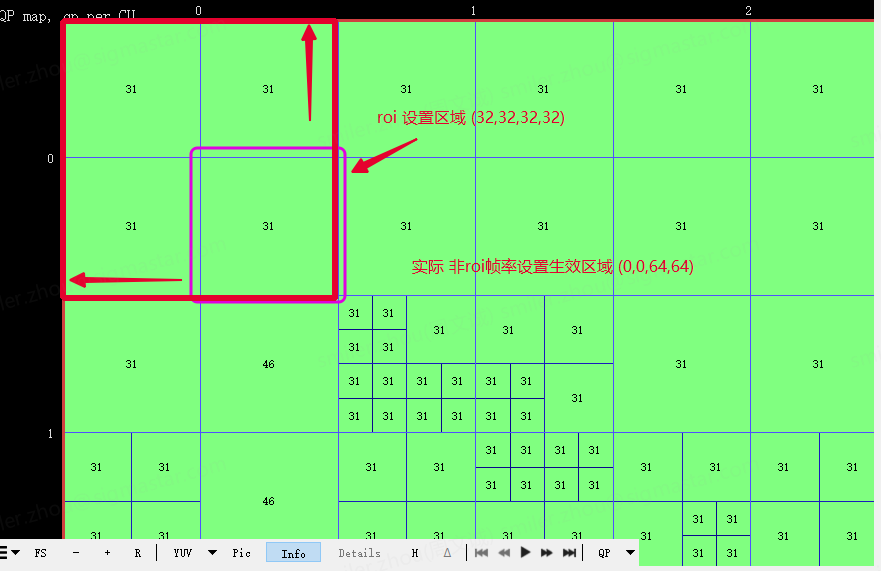
For example, if the parameter is set to (32,32,64,64), the actual area is (0,0,128,128) after the internal alignment is automatic.
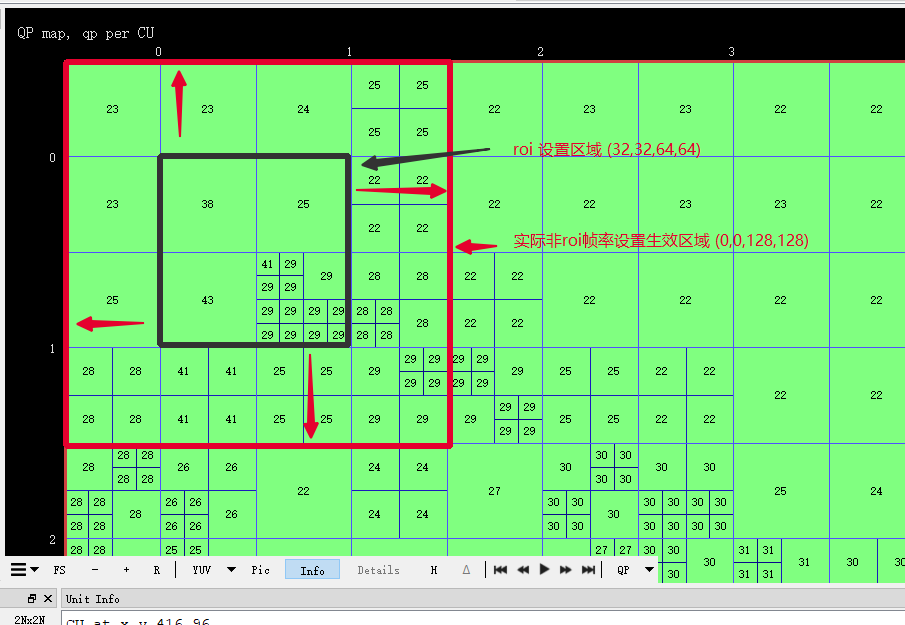
-
-
Related data types and interfaces
3.47. MI_VENC_RoiBgFrameRate_t
-
Description
Define the frame rate of the non-coded region of interest.
-
Definition
typedef struct MI_VENC_RoiBgFrameRate_s { MI_S32 s32SrcFrmRate; MI_S32 s32DstFrmRate; }MI_VENC_RoiBgFrameRate_t; -
Member
Member Name Description s32SrcFrmRate Source frame rate for non-ROI regions. s32DstFrmRate The target frame rate of the non-ROI area. -
Related data types and interfaces
3.48. MI_VENC_ParamRef_t
-
Description
Define advanced frame skipping reference parameters for H.264/H.265 encoding.
-
Definition
typedef struct MI_VENC_ParamRef_s { MI_U32 u32Base; MI_U32 u32Enhance; MI_BOOL bEnablePred; }MI_VENC_ParamRef_t; -
Member
Member Name Description u32Base The period of the base layer.Value range: (0, +∞ ). u32Enhance The period of the enhance layer.Value range: [0, 255]. bEnablePred Whether the frame representing the base layer is used as a reference by other frames in the base layer. When When MI_FALSE, all frames of the base layer refer to the IDR frame. -
Note
- Note the alignment of parameters when setting the frame rate in the non-ROI region in H.265 encoding mode. For details, see MI_VENC_RoiCfg_t.
-
Related data types and interfaces
3.49. MI_VENC_RcAttr_t
-
Description
Define the encoding channel rate controller attribute.
-
Definition
typedef struct MI_VENC_RcAttr_s { MI_VENC_RcMode_e eRcMode; union { MI_VENC_AttrH264Cbr_t stAttrH264Cbr; MI_VENC_AttrH264Vbr_t stAttrH264Vbr; MI_VENC_AttrH264FixQp_t stAttrH264FixQp; MI_VENC_AttrH264Abr_t stAttrH264Abr; MI_VENC_AttrH264Avbr_t stAttrH264Avbr; MI_VENC_AttrH264Ubr_t stAttrH264Ubr; MI_VENC_AttrMjpegCbr_t stAttrMjpegCbr; MI_VENC_AttrMjpegVbr_t stAttrMjpegVbr; MI_VENC_AttrMjpegFixQp_t stAttrMjpegFixQp; MI_VENC_AttrH265Cbr_t stAttrH265Cbr; MI_VENC_AttrH265Vbr_t stAttrH265Vbr; MI_VENC_AttrH265FixQp_t stAttrH265FixQp; MI_VENC_AttrH265Avbr_t stAttrH265Avbr; MI_VENC_AttrH265Ubr_t stAttrH265Ubr; }; MI_VOID* pRcAttr; }MI_VENC_RcAttr_t; -
Member
Member Name Description enRcMode RC mode. stAttrH264Cbr H.264 protocol encoding channel Cbr mode attribute. stAttrH264Vbr H.264 protocol encoding channel Vbr mode attribute. stAttrH264FixQp H.264 protocol encoding channel Fixqp mode attribute. stAttrH264Abr H.264 protocol encoding channel Abr mode attribute (not supported at this time). stAttrH264Avbr H.264 protocol encoding channel Avbr mode attribute. stAttrH264Ubr H.264 protocol encoding channel UBR mode attribute. stAttrMjpegCbr MJPEG protocol encoding channel Cbr mode attribute. stAttrMjpegVbr MJPEG protocol encoding channel Vbr mode attribute. stAttrMjpegFixQp MJPEG protocol encoding channel FixQp mode attribute. stAttrH265Cbr H.265 protocol encoding channel Cbr mode attribute. stAttrH265Vbr H.265 protocol encoding channel Vbr mode attribute. stAttrH265FixQp H.265 protocol encoding channel Fixqp mode attribute. stAttrH265Avbr H.265 protocol encoding channel Avbr mode attribute. stAttrH265Ubr H.265 protocol encoding channel UBR mode attribute. -
Related data types and interfaces
3.50. MI_VENC_RcMode_e
-
Description
Define the code channel rate controller mode.
-
Definition
typedef enum { E_MI_VENC_RC_MODE_H264CBR = 1, E_MI_VENC_RC_MODE_H264VBR, E_MI_VENC_RC_MODE_H264ABR, E_MI_VENC_RC_MODE_H264UBR, E_MI_VENC_RC_MODE_H264FIXQP, E_MI_VENC_RC_MODE_H264AVBR, E_MI_VENC_RC_MODE_MJPEGCBR, E_MI_VENC_RC_MODE_MJPEGVBR, E_MI_VENC_RC_MODE_MJPEGFIXQP, E_MI_VENC_RC_MODE_H265CBR, E_MI_VENC_RC_MODE_H265VBR, E_MI_VENC_RC_MODE_H265UBR, E_MI_VENC_RC_MODE_H265FIXQP, E_MI_VENC_RC_MODE_H265AVBR, E_MI_VENC_RC_MODE_MAX, }MI_VENC_RcMode_e; -
Member
Member Name Description E_MI_VENC_RC_MODE_H264CBR H.264 CBR mode. E_MI_VENC_RC_MODE_H264VBR H.264 VBR mode. E_MI_VENC_RC_MODE_H264ABR H.264 ABR mode (not available at the moment) E_MI_VENC_RC_MODE_H264FIXQP H.264 FixQp mode. E_MI_VENC_RC_MODE_H264AVBR H.264 AVBR mode E_MI_VENC_RC_MODE_MJPEGCBR MJPEG CBR mode E_MI_VENC_RC_MODE_MJPEGVBR MJPEG VBR mode E_MI_VENC_RC_MODE_MJPEGFIXQP MJPEG FixQp mode E_MI_VENC_RC_MODE_H265CBR H.265 CBR mode. E_MI_VENC_RC_MODE_H265VBR H.265 VBR mode. E_MI_VENC_RC_MODE_H265FIXQP H.265 FixQp mode E_MI_VENC_RC_MODE_H265AVBR H.265 AVBR mode -
Related data types and interfaces
3.51. MI_VENC_AttrH264Cbr_t
-
Description
Define the CBR attribute structure of the H.264 encoding channel.
-
Definition
typedef struct MI_VENC_AttrH264Cbr_s { MI_U32 u32Gop; MI_U32 u32StatTime; MI_U32 u32SrcFrmRateNum; MI_U32 u32SrcFrmRateDen; MI_U32 u32BitRate; MI_U32 u32FluctuateLevel; }MI_VENC_AttrH264Cbr_t; -
Member
Member Name Description u32Gop H.264 gop value. Value range: [1, 65536]. u32StatTime CBR code rate statistics time in seconds. Value range: [1, 60]. Not supported at the moment. u32SrcFrmRateNum The encoder frame rate molecule, in integer units. u32SrcFrmRateDen Encoder frame rate denominator, in integer units. u32BitRate Average bitrate in bps. Value range: [2000, 102400000]. u32FluctuateLevel The maximum code rate relative to the average bit rate fluctuation level. A volatility level of 0 is recommended. Not supported at the moment. -
Note
Src F rmRate should be set to the actual frame rate of the input encoder, and RC needs to be rate controlled according to SrcFrmRate.u32SrcFrmRateNum / u32SrcFrmRateDen range between (0, 65535].
-
Related data types and interfaces
3.52. MI_VENC_AttrH264Vbr_t
-
Description
Define the VBR attribute structure of the H.264 encoding channel.
-
Definition
typedef struct MI_VENC_AttrH264Vbr_s { MI_U32 u32Gop; MI_U32 u32StatTime; MI_U32 u32SrcFrmRateNum; MI_U32 u32SrcFrmRateDen; MI_U32 u32MaxBitRate; MI_U32 u32MaxQp; MI_U32 u32MinQp; }MI_VENC_AttrH264Vbr_t; -
Member
Member Name Description u32Gop H.264 gop value. Value range: [1, 65535]. u32StatTime VBR code rate statistics time in seconds. Value range: [1, 60]. Not supported at the moment. u32SrcFrmRateNum Encoder frame rate numerator, in integer units. u32SrcFrmRateDen Encoder denominator framerate, in units of integers. u32MaxBitRate The encoder outputs the maximum code rate in bps. Value range: [2000,102400000]. u32MaxQp The encoder supports image maximum QP. Value range: (u32MinQp, 48]. u32MinQp The encoder supports image minimum QP. Value range: [12, u32MaxQp). -
Note
See MI_VENC_AttrH264Cbr_t for a Description of u32SrcFrmRateNum and u32SrcFrmRateDen.
-
Related data types and interfaces
3.53. MI_VENC_AttrH264FixQp_t
-
Description
Define the Fixqp attribute structure of the H.264 encoding channel.
-
Definition
typedef struct MI_VENC_AttrH264FixQp_s { MI_U32 u32Gop; MI_U32 u32SrcFrmRateNum; MI_U32 u32SrcFrmRateDen; MI_U32 u32IQp; MI_U32 u32PQp; }MI_VENC_AttrH264FixQp_t; -
Member
Member Name Description u32Gop H.264gop value. Value range: [1, 65535]. u32SrcFrmRateNum Encoder frame rate numerator, in integer units. u32SrcFrmRateDen Encoder denominator framerate, in units of integers. u32IQp I frame all macroblock Qp values. Value range: [12, 48]. u32PQp P frame all macroblock Qp values. Value range: [12, 48]. -
Note
See MI_VENC_AttrH264Cbr_t for a Description of u32SrcFrmRateNum and u32SrcFrmRateDen.
-
Related data types and interfaces
3.54. MI_VENC_AttrH264Abr_t
-
Description
Define the ABR attribute structure of the H.264 encoding channel.
-
Definition
typedef struct MI_VENC_AttrH264Abr_s { MI_U32 u32Gop; MI_U32 u32StatTime; MI_U32 u32SrcFrmRateNum; MI_U32 u32SrcFrmRateDen; MI_U32 u32AvgBitRate; MI_U32 u32MaxBitRate; }MI_VENC_AttrH264Abr_t; -
Member
Member Name Description u32Gop H.264 gop value. Value range: [1, 65535] u32StatTime ABR code rate statistics time in seconds. Value range: [1, 60]. Not supported at the moment. u32SrcFrmRateNum Encoder frame rate numerator, in integer units. u32SrcFrmRateDen Encoder denominator framerate, in units of integers. u32AvgBitRate Average code rate in bps. Value range [2000, u32MaxBitRate) u32MaxBitRate Maximum code rate. Value range [2000,102400000] -
Note
See MI_VENC_AttrH264Cbr_t for a Description of u32SrcFrmRateNum and u32SrcFrmRateDen.
-
Related data types and interfaces
3.55. MI_VENC_AttrH264Avbr_t
-
Description
Define the AVBR attribute structure of the H.264 encoding channel.
-
Definition
typedef struct MI_VENC_AttrH264Avbr_s { MI_U32 u32Gop; MI_U32 u32StatTime; MI_U32 u32SrcFrmRateNum; MI_U32 u32SrcFrmRateDen; MI_U32 u32MaxBitRate; MI_U32 u32MaxQp; MI_U32 u32MinQp; } MI_VENC_AttrH264Avbr_t; -
Member
Member Name Description u32Gop gop value. Value range: [1, 65535]. u32StatTime Encode rate statistics time in seconds. Value range: [1, 60]. u32SrcFrmRateNum Encoder frame rate numerator, in integer units. u32SrcFrmRateDen Encoder denominator framerate, in units of integers. u32MaxBitRate The encoder outputs the maximum code rate in bps. Value range: [2000, 102400000]. u32MaxQp The encoder supports image maximum QP. Value range: (u32MinQp, 48]. u32MinQp The encoder supports image minimum QP. Value range: [12, u32MaxQp). -
Note
See MI_VENC_AttrH264Cbr_t for a Description of u32SrcFrmRateNum and u32SrcFrmRateDen.
-
Related data types and interfaces
3.56. MI_VENC_AttrMjpegCbr_t
-
Description
Define the CBR attribute structure of the MJPEG encoding channel.
-
Definition
typedef struct MI_VENC_AttrMjpegCbr_s { MI_U32 u32BitRate; MI_U32 u32SrcFrmRateNum; MI_U32 u32SrcFrmRateDen; } MI_VENC_AttrMjpegCbr_t; -
Member
Member Name Description u32BitRate Stream bit rate in bps. Value range: [2000,102400000] u32SrcFrmRateNum Encoder frame rate numerator, in integer units. u32SrcFrmRateDen Encoder denominator framerate, in units of integers. -
Note
See MI_VENC_AttrH264Cbr_t for a Description of u32SrcFrmRateNum and u32SrcFrmRateDen.
-
Related data types and interfaces
3.57. MI_VENC_AttrMjpegFixQp_t
-
Description
Define the CBR attribute structure of the MJPEG encoding channel.
-
Definition
typedef struct MI_VENC_AttrMjpegFixQp_s { MI_U32 u32SrcFrmRateNum; MI_U32 u32SrcFrmRateDen; MI_U32 u32Qfactor; } MI_VENC_AttrMjpegFixQp_t; -
Member
Member Name Description u32Qfactor Qfactor. Value range: [1,90] u32SrcFrmRateNum Encoder frame rate numerator, in integer units. u32SrcFrmRateDen Encoder denominator framerate, in units of integers. -
Note
See MI_VENC_AttrH264Cbr_t for a Description of u32SrcFrmRateNum and u32SrcFrmRateDen.
-
Related data types and interfaces
3.58. MI_VENC_AttrH265Cbr_t
-
Description
Define the HBR 265 code channel CBR attribute structure.
-
Definition
typedef struct MI_VENC_AttrH265Cbr_s { MI_U32 u32Gop; MI_U32 u32StatTime; MI_U32 u32SrcFrmRateNum; MI_U32 u32SrcFrmRateDen; MI_U32 u32BitRate; MI_U32 u32FluctuateLevel; }MI_VENC_AttrH265Cbr_t; -
Member
Member Name Description u32Gop H.265 gop value. Value range: [1, 65535]. u32StatTime CBR code rate statistics time in seconds. Value range: [1, 60]. u32SrcFrmRateNum Encoder frame rate numerator, in integer units. u32SrcFrmRateDen Encoder denominator framerate, in units of integers. u32BitRate Average bitrate in bps. Value range: [2000, 102400000]. u32FluctuateLevel The maximum code rate relative to the average bit rate fluctuation level. A volatility level of 0 is recommended. Not supported at the moment. -
Note
See MI_VENC_AttrH264Cbr_t for a Description of u32SrcFrmRateNum and u32SrcFrmRateDen.
-
Related data types and interfaces
3.59. MI_VENC_AttrH265Vbr_t
-
Description
Define the HBR attribute channel VBR attribute structure.
-
Definition
typedef struct MI_VENC_AttrH265Vbr_s { MI_U32 u32Gop; MI_U32 u32StatTime; MI_U32 u32SrcFrmRateNum; MI_U32 u32SrcFrmRateDen; MI_U32 u32MaxBitRate; MI_U32 u32MaxQp; MI_U32 u32MinQp; }MI_VENC_AttrH265Vbr_t; -
Member
Member Name Description u32Gop H.265gop value. Value range: [1,65535] u32StatTime VBR code rate statistics time in seconds. Value range: [1, 60]. u32SrcFrmRateNum Encoder frame rate numerator, in integer units. u32SrcFrmRateDen Encoder denominator frame rate, in units of integers. u32MaxBitRate The encoder outputs the maximum code rate in bps. Value range: [2000, 102400000]. u32MaxQp The encoder supports image maximum QP. Value range: (u32MinQp, 48]. u32MinQp The encoder supports image minimum QP. Value range: [12, u32MaxQp). -
Note
See MI_VENC_AttrH264Cbr_t for a Description of u32SrcFrmRateNum and u32SrcFrmRateDen.
-
Related data types and interfaces
3.60. MI_VENC_AttrH265FixQp_t
-
Description
Define the H.265 encoding channel Fixqp attribute structure.
-
Definition
typedef struct MI_VENC_AttrH265FixQp_s { MI_U32 u32Gop; MI_U32 u32SrcFrmRateNum; MI_U32 u32SrcFrmRateDen; MI_U32 u32IQp; MI_U32 u32PQp; }MI_VENC_AttrH265FixQp_t; -
Member
Member Name Description u32Gop H.265 gop value. Value range: [1, 65535]. u32SrcFrmRateNum Encoder frame rate numerator, in integer units. u32SrcFrmRateDen Encoder frame rate denominator, in integer units. u32IQp I frame all macroblock Qp values. Value range: [12, 48]. u32PQp P frame all macroblock Qp values. Value range: [12, 48]. -
Note
See MI_VENC_AttrH264Cbr_t for a Description of u32SrcFrmRateNum and u32SrcFrmRateDen.
-
Related data types and interfaces
3.61. MI_VENC_AttrH265Avbr_t
-
Description
Define the AVBR attribute structure of the H.265 encoding channel.
-
Definition
typedef struct MI_VENC_AttrH265Avbr_s { MI_U32 u32Gop; MI_U32 u32StatTime; MI_U32 u32SrcFrmRateNum; MI_U32 u32SrcFrmRateDen; MI_U32 u32MaxBitRate; MI_U32 u32MaxQp; MI_U32 u32MinQp; } MI_VENC_AttrH265Avbr_t; -
Member
Member Name Description u32Gop gop value. Value range: [1, 65536]. u32StatTime Encode rate statistics time in seconds. Value range: [1, 60]. Not supported at the moment. u32SrcFrmRateNum Encoder frame rate numerator, in integer units. u32SrcFrmRateDen Encoder denominator framerate, in units of integers. u32MaxBitRate The encoder outputs the maximum code rate in bps. Value range: [2000, 102400000]. u32MaxQp The encoder supports image maximum QP. Value range: (u32MinQp, 48]. u32MinQp The encoder supports image minimum QP. Value range: [12, u32MaxQp). -
Note
See MI_VENC_AttrH264Cbr_t for a Description of u32SrcFrmRateNum and u32SrcFrmRateDen.
-
Related data types and interfaces
3.62. MI_VENC_SuperFrmMode_e
-
Description
Define the superframe processing mode in rate control.
-
Definition
typedef enum { E_MI_VENC_SUPERFRM_NONE, E_MI_VENC_SUPERFRM_DISCARD, E_MI_VENC_SUPERFRM_REENCODE, E_MI_VENC_SUPERFRM_MAX }MI_VENC_SuperFrmMode_e; -
Member
Member Name Description E_MI_VENC_SUPERFRM_NONE No special strategy. E_MI_VENC_SUPERFRM_DISCARD Discard jumbo frames. E_MI_VENC_SUPERFRM_REENCODE Reprogram oversized frames. -
Related data types and interfaces
3.63. MI_VENC_ParamH264Vbr_t
-
Description
Define the H264 protocol encoding channel VBR rate control mode advanced parameter configuration.
-
Definition
typedef struct MI_VENC_ParamH264Vbr_s { MI_S32 s32IPQPDelta; MI_S32 s32ChangePos; MI_U32 u32MaxIQp; MI_U32 u32MinIQP; MI_U32 u32MaxIPProp; MI_U32 u32MaxISize; MI_U32 u32MaxPSize; }MI_VENC_ParamH264Vbr_t; -
Member
Member Name Description s32IPQPDelta IPQP change value. Value range: [ -12, 12 ]. s32ChangePos The ratio of the code rate at the time when VBR starts to adjust Qp to the maximum code rate. Value range: [50,100]. u32MaxIQp The maximum QP of the I frame. The minimum number of bits used to control the I frame. Value range: (MinQp, MaxQp]. u32MinIQP The minimum QP of the I frame. The maximum number of bits used to control the I frame. Value range: [MinQp, MaxQp). u32MaxIPProp Maximum ratio of I/P frame size, range of value [5,100]. u32MaxISize The maximum size of the I frame. Rate control will try to let the target size not exceed the max size. If value is 0, it means that rate control will not consider the parameter. Value range:[0, 0xFFFFFFFF] default value:0 u32MaxPSize The maximum size of the P frame. Rate control will try to let the target size not exceed the max size. If value is 0, it means that rate control will not consider the parameter. Value range:[0, 0xFFFFFFFF] default value:0 -
Related data types and interfaces
3.64. MI_VENC_ParamH264Cbr_t
-
Description
Define the CBR rate control mode advanced parameter configuration of the H264 protocol encoding channel.
-
Definition
typedef struct MI_VENC_ParamH264Cbr_s { MI_U32 u32MaxQp; MI_U32 u32MinQp; MI_S32 s32IPQPDelta; MI_U32 u32MaxIQp; MI_U32 u32MinIQp; MI_U32 u32MaxIPProp; MI_U32 u32MaxISize; MI_U32 u32MaxPSize }MI_VENC_ParamH264Cbr_t; -
Member
Member Name Description u32MaxQp Frame maximum QP for clamp quality. Value range: (u32MinQp, 48]. u32MinQp Frame minimum QP for clamp rate fluctuations. Value range: [12, u32MaxQp). s32IPQPDelta IPQP change value. Value range: [-12,12 ]. u32MaxIQp The maximum QP of the I frame. The minimum number of bits used to control the I frame. Value range: [u32MinIQp, 48 ]. u32MinIQp The minimum QP of the I frame. The maximum number of bits used to control the I frame. Value range: [12, u32MaxIQp). u32MaxIPProp Maximum ratio of I/P frame size, Value range: [5,100]. u32MaxISize The maximum size of the I frame. Rate control will try to let the target size not exceed the max size. If value is 0, it means that rate control will not consider the parameter. Value range:[0, 0xFFFFFFFF] default value:0 u32MaxPSize The maximum size of the P frame. Rate control will try to let the target size not exceed the max size. If value is 0, it means that rate control will not consider the parameter. Value range:[0, 0xFFFFFFFF] default value:0 -
Related data types and interfaces
3.65. MI_VENC_ParamH264Avbr_t
-
Description
Define the H264 protocol encoding channel AVBR rate control mode advanced parameter configuration.
-
Definition
typedef struct MI_VENC_ParamH264Avbr_s { MI_S32 s32IPQPDelta; MI_S32 s32ChangePos; MI_U32 u32MinIQp; MI_U32 u32MaxIPProp; MI_U32 u32MaxIQp; MI_U32 u32MaxISize; MI_U32 u32MaxPSize; MI_U32 u32MinStillPercent; MI_U32 u32MaxStillQp; MI_U32 u32MotionSensitivity; } MI_VENC_ParamH264Avbr_t; -
Member
Member Name Description s32IPQPDelta IPQP change value. Value range: [ -12, 12 ]. default value:0 s32ChangePos The ratio of the code rate at the time when VBR starts to adjust Qp to the maximum code rate. Value range: [50,100]. default value:80 u32MinIQP The minimum QP of the I frame. The maximum number of bits used to control the I frame. Value range: [MinQp, MaxQp). default value:12 u32MaxIPProp Maximum ratio of I/P frame size, Value range: [5,100]. default value:0 u32MaxIQp The maximum QP of the I frame. The minimum number of bits used to control the I frame. Value range: (MinQp, MaxQp]. default value:48 u32MaxISize The maximum size of the I frame. Rate control will try to let the target size not exceed the max size. If value is 0, it means that rate control will not consider the parameter. Value range:[0, 0xFFFFFFFF] default value:0 u32MaxPSize The maximum size of the P frame. Rate control will try to let the target size not exceed the max size. If value is 0, it means that rate control will not consider the parameter. Value range:[0, 0xFFFFFFFF] default value:0 u32MinStillPercent The minimum percent of target bitrate in still state. If the value set to 100,then AVBR will not actively decrease target rate in still state, so the behavior of AVBR will be same with VBR. Value range:[5,100] u32MaxStillQp The maximum QP of the I frame in still state. Value range:[MinIQp, MaxIQp] Not supported yet. u32MotionSensitivity The sensitivity of adjusting bitrate depending on the motion of picture. Value range: [0,100]. Default value: 100. -
Related data types and interfaces
3.66. MI_VENC_ParamMjpegCbr_t
-
Description
Define the MJPEG protocol encoding channel CBR new version rate control mode advanced parameter configuration.
-
Definition
typedef struct MI_VENC_ParamMjpegCbr_s { MI_U32 u32MaxQfactor; MI_U32 u32MinQfactor; } MI_VENC_ParamMjpegCbr_t; -
Member
Member Name Description u32MaxQfactor Maximum Qfactor for clamp quality. Value range: (u32MinQfactor, 90]. u32MinQfactor Minimum Qfactor for clamp quality. Value range: [1, u32MaxQfactor). -
Related data types and interfaces
3.67. MI_VENC_ParamH265Vbr_t
-
Description
Define the advanced parameter configuration of the VBR rate control mode of the H265 protocol code channel.
-
Definition
typedef struct MI_VENC_ParamH265Vbr_s { MI_S32 s32IPQPDelta; MI_S32 s32ChangePos; MI_U32 u32MaxIQp; MI_U32 u32MinIQP; MI_U32 u32MaxIPProp; MI_U32 u32MaxISize; MI_U32 u32MaxPSize; }MI_VENC_ParamH265Vbr_t; -
Member
Member Name Description s32IPQPDelta IPQP change value. Value range: [-12, 12]. s32ChangePos The ratio of the code rate at the time when VBR starts to adjust Qp to the maximum code rate. Value range: [50,100]. u32MaxIQp The maximum QP of the I frame. The minimum number of bits used to control the I frame. Value range: (MinQp, MaxQp]. u32MinIQP The minimum QP of the I frame. The maximum number of bits used to control the I frame. Value range: [MinQp, MaxQp). u32MaxIPProp Maximum ratio of I/P frame size, Value range: [5,100]. u32MaxISize The maximum size of the I frame. Rate control will try to let the target size not exceed the max size. If value is 0, it means that rate control will not consider the parameter. Value range:[0, 0xFFFFFFFF] default value:0 u32MaxPSize The maximum size of the P frame. Rate control will try to let the target size not exceed the max size. If value is 0, it means that rate control will not consider the parameter. Value range:[0, 0xFFFFFFFF] default value:0 -
Related data types and interfaces
3.68. MI_VENC_ParamH265Cbr_t
-
Description
Define the H265 protocol encoding channel CBR new version rate control mode advanced parameter configuration.
-
Definition
typedef struct MI_VENC_ParamH265Cbr_s { MI_U32 u32MaxQp; MI_U32 u32MinQp; MI_S32 s32IPQPDelta; MI_U32 u32MaxIQp; MI_U32 u32MinIQp; MI_U32 u32MaxIPProp; MI_U32 u32MaxISize; MI_U32 u32MaxPSize; }MI_VENC_ParamH265Cbr_t; -
Member
Member Name Description u32MaxQp Frame maximum QP for clamp quality. Value range: (u32MinQp, 48]. u32MinQp Frame minimum QP for clamp rate fluctuations. Value range: [12, u32MaxQp). s32IPQPDelta IPQP change value. Value range: [-12, 12]. u32MaxIQp The maximum QP of the I frame. The minimum number of bits used to control the I frame. Value range: [u32MinIQp, u32MaxQp). u32MinIQp The minimum QP of the I frame. The maximum number of bits used to control the I frame. Value range: [u32MinQp, u32MaxIQp). u32MaxIPProp Maximum ratio of I/P frame size, Value range: [5,100]. u32MaxISize The maximum size of the I frame. Rate control will try to let the target size not exceed the max size. If value is 0, it means that rate control will not consider the parameter. Value range:[0, 0xFFFFFFFF] default value:0 u32MaxPSize The maximum size of the P frame. Rate control will try to let the target size not exceed the max size. If value is 0, it means that rate control will not consider the parameter. Value range:[0, 0xFFFFFFFF] default value:0 -
Related data types and interfaces
3.69. MI_VENC_ParamH265Avbr_t
-
Description
Define the H265 protocol encoding channel AVBR rate control mode advanced parameter configuration.
-
Definition
typedef struct MI_VENC_ParamH265Avbr_s { MI_S32 s32IPQPDelta; MI_S32 s32ChangePos; MI_U32 u32MinIQp; MI_U32 u32MaxIPProp; MI_U32 u32MaxIQp; MI_U32 u32MaxISize; MI_U32 u32MaxPSize; MI_U32 u32MinStillPercent; MI_U32 u32MaxStillQp; MI_U32 u32MotionSensitivity; } MI_VENC_ParamH265Avbr_t; -
Member
Member Name Description s32IPQPDelta IPQP change value. Value range: [ -12, 12 ]. default value:0 s32ChangePos The ratio of the code rate at the time when AVBR starts to adjust Qp to the maximum code rate. Value range: [50,100]. default value:80 u32MinIQP The minimum QP of the I frame. The maximum number of bits used to control the I frame. Value range: [MinQp, MaxQp). default value:12 u32MaxIPProp Maximum ratio of I/P frame size, Value range: [5,100]. default value:0 u32MaxIQp The maximum QP of the I frame. The minimum number of bits used to control the I frame. Value range: (MinQp, MaxQp]. default value:48 u32MaxISize The maximum size of the I frame. Rate control will try to let the target size not exceed the max size. If value is 0, it means that rate control will not consider the parameter. Value range:[0, 0xFFFFFFFF] default value:0 u32MaxPSize The maximum size of the P frame. Rate control will try to let the target size not exceed the max size. If value is 0, it means that rate control will not consider the parameter. Value range:[0, 0xFFFFFFFF] default value:0 u32MinStillPercent The minimum percent of target bitrate in still state. If the value set to 100,then AVBR will not actively decrease target rate in still state, so the behavior of AVBR will be same with VBR. Value range:[5,100] u32MaxStillQp The maximum QP of the I frame in still state. Value range:[MinIQp, MaxIQp] Not supported yet. u32MotionSensitivity The sensitivity of adjusting bitrate depending on the motion of picture. Value range: [0,100] Default value: 100. -
Related data types and interfaces
3.70. MI_VENC_RcParam_t
-
Description
Define the rate control advanced parameters of the code channel.
-
Definition
typedef struct MI_VENC_RcParam_s { MI_U32 au32ThrdI[RC_TEXTURE_THR_SIZE]; MI_U32 au32ThrdP[RC_TEXTURE_THR_SIZE]; MI_U32 u32RowQpDelta; union { MI_VENC_ParamH264Cbr_t stParamH264Cbr; MI_VENC_ParamH264Vbr_t stParamH264VBR; MI_VENC_ParamH264Avbr_t stParamH264Avbr; MI_VENC_ParamMjpegCbr_t stParamMjpegCbr; MI_VENC_ParamMjpegVbr_t stParamMjpegVbr; MI_VENC_ParamH265Cbr_t stParamH265Cbr; MI_VENC_ParamH265Vbr_t stParamH265Vbr; MI_VENC_ParamH265Avbr_t stParamH265Avbr; }; MI_VOID*pRcParam; }MI_VENC_RcParam_t; -
Member
Member Name Description au32ThrdI The mad threshold of the I frame macroblock level code rate control. Value range: [0, 255]. Not supported yet. au32ThrdP The mad threshold of the P frame macroblock level rate control. Value range: [0, 255]. Not supported yet. u32RowQpDelta Row level rate control. Value range: [0,10]. Not supported yet. stParamH264Cbr H.264 channel CBR (ConstantBitRate) rate control mode advanced parameters. stParamH264Vbr H.264 channel VBR (VariableBitRate) rate control mode advanced parameters. stParamH264Avbr H.264 channel AVBR (AdaptiveVariableBitRate) rate control mode advanced parameters. stParamMjpegCbr JPEG channel CBR (ConstantBitRate) rate control mode advanced parameters. stParamMjpegVbr JPEG channel VBR (VariableBitRate) rate control mode advanced parameters. stParamH265Cbr H.265 channel CBR (ConstantBitRate) rate control mode advanced parameters. stParamH265Vbr H.265 channel VBR (VariableBitRate) rate control mode advanced parameters. stParamH265Avbr H.265 channel AVBR (AdaptiveVariableBitRate) rate control mode advanced parameters. pRcParam The parameters are reserved and are not currently used. -
Related data types and interfaces
3.71. MI_VENC_CropCfg_t
-
Description
Define the channel crop parameter.
-
Definition
typedef struct MI_VENC_CropCfg_s { MI_BOOL bEnable; /* Crop region enable */ MI_VENC_Rect_t stRect; /* Crop region, note: s32X must be multi of 16 */ } MI_VENC_CropCfg_t; -
Member
Member Name Description bEnable Whether to cut. MI_TRUE: Enable cropping. MI_FALSE: Cropping is not enabled. stRect Cropped area. stRect.s32X: H.264 must be 16 pixels aligned and H.265 must be 32 pixels aligned. stRect.s32Y: H.264/H.265 must be 2 pixels aligned. stRect.u32Width, s32Rect.u32Height: H.264 must be 16 pixels aligned, H.265 must be 32 pixels aligned. -
Related data types and interfaces
3.72. MI_VENC_RecvPicParam_t
-
Description
Receives the specified frame number image encoding.
-
Definition
typedef struct MI_VENC_RecvPicParam_s { MI_S32 s32RecvPicNum; }MI_VENC_RecvPicParam_t; -
Member
Member Name Description s32RecvPicNum The number of frames that the encoding channel continuously receives and encodes. -
Related data types and interfaces
3.73. MI_VENC_H264eIdrPicIdMode_e
-
Description
Set the mode of the IDR frame or the idr_pic_id of the I frame.
-
Definition
typedef enum { E_MI_VENC_H264E_IDR_PIC_ID_MODE_USR, }MI_VENC_H264eIdrPicIdMode_e; -
Member
Member Name Description E_MI_VENC_H264E_IDR_PIC_ID_MODE_USR User mode; ie idr_pic_id is set by the user. -
Related data types and interfaces
3.74. MI_VENC_H264IdrPicIdCfg_t
-
Description
The idr_pic_id parameter of the IDR frame or I frame.
-
Definition
typedef struct MI_VENC_H264IdrPicIdCfg_s { MI_VENC_H264eIdrPicIdMode_e eH264eIdrPicIdMode; MI_U32 u32H264eIdrPicId; }MI_VENC_H264IdrPicIdCfg_t; -
Member
Member Name Description enH264eIdrPicIdMode Set the mode of idr_pic_id. u32H264eIdrPicId The value of idr_pic_id. The value range is: [0,65535]. -
Related data types and interfaces
3.75. MI_VENC_FrameLostMode_e
-
Description
Drop frame mode when the instantaneous code rate exceeds the threshold.
-
Definition
typedef enum { E_MI_VENC_FRMLOST_NORMAL, E_MI_VENC_FRMLOST_PSKIP, E_MI_VENC_FRMLOST_MAX, }MI_VENC_FrameLostMode_e; -
Member
Member Name Description E_MI_VENC_FRMLOST_NORMAL Normal frame loss when the instantaneous code rate exceeds the threshold. E_MI_VENC_FRMLOST_PSKIP The pskip frame is encoded when the instantaneous code rate exceeds the threshold. -
Related data types and interfaces
3.76. MI_VENC_ParamFrameLost_t
-
Description
The frame loss policy parameter when the instantaneous code rate exceeds the threshold.
-
Definition
typedef struct MI_VENC_ParamFrameLost_s { MI_BOOL bFrmLostOpen; MI_U32 u32FrmLostBpsThr; MI_VENC_FrameLostMode_e eFrmLostMode; MI_U32 u32EncFrmGaps; } MI_VENC_ParamFrameLost_t; -
Member
Member Name Description bFrmLostOpen The frame loss switch when the instantaneous code rate exceeds the threshold. u32FrmLostBpsThr Drop frame threshold. (in bits/s) enFrmLostMode Frame loss mode when the instantaneous code rate exceeds the threshold. u32EncFrmGaps Frame loss interval, the default is 0.Value range: [0,65535] -
Related data types and interfaces
3.77. MI_VENC_SuperFrameCfg_t
-
Description
Very large frame processing strategy parameters.
-
Definition
typedef struct MI_VENC_SuperFrameCfg_s { MI_VENC_SuperFrmMode_e eSuperFrmMode; MI_U32 u32SuperIFrmBitsThr; MI_U32 u32SuperPFrmBitsThr; MI_U32 u32SuperBFrmBitsThr; }MI_VENC_SuperFrameCfg_t; -
Member
Member Name Description eSuperFrmMode Large frame processing mode. u32SuperIFrmBitsThr The I frame has a large threshold and defaults to 0. Value range: greater than or equal to 0. (unit: bits) u32SuperPFrmBitsThr The P frame has a large threshold and defaults to 0. Value range: greater than or equal to 0. (unit: bits) u32SuperBFrmBitsThr The B frame has a large threshold and defaults to 0. Value range: greater than or equal to 0. (unit: bits) -
Note
If the threshold is set to 0, the corresponding setting will not take effect. For example, the I frame threshold ≠ 0 and the P frame threshold = 0, then the jumbo frame setting will only take effect for I frame.
-
Related data types and interfaces
3.78. MI_VENC_RcPriority_e
-
Description
Rate control priority enumeration.
-
Definition
typedef enum { E_MI_VENC_RC_PRIORITY_BITRATE_FIRST=1, E_MI_VENC_RC_PRIORITY_FRAMEBITS_FIRST, E_MI_VENC_RC_PRIORITY_MAX, }MI_VENC_RcPriority_e; -
Member
Member Name Description E_MI_VENC_RC_PRIORITY_BITRATE_FIRST The target bit rate is prioritized. E_MI_VENC_RC_PRIORITY_FRAMEBITS_FIRST The oversized frame threshold is prioritized.
3.79. MI_VENC_ModParam_t
-
Description
Encode related module parameters.
-
Definition
typedef struct MI_VENC_ModParam_s { MI_VENC_ModType_e eVencModType; union { //MI_VENC_ParamModVenc_t stVencModParam; //not defined yet //MI_VENC_ParamModH264e_t stH264eModParam; //not defined yet MI_VENC_ParamModH265e_t stH265eModParam; MI_VENC_ParamModJpege_t stJpegeModParam; }; } MI_VENC_ModParam_t; -
Member
Member Name Description eVencModType Set or get the type of module parameter. stH265eModParam/ stJpegeModParam mi_venc.ko module parameter structure.
3.80. MI_VENC_ModType_e
-
Description
Encoding related module parameter types.
-
Definition
typedef enum { E_MI_VENC_MODTYPE_VENC=1, E_MI_VENC_MODTYPE_H264E, E_MI_VENC_MODTYPE_H265E, E_MI_VENC_MODTYPE_JPEGE, E_MI_VENC_MODTYPE_MAX }MI_VENC_ModType_e; -
Member
Member Name Description E_MI_VENC_MODTYPE_VENC VENC module parameter type, not support. E_MI_VENC_MODTYPE_H264E h264 module parameter type E_MI_VENC_MODTYPE_H265E h265 module parameter type E_MI_VENC_MODTYPE_JPEGE jpeg module parameter type -
Related data types and interfaces
3.81. MI_VENC_ParamModH265e_t
-
Description
mi_h265.ko module parameters.
-
Definition
typedef struct MI_VENC_ParamModH265e_s { MI_U32 u32OneStreamBuffer; MI_U32 u32H265eMiniBufMode; }MI_VENC_ParamModH265e_t; -
Member
Member Name Description u32OneStreamBuffer The u32OneStreamBuffer parameter in the mi_h265.ko module. 0: Multi-package mode 1: single package mode u32H265eMiniBufMode u32H265eMiniBufMode parameter in the mi_h265.ko module. 0: code stream buffer is allocated according to resolution 1: The minimum buffer of the stream buffer is 32k, which is guaranteed by the user. -
Related data types and interfaces
3.82. MI_VENC_ParamModJpege_t
-
Description
Parameters in the mi_jpeg.ko module.
-
Definition
typedef struct MI_VENC_ParamModJpege_s { MI_U32 u32OneStreamBuffer; MI_U32 u32JpegeMiniBufMode; }MI_VENC_ParamModJpege_t; -
Member
Member Name Description u32OneStreamBuffer The u32OneStreamBuffer parameter in the mi_jpeg.ko module. 0: Multi-package mode 1: single package mode u32JpegeMiniBufMode u32JpegeMiniBufMode parameter in the mi_jpeg.ko module. 0: code stream buffer is allocated according to resolution 1: The minimum buffer of the stream buffer is 32k, which is guaranteed by the user. -
Related data types and interfaces
3.83. MI_VENC_AdvCustRcAttr_t
-
Description
Customer defined advanced RC configuration parameters.
-
Definition
typedef struct MI_VENC_AdvCustRcAttr_s { MI_BOOL bEnableQPMap; MI_BOOL bAbsQP; MI_BOOL bEnableModeMap; MI_BOOL bEnabelHistoStaticInfo; }MI_VENC_AdvCustRcAttr_t; -
Member
Member Name Description bEnableQPMap Whether to enable QPMap function. MI_TRUE: ON. MI_FALSE: OFF. bAbsQP Whether to use the absolute QP when QP Map is configured. MI_TRUE: YES. MI_FALSE: NONE. The relative QP value is used. bEnableModeMap Whether to enable ModeMap function. MI_TRUE: ON. MI_FALSE: OFF. bEnabelHistoStaticInfo Whether to enable the lastest information acquisition function of the encoded frame. MI_TRUE: ON. MI_FALSE: OFF. -
Related data types and interfaces
3.84. MI_VENC_FrameHistoStaticInfo_t
-
Description
Attributes of the encoded frame.
-
Definition
typedef struct MI_VENC_FrameHistoStaticInfo_s { MI_U8 u8PicSkip; MI_U16 u16PicType; MI_U32 u32PicPoc; MI_U32 u32PicSliNum; MI_U32 u32PicNumIntra; MI_U32 u32PicNumMerge; MI_U32 u32PicNumSkip; MI_U32 u32PicAvgCtuQp; MI_U32 u32PicByte; MI_U32 u32GopPicIdx; MI_U32 u32PicNum; MI_U32 u32PicDistLow; MI_U32 u32PicDistHigh; } MI_VENC_FrameHistoStaticInfo_t; -
Member
Member Name Description u8PicSkip The frame skip flag. u16PicType Encoded frame type: 0: I 1: P 2: B u32PicPoc A POC value of the currently encoded picture. u32PicSliNum The number of slice segments. u32PicNumIntra The number of intra blocks in the encoded frame (8x8 unit). u32PicNumMerge The number of merge blocks in the encoded frame (8x8 unit). u32PicNumSkip The number of skip blocks in the encoded frame (8x8 unit). u32PicAvgCtuQp An average value of CTU QPs. u32PicByte The size of encoded picture in byte. u32GopPicIdx A picture index in GOP. u32PicNum The encoded picture number. u32PicDistLow Low 32-bit SSD between source Y picture and reconstructed Y picture. u32PicDistHigh Low 32-bit SSD between source Y picture and reconstructed Y picture. -
Related data types and interfaces
3.85. MI_VENC_InputSourceConfig_t
-
Description
Input source config parameters.
-
Definition
typedef struct MI_VENC_InputSourceConfig_s { MI_VENC_InputSrcBufferMode_e eInputSrcBufferMode; } MI_VENC_InputSourceConfig_t; -
Member
Member Name Description eInputSrcBufferMode Input buffer mode -
Related data types and interfaces
3.86. MI_VENC_InputSrcBufferMode_e
-
Description
Define H.264/H.265 input buffer mode enumeration.
-
Definition
typedef enum { E_MI_VENC_INPUT_MODE_NORMAL_FRMBASE = 0, /*Handshake with input by about 3 buffers in frame mode*/ E_MI_VENC_INPUT_MODE_RING_ONE_FRM, /*Handshake with input by one buffer in ring mode*/ E_MI_VENC_INPUT_MODE_RING_HALF_FRM, /*Handshake with input by half buffer in ring mode*/ E_MI_VENC_INPUT_MODE_HW_AUTO_SYNC, /*Handshake with input by hw auto sync in ring mod*/ E_MI_VENC_INPUT_MODE_RING_UNIFIED_DMA, /*Multiple venc main channel handshake with input by one unified buffer in ring mode*/ E_MI_VENC_INPUT_MODE_MAX } MI_VENC_InputSrcBufferMode_e; -
Member
Member Name Description E_MI_VENC_INPUT_MODE_NORMAL_FRMBASE Handshake with input by about 3 buffers in frame mode. E_MI_VENC_INPUT_MODE_RING_ONE_FRM Handshake with input by one buffer in ring mode. E_MI_VENC_INPUT_MODE_RING_HALF_FRM Handshake with input by half buffer in ring mode. E_MI_VENC_INPUT_MODE_HW_AUTO_SYNC Use this to distinguish ring mode and hw auto sync mode E_MI_VENC_INPUT_MODE_RING_UNIFIED_DMA When the front stage is connected to SCL, the main channel of Venc multiplexes the same ring buf. -
Related data types and interfaces
3.87. VENC_MAX_SAD_RANGE_NUM
-
Description
define the maximum number of statistical SAD values that fall within the range of the intelligent detection.
-
Definition
#define VENC_MAX_SAD_RANGE_NUM 16
3.88. MI_VENC_SmartDetType_e
-
Description
Define the intelligent detection type.
-
Definition
typedef enum { E_MI_VENC_MD_DET=1, E_MI_VENC_ROI_DET, E_MI_VENC_SMART_DET_MAX, } MI_VENC_SmartDetType_e; -
Member
Member Name Description E_MI_VENC_MD_DET type of motion detection E_MI_VENC_ROI_DET type of ROI detection
3.89. MI_VENC_MdInfo_t
-
Description
Define the statistics of motion detection.
-
Definition
typedef struct MI_VENC_MdInfo_s { MI_U16 u16SadRangeRatio[VENC_MAX_SAD_RANGE_NUM]; } MI_VENC_MdInfo_t; -
Member
Member Name Description U16SadRangeRatio The percentage of SAD of all MB in each frame that falls into each interval. -
Note
The value range of SAD is [0, 255]. All SAD values are divided into 16 ranges:
[0,10), [10,15), [15,20), [20,25), [25,30), [30,40), [40,50), [50,60), [60,70), [70,80), [80,90), [90,100), [100,120), [120,140), [140,160), [160, 255].
Here is the percentage of all MB(8*8) in a frame that falls into the above range.
-
Related data types and interfaces
3.90. MI_VENC_SmartDetInfo_t
-
Description
Define the statistics required by the intelligent detection algorithm.
-
Definition
typedef struct MI_VENC_SmartDetInfo_s { MI_VENC_SmartDetType_e eSmartDetType; union { MI_VENC_MdInfo_t stMdInfo; MI_BOOL bRoiExist; }; MI_U8 u8ProtectFrmNum; } MI_VENC_SmartDetInfo_t; -
Member
Member Name Description eSmartDetType type of intelligent detection stMdInfo statistics of motion detection bRoiExist information in the ROI region MI_TRUE: the current frame has ROI MI_FALSE: no ROI exists for the current frame u8ProtectFrmNum number of protected frames
3.91. MI_VENC_IntraRefresh_t
-
Description
Support P-frame containing Islice.
-
Definition
typedef struct MI_VENC_IntraRefresh_s { MI_BOOL bEnable; MI_U32 u32RefreshLineNum; MI_U32 u32ReqIQp; }MI_VENC_IntraRefresh_t; -
Member
Member Name Description bEnable Enable venc Intra Refresh u32RefreshLineNum Total number of Islices that need to be refreshed in each gop sequence u32ReqIQp Whether or not to encode I frames -
Note
Only H.264 and H.265 are supported.
-
Related data types and interfaces
3.92. MI_VENC_InitParam_t
-
Description
Venc device initialization parameter.
-
Definition
typedef struct MI_VENC_InitParam_s { MI_U32 u32MaxWidth; MI_U32 u32MaxHeight; }MI_VENC_InitParam_t; -
Member
Member Name Description u32MaxWidth Max width used by venc device u32MaxHeight Max height used by venc device -
Note
Pudding, Ispahan, Tiramisu, Ikayaki, Muffin, Mochi and Maruko series should set max width and max height according to actual need.
-
Related data types and interfaces
3.93. MI_VENC_H265eRefType_e
-
Description
Defines the frame type and reference attribute of the H.265 frame skip reference stream.
-
Definition
typedef MI_VENC_H264eRefType_e MI_VENC_H265eRefType_e;
-
Note
Please refer to MI_VENC_H264eRefType_e for details.
-
Related data types and interface
3.94. MI_VENC_AttrMjpegVbr_t
-
Description
Define the VBR attribute structure of the MJPEG encoding channel.
-
Definition
typedef struct MI_VENC_AttrMjpegVbr_s { MI_U32 u32MaxBitRate; MI_U32 u32SrcFrmRateNum; MI_U32 u32SrcFrmRateDen; } MI_VENC_AttrMjpegVbr_t; -
Member
Member Name Description u32MaxBitRate The encoder outputs the maximum code rate in bps. Value range: [2000,102400000]. u32SrcFrmRateNum Encoder frame rate numerator, in integer units. u32SrcFrmRateDen Encoder denominator framerate, in integer units. -
Note
See MI_VENC_AttrH264Cbr_t for a Description of u32SrcFrmRateNum and u32SrcFrmRateDen.
-
Related data types and interfaces
3.95. MI_VENC_ParamMjpegVbr_t
-
Description
Define the VBR rate control mode advanced parameter configuration of the MJPEG protocol encoding channel.
-
Definition
typedef struct MI_VENC_ParamMjpegVbr_s { MI_U32 u32MaxQfactor; MI_U32 u32MinQfactor; MI_S32 s32ChangePos; } MI_VENC_ParamMjpegVbr_t; -
Member
Member Name Description u32MaxQfactor Maximum Qfactor for clamp quality. Value range: (u32MinQfactor, 90]. u32MinQfactor Minimum Qfactor for clamp quality. Value range: [1, u32MaxQfactor). s32ChangePos The ratio of the code rate at the time when VBR starts to adjust Qp to the maximum code rate. Value range: [50,100]. -
Related data types and interfaces
3.96. MI_VENC_AttrH264Ubr_t
-
Description
Define H264 encoding channel UBR attribute structure.
-
Definition
typedef struct MI_VENC_AttrH264Ubr_s { MI_U32 u32Gop; MI_U32 u32StatTime; MI_U32 u32SrcFrmRateNum; MI_U32 u32SrcFrmRateDen; MI_U32 u32MaxBitRate; MI_U32 u32MaxQp; MI_U32 u32MinQp; } MI_VENC_AttrH264Ubr_t; -
Member
Member Name Description u32Gop H.264 gop value. Value range: [1, 65536]. u32StatTime CBR code rate statistics time in seconds. Value range: [1, 60]. Not supported at the moment. u32SrcFrmRateNum The encoder frame rate molecule, in integer units. u32SrcFrmRateDen Encoder frame rate denominator, in integer units. u32MaxBitRate The encoder outputs the maximum code rate in bps. Value range: [2000,102400000]. u32MaxQp The encoder supports image maximum QP. Value range: (u32MinQp, 48]. u32MinQp The encoder supports image minimum QP. Value range: [12, u32MaxQp). -
Note
See MI_VENC_AttrH264Cbr_t for a Description of u32SrcFrmRateNum and u32SrcFrmRateDen.
-
Related data types and interfaces
3.97. MI_VENC_AttrH265Ubr_t
-
Description
Define H264 encoding channel UBR attribute structure.
-
Definition
typedef struct MI_VENC_AttrH265Ubr_s { MI_U32 u32Gop; MI_U32 u32StatTime; MI_U32 u32SrcFrmRateNum; MI_U32 u32SrcFrmRateDen; MI_U32 u32MaxBitRate; MI_U32 u32MaxQp; MI_U32 u32MinQp; } MI_VENC_AttrH265Ubr_t; -
Member
Member Name Description u32Gop H.264 gop value. Value range: [1, 65536]. u32StatTime CBR code rate statistics time in seconds. Value range: [1, 60]. Not supported at the moment. u32SrcFrmRateNum The encoder frame rate molecule, in integer units. u32SrcFrmRateDen Encoder frame rate denominator, in integer units. u32MaxBitRate The encoder outputs the maximum code rate in bps. Value range: [2000,102400000]. u32MaxQp The encoder supports image maximum QP. Value range: (u32MinQp, 48]. u32MinQp The encoder supports image minimum QP. Value range: [12, u32MaxQp). -
Note
See MI_VENC_AttrH264Cbr_t for a Description of u32SrcFrmRateNum and u32SrcFrmRateDen.
-
Related data types and interfaces
3.98. MI_VENC_UserRcChnAttr_t
-
Description
Define UBR RC algorithm encoding channel attribute structure.
-
Definition
typedef struct MI_VENC_UserRcChnAttr_s { MI_U32 u32Gop; MI_U32 u32PicWidth; MI_U32 u32PicHeight; MI_U32 u32SrcFrmRateNum; MI_U32 u32SrcFrmRateDen; MI_U32 u32Bitrate; MI_U32 u32MaxQp; MI_U32 u32MinQp; } MI_VENC_UserRcChnAttr_t; -
Member
Member Name Description u32Gop H.264 gop value. Value range: [1, 65536]. u32PicWidth Encode image width. Value range: [MIN_WIDTH, u32MaxPicWidth], in pixels. Must be an integer multiple of MIN_ALIGN. Dynamic attribute. u32PicHeight Encode image height. Value range: [MIN_HEIGHT, u32MaxPicHeight], in pixels Bit. Must be an integer multiple of MIN_ALIGN Dynamic attribute. u32SrcFrmRateNum The encoder frame rate molecule, in integer units. u32SrcFrmRateDen Encoder frame rate denominator, in integer units. u32Bitrate Stream bitrate, in kbps. u32MaxQp The encoder supports image maximum QP. Value range: (u32MinQp, 48]. u32MinQp The encoder supports image minimum QP. Value range: [12, u32MaxQp). -
Related data types and interfaces
3.99. MI_VENC_UserRcFrameAttr_t
-
Description
Define the frame encoding information before user encoding control algorithm in UBR RC algorithm.
-
Definition
typedef struct MI_VENC_UserRcFrameAttr_s { MI_VENC_UserRcRefType_e eRefType; MI_U32 u32FrameIdx; MI_BOOL bLtrFrame; MI_U32 u32PreFrameBits; } MI_VENC_UserRcFrameAttr_t; -
Member
Member Name Description eRefType The reference relationship of the current frame u32FrameIdx The number of the current frame in a GOP bLtrFrame Whether the current frame is a virtual I frame u32PreFrameBits The actual bits consumption of the previous frame -
Related data types and interfaces
3.100. MI_VENC_UserRcEncParam_t
-
Description
Define the frame encoding information after user encoding control algorithm in UBR RC algorithm.
-
Definition
typedef struct MI_VENC_UserRcEncParam_s { MI_U8 u8FrameQp; MI_U32 u32PicTargetBits; } MI_VENC_UserRcEncParam_t; -
Member
Member Name Description u8FrameQp The frame level QP of current frame u32PicTargetBits The desired bit size of current frame -
Related data types and interfaces
4. ERROR CODE
The video coding API error codes are shown in the table below:
| Error Code | Macro Definition | Description |
|---|---|---|
| 0xa0022000 | MI_VENC_OK | success |
| 0xa0022001 | MI_ERR_VENC_INVALID_DEVID | invalid device ID |
| 0xa0022002 | MI_ERR_VENC_INVALID_CHNID | invalid channel ID |
| 0xa0022003 | MI_ERR_VENC_ILLEGAL_PARAM | at least one parameter is illegal |
| 0xa0022004 | MI_ERR_VENC_EXIST | channel exists |
| 0xa0022005 | MI_ERR_VENC_UNEXIST | channel unexist |
| 0xa0022006 | MI_ERR_VENC_NULL_PTR | using a NULL point |
| 0xa0022007 | MI_ERR_VENC_NOT_CONFIG | try to enable or initialize device or channel, before configuring attribute |
| 0xa0022008 | MI_ERR_VENC_NOT_SUPPORT | operation is not supported by NOW |
| 0xa0022009 | MI_ERR_VENC_NOT_PERM | operation is not permitted |
| 0xa002200C | MI_ERR_VENC_NOMEM | failure caused by malloc memory |
| 0xa002200D | MI_ERR_VENC_NOBUF | failure caused by malloc buffer |
| 0xa002200E | MI_ERR_VENC_BUF_EMPTY | no data in buffer |
| 0xa002200F | MI_ERR_VENC_BUF_FULL | no buffer for new data |
| 0xa0022010 | MI_ERR_VENC_NOTREADY | System is not ready |
| 0xa0022011 | MI_ERR_VENC_BADADDR | bad address |
| 0xa0022012 | MI_ERR_VENC_BUSY | resource is busy |
| 0xa0022013 | MI_ERR_VENC_CHN_NOT_STARTED | channel not started |
| 0xa0022014 | MI_ERR_VENC_CHN_NOT_STOPPED | channel not stopped |
| 0xa002201F | MI_ERR_VENC_UNDEFINED | unexpected error |
5. PROCFS INTRODUCTION
5.1. cat
-
Debug info
#cat /proc/mi_modules/mi_venc/mi_vencN
N represents different devices, and the values of N for different chips are as follows:
Table 5-1: N values of different chips
Chip
N value
H.264/H.265 JPEG Pretzel 0 1 Macaron 0 1 Pudding 0 1 Ispahan 0 1 Tiramisu 0 8 Ikayaki 0 1 Muffin 0, 1 8, 9 Mochi 0 8, 9 Maruko 0 8 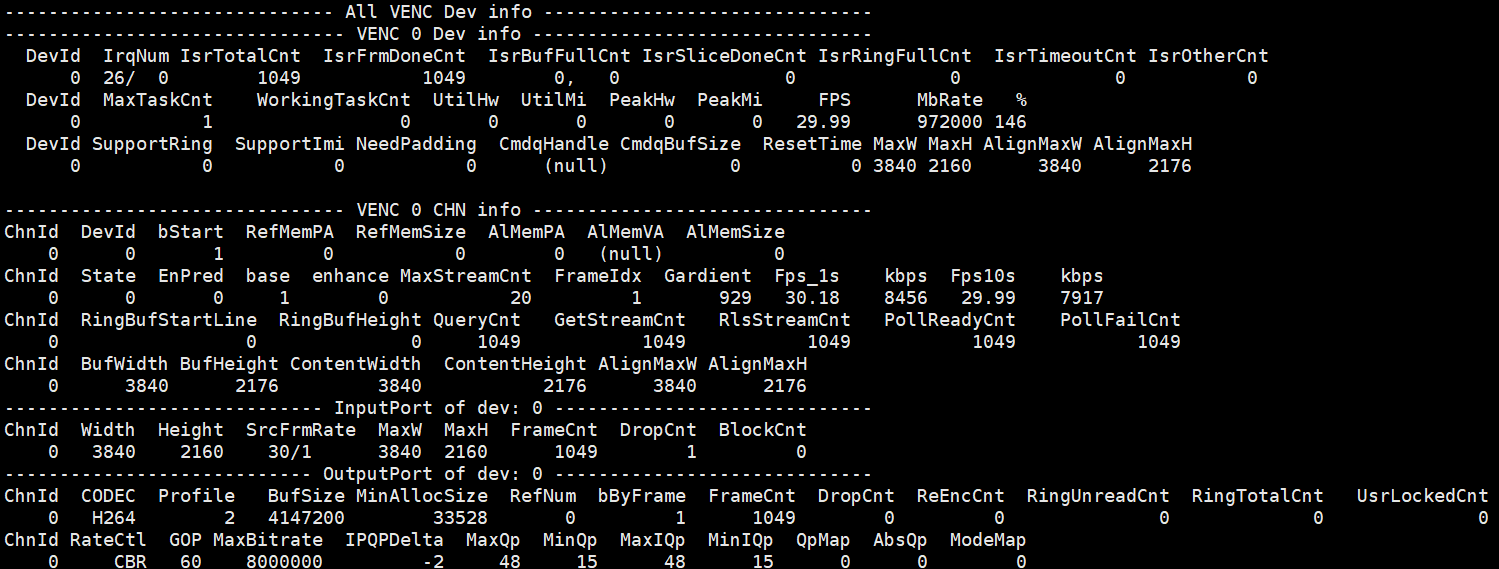
-
Debug info analysis
Record the current usage status of a VENC device, as well as device attributes, layer attributes, and inputport attributes, which can be dynamically obtained for debugging and testing.
-
Parameter Description
Parameter Description Dev info DevId Device number, refer to Table 5-1 IrqNum Interrupt number IsrTotalCnt Total number of various types of interrupt IsrFrmDoneCnt Total number of interrupt of frame done type IsrBufFullCnt The total number of interrupt of buffer full type IsrSliceDoneCnt Total number of interrupt of slice done IsrRingFullCnt The total number of interrupt of ring buffer full type IsrReEncCnt The total number of interrupt of re-encoding type IsrTimeoutCnt The total number of interrupt timed out IsrOtherCnt The total number of other types of interrupt MaxTaskCnt Support the maximum number of tasks that can be processed at the same time WorkingTaskCnt Number of tasks being processed FPS Statistics the output frame rate of the device SupportRing Whether to support HW RING SupportImi Whether to support HW REALTIME NeedPadding Need MI SYS clear padding or not CmdqHandle cmdq handle value CmdqBufSize cmdq buffer size ResetTime Device reset time MaxW The width of max resolution MaxH The height of max resolution AlignMaxW The aligned width of max resolution AlignMaxH The aligned height of max resolution CHN info ChnId Channel ID bStart Whether channel encoding has been started bStartReceive Whether the channel has started receiving image data ReceiveFrameCnt The number of frames received by the last call to the start interface. If the value is 0, it means that the image coding is received until the user stops receiving the image coding RefMemPA The hardware physical address required by the underlying driver RefMemSize The hardware memory size required by the underlying driver AlMemPA The CPU physical address required by underlying driver AlMemVA The CPU virtual address required by underlying driver AlMemSize The CPU memory size required by underlying driver State Underlying processing state: typedef enum
{
E_MI_VENC_BUFSTATE_IDLE = 0,
E_MI_VENC_BUFSTATE_ENCODE,
E_MI_VENC_BUFSTATE_DONEWAIT_CMDQ,
E_MI_VENC_BUFSTATE_CHECK,
E_MI_VENC_BUFSTATE_DROP,
E_MI_VENC_BUFSTATE_DROP_FORCEBUF_OVERRIDE,
E_MI_VENC_BUFSTATE_RECOVER,
E_MI_VENC_BUFSTATE_BUF_FULL,
E_MI_VENC_BUFSTATE_MAX
} MI_VENC_BufferState_e;EnPred Whether the frame of the base layer is used as a reference by other frames of the base layer base Period of the base layer, value range: (0, +∞) enhance Period of the enhance layer, value range: [0, 255] MaxStreamCnt Maximum output buffer number Fps_1s Count the output frame rate within 1s kbps1s Count the output bit rate within 1s Fps10s Count the output frame rate within 10s kbps10s Statistic output code rate within 10s QueryCnt The number of times that APP calls MI_VENC_Query GetStreamCnt The number of times that APP calls MI_VENC_GetStream RlsStreamCnt The number of times that APP calls MI_VENC_ReleaseStream PollReadyCnt The number of successful APP calls to select/poll PollFailCnt Number of failed select/poll calls by APP FrameIdx The serial number of the current frame: Before Pudding, the value is: 1, 2, 3, 4 After Pudding, the value is: 1, 2, 4 BufW The width of input yuv buffer BufH The height of input yuv buffer Stride The stride of input yuv buffer ContentW The effective width of input yuv buffer ContentH The effective height of input yuv buffer RingStartLine ring start line in ring mode RingRealTotalHeight ring real total height in ring mode YBufSize Y buffer size BufSize YUV total buffer size Gradient The gradient value passed by the front-end isp chn pipeline delay in us Flow GetStream by app Min The minimum delay from the Buffer generation to the flow corresponding to the chn Max The maximum delay from the Buffer generation to the flow corresponding to the chn Avg The average delay between the Buffer generation and the corresponding Flow of the chn Diff The current delay from the Buffer generation to the flow corresponding to the chn Inputport info ChnId Channel ID Width Picture width (pixels) Height Picture height (pixels) SrcFrmRate Source frames per second, usually used as a parameter of rate control MaxW Maximum picture width (pixels) MaxH Maximum picture height (pixels) FrameCnt Count of frames processed DropFrameCnt Count of dropped frames BlockCnt The total number of input pictures that have been received but rewinded because the previous input picture is still being processed. Assuming that it can process up to two input pictures at the same time, if the two input pictures have not been encoded and executed, the third frame comes, then the third frame will be rewinded, BlockCnt++. Outputport info ChnId Channel ID CODEC Which CODEC to use: H264,H265,JPEG Profile Profile value BufSize Output pool total size (bytes) set by user MinAllocSize Minimum output buffer size allowed to be allocated RefNum Maximum number of reference frames bByFrame Does the subsequent take one frame at a time?
0: No, usually means to fetch data according to slice.
1: YesFrameCnt Count of frames that have been encoded and released DropCnt Count of frames that have been encoded but dropped ReEncCnt Count of re-encoded frames RingUnreadCnt Count of frames in the output pool that have not yet been taken RingTotalCnt Count of frames in the output pool UsrLockedCnt Count of frames the user is holding RateCtl Rate Control algorithm: CBR/VBR/AVBR/FixQP, etc. GOP Group of Picture, I frame interval MaxBitrate In CBR/VBR/AVBR, the maximum target bit rate (bits per second) IPQPDelta The Delta between the average QP value and the QP of the current I frame MaxQp In CBR/VBR/AVBR, the maximum allowed QP MinQp In CBR/VBR/AVBR, the minimum allowed QP MaxIQP In CBR/VBR/AVBR, the maximum allowed I frame QP MinIQP In CBR/VBR/AVBR, the minimum allowed I frame QP MaxISize Maximum size of I frame MaxPSize Maximum size of P frame ChangePos The ratio of the bit rate when VBR/AVBR starts to adjust QP to the maximum bit rate MinStPct In AVBR, the minimum percentage of the target bit rate in the static state MaxStillQp In AVBR, the maximum I frame QP in static state MotionSens In AVBR, adjust the sensitivity of the bit rate according to the degree of motion of the screen QpMap The QPMAP mode allows users to freely determine the rate control strategy AbsQp Use absolute QP value ModeMap 0 decided byhw; 1 force skip; 2 force intra Qfactor Under PEG FixQP, the quantization factor MaxQfactor Under JPEG CBR, the maximum quantization factor MinQfactor Under JPEG CBR, the minimum quantization factor
5.2. echo
| Function | Dump input buffer |
|---|---|
| Command | echo dump_in [ChnId] [num] [dump_path] > /proc/mi_modules/mi_venc/mi_venc[DevID] |
| Parameter Description | [ChnId]: Channel ID [num]: The total number of sheets that need dump_in [dump_path]: Path to save the file [DevID]: Device ID, refer to Table 5-1 |
| Example | echo dump_in 0 10 /mnt > /proc/mi_modules/mi_venc/mi_venc0 |
| Function | Dump output stream |
|---|---|
| Command | echo dump_out [ChnId] [num] [dump_path] > /proc/mi_modules/mi_venc/mi_venc[DevID] |
| Parameter Description | [ChnId]: Channel ID [num]: The total number of sheets that need dump_out [dump_path]: Path to save the file [DevID]: Device ID, refer to Table 5-1 |
| Example | echo dump_out 0 100 /mnt > /proc/mi_modules/mi_venc/mi_venc0 |
| Function | Show all used device info |
|---|---|
| Command | echo show all [Status] > /proc/mi_modules/mi_venc/mi_venc[DevID] |
| Parameter Description | [Status]: 0-1 0:Show only requested device info 1:Show all used device info. (with created channels) [DevID]: Device ID, refer to Table 5-1 |
| Example | echo show_all 1 > /proc/mi_modules/mi_venc/mi_venc0 |
| Function | Show output frame count |
|---|---|
| Command | echo frame_cnt [ChnId] > /proc/mi_modules/mi_venc/mi_venc[DevID] |
| Parameter Description | [ChnId]: Channel ID [DevID]: Device ID, refer to Table 5-1 |
| Example | echo frame_cnt 0 > /proc/mi_modules/mi_venc/mi_venc0 |
| Function | Drop/Release the corresponding channel output task |
|---|---|
| Command | echo drop_out [ChnId] [Status] > /proc/mi_modules/mi_venc/mi_venc[DevID] |
| Parameter Description | [ChnId]: Channel ID, a means all channels [Status]: r : release the corresponding channel output task d : drop the corresponding channel output task [DevID]: Device ID, refer to Table 5-1 |
| Example | echo drop_out 0 d > /proc/mi_modules/mi_venc/mi_venc0 // drop channel 0 output task echo drop_out 0 r > /proc/mi_modules/mi_venc/mi_venc0 // release channel 0 output task echo drop_out a d > /proc/mi_modules/mi_venc/mi_venc0 // drop the whole channel output task echo drop_out a r > /proc/mi_modules/mi_venc/mi_venc0 // release the whole channel output task |
| Function | Drop/Release the corresponding channel input task |
|---|---|
| Command | echo drop_in [ChnId] [Status] > /proc/mi_modules/mi_venc/mi_venc[DevID] |
| Parameter Description | [ChnId]: Channel ID, a means all channels [Status]: r : release the corresponding channel input task d : drop the corresponding channel input task [DevID]: Device ID, refer to Table 5-1 |
| Example | echo drop_in 0 d > /proc/mi_modules/mi_venc/mi_venc0 // drop channel 0 input task echo drop_in 0 r > /proc/mi_modules/mi_venc/mi_venc0 // release channel 0 input task echo drop_in a d > /proc/mi_modules/mi_venc/mi_venc0 // drop the whole channel input task echo drop_in a r > /proc/mi_modules/mi_venc/mi_venc0 // release the whole channel input task |
| Function | Set debug level for super frame flow |
|---|---|
| Command | echo dbg_supfrm [ChnId] [debug_level] > /proc/mi_modules/mi_venc/mi_venc[DevID] |
| Parameter Description | [ChnId]: Channel ID [debug_level]: 0.none 1.warn 2.info [DevID]: Device ID, refer to Table 5-1 |
| Example | echo dbg_supfrm 0 2 > /proc/mi_modules/mi_venc/mi_venc0 |
| Function | Set debug level for frame lost flow |
|---|---|
| Command | echo dbg_frmlost [ChnId] [debug_level] > /proc/mi_modules/mi_venc/mi_venc[DevID] |
| Parameter Description | [ChnId]: Channel ID [debug_level]: 0.none 1.warn 2.info [DevID]: Device ID, refer to Table 5-1 |
| Example | echo dbg_frmlost 0 2 > /proc/mi_modules/mi_venc/mi_venc0 |
| Function | Set debug level for get frame flow |
|---|---|
| Command | echo dbg_getout [ChnId] [debug_level] > /proc/mi_modules/mi_venc/mi_venc[DevID] |
| Parameter Description | [ChnId]: Channel ID [debug_level]: 0.none 1.warn 2.info [DevID]: Device ID, refer to Table 5-1 |
| Example | echo dbg_getout 0 2 > /proc/mi_modules/mi_venc/mi_venc0 |
| Function | Dump dump customer qp map |
|---|---|
| Command | echo dump_map [ChnId] [dump_times] [dump_path] > /proc/mi_modules/mi_venc/mi_venc0 |
| Parameter Description | [ChnId]: Channel ID [dump_times]: Dump times [dump_path]: Path to save the file [DevID]: Device ID, refer to Table 5-1 |
| Example | echo dump_map 0 1 /mnt > /proc/mi_modules/mi_venc/mi_venc0 |
| Function | Dump the internal buffer |
|---|---|
| Command | echo dump_dram [ChnId] [dump_path] > /proc/mi_modules/mi_venc/mi_venc[DevID] |
| Parameter Description | [ChnId]: Channel ID [dump_path]: Path to save the file [DevID]: Device ID, refer to Table 5-1 |
| Example | echo dump_dram 0 /mnt > /proc/mi_modules/mi_venc/mi_venc0 |
| Function | Enable to run shell script when hang |
|---|---|
| Command | echo run_sh [Status] [path]> /proc/mi_modules/mi_venc/mi_venc[DevID] |
| Parameter Description | [Status]: 1:enable 0:disable [path]: The path of shell script [DevID]: Device ID, refer to Table 5-1 |
| Example | echo run_sh 1 /mnt/dump_mhal_venc_status_hook.sh > /proc/mi_modules/mi_venc/mi_venc0 |
| Function | Enable to recover when hang |
|---|---|
| Command | echo en_recover [Status] > /proc/mi_modules/mi_venc/mi_venc[DevID] |
| Parameter Description | [Status]: 1:enable 0:disable 2:show [DevID]: Device ID, refer to Table 5-1 |
| Example | echo en_recover 0 > /proc/mi_modules/mi_venc/mi_venc0 |
| Function | Show output stream info |
|---|---|
| Command | echo show_out [ChnId] > /proc/mi_modules/mi_venc/mi_venc[DevID] |
| Parameter Description | [ChnId]: Channel ID [DevID]: Device ID, refer to Table 5-1 |
| Example | echo show_out 0 > /proc/mi_modules/mi_venc/mi_venc0 |
| Function | Dynamic debug sed ROI info or sad info |
|---|---|
| Command | echo debug_sed [ChnId] [SedType] [Status] > /proc/mi_modules/mi_venc/mi_venc[DevID] |
| Parameter Description | [ChnId]: Channel ID [SedType]: 0: ive detector algorithm ROI info 1: cnn detector algorithm ROI info 2: motion detector algorithm ROI info [Status]: ture: enable false: disable [DevID]: Device ID, refer to Table 5-1 |
| Example | echo debug_sed 0 0 true > /proc/mi_modules/mi_venc/mi_venc0 // show ive detector algorithm ROI info echo debug_sed 0 1 true > /proc/mi_modules/mi_venc/mi_venc0 // show cnn detector algorithm ROI info echo debug_sed 0 2 true > /proc/mi_modules/mi_venc/mi_venc0 // show motion detector algorithm ROI info |
| Function | Enable to show sram info |
|---|---|
| Command | echo debug_sram [ChnId] [Status] > /proc/mi_modules/mi_venc/mi_venc[DevID] |
| Parameter Description | [ChnId]: Channel ID [Status]: ture: enable false: disable [DevID]: Device ID, refer to Table 5-1 |
| Example | echo debug_sram 0 true > /proc/mi_modules/mi_venc/mi_venc0 |
| Function | Enable to show channel function stat info |
|---|---|
| Command | echo flow_stat [ChnId] [Status] > /proc/mi_modules/mi_venc/mi_venc[DevID] |
| Parameter Description | [ChnId]: Channel ID [Status]: 1: enable 0: disable [DevID]: Device ID, refer to Table 5-1 |
| Example | echo flow_stat 0 1 > /proc/mi_modules/mi_venc/mi_venc0 |